

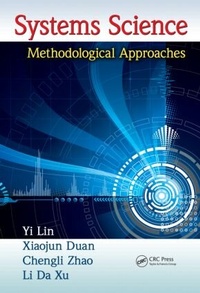
Systems Science
Methodological Approaches
1st Edition
Published on 26. November 2012
Book
Hardback
399 pages
978-1-4398-9551-1 (ISBN)
Description
By making use of the principles of systems science, the scientific community can explain many complicated matters of the world and shed new light on unsettled problems. Each real science has its own particular methodology for not only qualitative but also quantitative analyses, so it is important to understand the organic whole of systems research with operable mathematical methods. Systems Science: Methodological Approaches presents a mathematical explanation of systems science, giving readers a complete technical formulation of different systemic laws. It enables them to use a unified methodology to attack different problems that are hard, if not impossible, for modern science to handle.
Following a brief history of systems science, the book explores:
Basic concepts, characteristics, properties, and classifications of general systems
Nonlinear systems dynamics and the theory of catastrophe
Dissipative structures and synergistics
Studies of chaos, including logistic mapping, phase space reconstruction, Lyapunov exponents, and chaos of general single relation systems
Different aspects and concepts of fractals, including a presentation of L systems analysis and design
Complex systems and complexity, with a discussion of how the phenomena of "three" and complexity are related, and how various cellular automata can be constructed to generate useful simulations and figurative patterns
Complex adaptive systems and open complex giant systems, with introduction of the yoyo model and practical applications
Complex networks and related concepts and methods
The book concludes with several case studies that demonstrate how various concepts and the logic of systems can be practically applied to resolve real-life problems, such as the prediction of natural disasters. The book will be useful in directing future research and applications of systems science on a commonly accepted platform and playground.
Following a brief history of systems science, the book explores:
Basic concepts, characteristics, properties, and classifications of general systems
Nonlinear systems dynamics and the theory of catastrophe
Dissipative structures and synergistics
Studies of chaos, including logistic mapping, phase space reconstruction, Lyapunov exponents, and chaos of general single relation systems
Different aspects and concepts of fractals, including a presentation of L systems analysis and design
Complex systems and complexity, with a discussion of how the phenomena of "three" and complexity are related, and how various cellular automata can be constructed to generate useful simulations and figurative patterns
Complex adaptive systems and open complex giant systems, with introduction of the yoyo model and practical applications
Complex networks and related concepts and methods
The book concludes with several case studies that demonstrate how various concepts and the logic of systems can be practically applied to resolve real-life problems, such as the prediction of natural disasters. The book will be useful in directing future research and applications of systems science on a commonly accepted platform and playground.
More details
Series
Language
English
Place of publication
Bosa Roca
United States
Publishing group
Taylor & Francis Inc
Target group
Professional and scholarly
Academic and Professional Practice & Development
Illustrations
174 s/w Abbildungen, 15 s/w Tabellen
15 Tables, black and white; 174 Illustrations, black and white
Dimensions
Height: 254 mm
Width: 178 mm
Weight
884 gr
ISBN-13
978-1-4398-9551-1 (9781439895511)
Copyright in bibliographic data and cover images is held by Nielsen Book Services Limited or by the publishers or by their respective licensors: all rights reserved.
Schweitzer Classification
Other editions
Additional editions
Book
10/2017
1st Edition
CRC Press
€85.60
Shipment within 10-20 days
E-Book
11/2012
CRC Press
€69.99
Available for download
E-Book
11/2012
1st Edition
CRC Press
€69.99
Available for download
Persons
Dr. Yi Lin, also known as Jeffrey Yi-Lin Forrest, is a specially appointed professor in economics, finance, systems science, and mathematics at several major universities in China as well as tenured professor of mathematics at the Pennsylvania State System of Higher Education (Slippery Rock campus). His research interests are mainly in the area of systems research and applications in a wide-ranging number of disciplines of the traditional sciences, including mathematical modeling, foundations of mathematics, data analysis, theory and methods of predictions of disastrous natural events, economics and finance, management science, and philosophy of science.
Dr. Xiaojun Duan
is a professor at the Department of Mathematics and System Sciences, College of Science, National University of Defense Technology, Changsha, China. Her research interests include general systems theory and applications, data analysis, and complex system test and evaluation.
Mr. Chengli Zhao
is a lecturer at the Department of Mathematics and Systems Science of the National University of Defense Technology. Mr. Zhao's scientific interests and publications cover studies of complex systems, massive data computing, and web data mining.
Dr. Xiaojun Duan
is a professor at the Department of Mathematics and System Sciences, College of Science, National University of Defense Technology, Changsha, China. Her research interests include general systems theory and applications, data analysis, and complex system test and evaluation.
Mr. Chengli Zhao
is a lecturer at the Department of Mathematics and Systems Science of the National University of Defense Technology. Mr. Zhao's scientific interests and publications cover studies of complex systems, massive data computing, and web data mining.
Content
A Brief History of Systems Science. Concepts, Characteristics, and Classifications of Systems. Nonlinear Systems Dynamics and Catastrophe. Self-Organization: Dissipative Structures and Synergetics. Chaos. Fractals. Complex Systems and Complexity. Complex Adaptive Systems. Open Complex Giant Systems. Complex Networks. Case Studies. Bibliography. Index.