

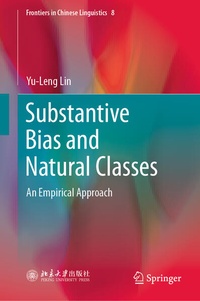
Substantive Bias and Natural Classes
An Empirical Approach
Published on 21. January 2019
Book
Hardback
XV, 122 pages
978-981-13-3533-4 (ISBN)
Description
This book offers a laboratory phonological analysis of the sonority hierarchy and natural classes in nasal harmony using an artificial grammar-learning paradigm. It is aimed at postgraduate students and linguists in general whose research interests lie in phonology, phonetics, and/or psycholinguistics. It is useful for linguists who are struggling to figure out how to effectively design an artificial phonological grammar and those who have not designed experiments on their own but would like to do so as an additional means to testing linguistic theories. This book is also a valuable resource for anyone building crosslinguistic artificial grammar paradigm resources.
More details
Series
Edition
2019 ed.
Language
English
Place of publication
Singapore
Singapore
Target group
Professional and scholarly
Illustrations
6 s/w Abbildungen
XV, 122 p. 6 illus.
Dimensions
Height: 241 mm
Width: 160 mm
Thickness: 14 mm
Weight
383 gr
ISBN-13
978-981-13-3533-4 (9789811335334)
DOI
10.1007/978-981-13-3534-1
Schweitzer Classification
Other editions
Additional editions
E-Book
01/2019
1st Edition
Springer
€53.49
Available for download
Person
Yu-Leng Lin
is an Assistant Professor in the Department of Foreign Languages and Literature at the Feng Chia University. She received her PhD degree from the Department of Linguistics at the University of Toronto in 2016. Before joining the Feng Chia University, she served as a postdoctoral fellow in the Hong Kong Polytechnic University's Department of Chinese and Bilingual Studies. Her research interests include psycholinguistics, Chinese linguistics, laboratory phonology, and sociophonetics. Her publications include a journal paper, a book chapter and conference proceedings, and she has presented her work - ranging from learning bias, speech perception and production, tonal studies, and comparative studies among Mandarin, Taiwan Southern Min, Cantonese, and English - at several international conferences.
Content
Chapter 1 Introduction.- Chapter 2 An introduction to Vowel-consonant nasal harmony.- Chapter 3 Introduction to artificial goals and challenges.- Chapter 4 Experiment 1.- Chapter 5 Experiment 2: sonority effects.- Chapter 6 Conclusions.- References.- Appendix I.- Appendix II.