

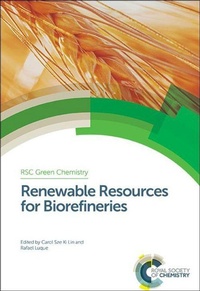
Renewable Resources for Biorefineries
Published on 4. August 2014
Book
Hardback
216 pages
978-1-84973-898-9 (ISBN)
Description
With the increasing awareness and concern about the dependency on fossil resources and the depletion of crude oil reserves, experts from industrial biotechnology, renewable resources, green chemistry, and biorefineries are stimulating the transition from the fossil-based to the bio-based economy. This text confronts scientific and economic challenges and strategies for making this crucial transition.
Renewable Resources for Biorefineries is the work of a strongly interdisciplinary authorship, offering perspectives from biology, chemistry, biochemical engineering, materials science, and industry. This unique approach provides an opportunity for a much broader coverage of biomass and valorisation than has been attempted in previous titles. This book also represents the fundamentally important technical and policy aspects of a bio-based economy, to ground this important science in a realistic and viable economic framework. Chapters in this book cover a diverse range of topics, including: advanced generation bioenergy sectors; biobased polymers and materials; chemical platform molecules; industrial crops and biorefineries; financing and policy for change; and valorisation of biomass waste streams.
This is an ideal book for upper level undergraduate and postgraduate students taking modules on Renewable resources, green chemistry, sustainable development, environmental science, agricultural science and environmental technology. It will also benefit industry professionals and product developers who are looking to improve economic and environmental ways to utilise renewable resources in current and future biorefineries.
Renewable Resources for Biorefineries is the work of a strongly interdisciplinary authorship, offering perspectives from biology, chemistry, biochemical engineering, materials science, and industry. This unique approach provides an opportunity for a much broader coverage of biomass and valorisation than has been attempted in previous titles. This book also represents the fundamentally important technical and policy aspects of a bio-based economy, to ground this important science in a realistic and viable economic framework. Chapters in this book cover a diverse range of topics, including: advanced generation bioenergy sectors; biobased polymers and materials; chemical platform molecules; industrial crops and biorefineries; financing and policy for change; and valorisation of biomass waste streams.
This is an ideal book for upper level undergraduate and postgraduate students taking modules on Renewable resources, green chemistry, sustainable development, environmental science, agricultural science and environmental technology. It will also benefit industry professionals and product developers who are looking to improve economic and environmental ways to utilise renewable resources in current and future biorefineries.
More details
Series
Language
English
Place of publication
Cambridge
United Kingdom
Target group
Professional and scholarly
Product notice
Unsewn / adhesive bound
Dimensions
Height: 241 mm
Width: 159 mm
Thickness: 17 mm
Weight
467 gr
ISBN-13
978-1-84973-898-9 (9781849738989)
DOI
10.1039/b10030
Copyright in bibliographic data and cover images is held by Nielsen Book Services Limited or by the publishers or by their respective licensors: all rights reserved.
Schweitzer Classification
Other editions
Additional editions
Carol Lin | Rafael Luque
Renewable Resources for Biorefineries
E-Book
08/2014
1st Edition
Royal Society of Chemistry
€165.99
Available for download
Carol Lin | Rafael Luque
Renewable Resources for Biorefineries
E-Book
08/2014
1st Edition
Royal Society of Chemistry
€165.99
Available for download
Persons
Dr. Rafael Luque is currently a Ramon y Cajal fellow in the Departamento de Quimica Organica of Universidad de Cordoba (UCO) in Spain. His research interests are green chemistry applied to nanomaterials, supported metal/metal oxide nanoparticles on porous materials, heterogeneous catalysis and biofuels.
Content
Advanced generation bioenergy sectors;
Bioactive compounds from biomass;
Biobased polymers and materials;
Biocatalysis for bioresource transformation;
Chemical platform molecules;
Industrial crops and biorefineries;
Making possible the bio-economy transition - Financing and policy for change;
Metabolic Engineering of Fermentation Processes;
Micro-algae Technology;
Pretreatment and Transformation of Lignocellulosics;
Process intensification for Biorefineries;
Sustainability;
Thermochemical transformation of biomass;
Valorisation of biomass waste streams
Bioactive compounds from biomass;
Biobased polymers and materials;
Biocatalysis for bioresource transformation;
Chemical platform molecules;
Industrial crops and biorefineries;
Making possible the bio-economy transition - Financing and policy for change;
Metabolic Engineering of Fermentation Processes;
Micro-algae Technology;
Pretreatment and Transformation of Lignocellulosics;
Process intensification for Biorefineries;
Sustainability;
Thermochemical transformation of biomass;
Valorisation of biomass waste streams