

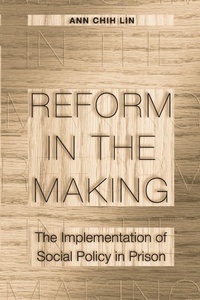
Reform in the Making
The Implementation of Social Policy in Prison
Published on 30. June 2002
Book
Paperback/Softback
232 pages
978-0-691-09599-8 (ISBN)
Description
Is it time to give up on rehabilitating criminals? Record numbers of Americans are going to prison, and most of them will eventually return to society with a high chance of becoming repeat offenders. But a decision to abandon rehabilitation programs now would be premature warns Ann Chih Lin, who finds that little attention has been given to how these programs are actually implemented and why they tend to fail. In Reform in the Making, she not only supplies much-needed information on the process of program implementation but she also considers its social context, the daily realities faced by prison staff and inmates. By offering an in-depth look at common rehabilitation programs currently in operation--education, job training, and drug treatment--and examining how they are used or misused, Lin offers a practical approach to understanding their high failure rate and how the situation could be improved.
Based on extensive observation and over 350 interviews with staff and prisoners in five medium-security male prisons, the book contrasts successfully implemented programs with subverted, abandoned, or neglected programs (those which staff reject or which do not teach prisoners anything useful). Lin explains that staff and prisoners have little patience with programs aimed at long-range goals when they must face the ongoing, immediate challenge of surviving prison life. Finding incentives to make both sides participate fully in rehabilitation is among the book's many contributions to improving prison policy.
Based on extensive observation and over 350 interviews with staff and prisoners in five medium-security male prisons, the book contrasts successfully implemented programs with subverted, abandoned, or neglected programs (those which staff reject or which do not teach prisoners anything useful). Lin explains that staff and prisoners have little patience with programs aimed at long-range goals when they must face the ongoing, immediate challenge of surviving prison life. Finding incentives to make both sides participate fully in rehabilitation is among the book's many contributions to improving prison policy.
Reviews / Votes
"An important and convincing book... A welcome addition to the literature on both the implementation of social policy and the study of prisons... Thoughtful and well-conceived."--Malcolm M. Feeley, Law and Politics Book Review "Lin's acceptance of the problem of any general rehabilitative program in prison is her strong point, and the great value of this book. Putting grand theory behind helps to point the way out of the miasma and double-bind of prison life."--Larry E. Sullivan, Contemporary SociologyMore details
Language
English
Place of publication
New Jersey
United States
Target group
Professional and scholarly
College/higher education
Product notice
Paperback (trade)
Illustrations
11 tables
Dimensions
Height: 234 mm
Width: 156 mm
Thickness: 14 mm
Weight
395 gr
ISBN-13
978-0-691-09599-8 (9780691095998)
Copyright in bibliographic data and cover images is held by Nielsen Book Services Limited or by the publishers or by their respective licensors: all rights reserved.
Schweitzer Classification
Other editions
Additional editions
E-Book
06/2015
1st Edition
Princeton University Press
€171.95
Available for download
Person
Ann Chih Lin is Assistant Professor of Public Policy and Political Science at the University of Michigan. With Sheldon Danziger, she is the coeditor of "The Social Contexts of Urban Poverty: Qualitative Research on the African-American Experience".
Content
List of Tables ix Acknowledgments Xi Introduction "This Place Just by Being Here Is Not Going to Correct You": The Rediscovery of Rehabilitation 3 1. Revisiting Rehabilitation: Why "What Works" Is the Wrong Question 15 2. Keeping the Peace: Institutional Needs, Institutional Values, and Implementation 33 3. Unsuccessful Implementation: The Use and Abuse of Programs 60 4. Successful Implementation: Keeping Busy and Helping Yourself 98 5. The Importance of Successful Implementation: Recasting the Debate over Mandatory and Voluntary Programs 129 Conclusion Deliberately Successful Implementation: Doing Time, Doing My Time, and Letting the Time Do Me 160 Appendix 1 Research Design Meets Prison Administration: Methodological Notes 175 Appendix 2 On Being Who You Are: Credibility, Bias, and Good Research 186 Bibliography 195 Index 207