

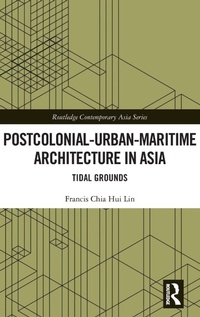
Postcolonial-Urban-Maritime Architecture in Asia
Tidal Grounds
1st Edition
Will be published approx. on 18. June 2026
Book
Hardback
154 pages
978-1-041-21315-4 (ISBN)
Description
This book proposes a new theoretical framework for understanding architecture and urbanism in Asia through the intertwined metaphors of the postcolonial, the urban, and the maritime.
It positions Asia not as a cultural identity or fixed geography, but as a methodological horizon shaped by articulation, negotiation, and discontinuous historicity. Against universalising narratives that treat Asian architecture as derivative or exceptional, this book foregrounds entanglement and circulation as constitutive conditions of spatial knowledge. Concepts such as display, colony character, appropriate fuzziness, and micro-historicity are mobilised to capture the fractured and provisional character of architectural knowledge in Asia. These are developed through empirical sites across East and Southeast Asia, where infrastructural improvisations and heteroglossic assemblages reveal architecture as a field continually reconfigured through contestation. Rather than presenting a unified theory, this book offers a repertoire of concepts attentive to flux, opacity, and unfinishedness. In doing so, it advances a situated and dynamic theorisation of architecture in Asia, where amphibious 'tidal grounds' articulate the restless interplay of thought, practice, and environment.
Providing a unique analytical framework attentive to the fluidities of region, history, and spatial knowledge, this book is a valuable resource for students, scholars, and practitioners in architecture and urban design, postcolonial studies, cultural geography, Asian studies, and maritime urban history.
It positions Asia not as a cultural identity or fixed geography, but as a methodological horizon shaped by articulation, negotiation, and discontinuous historicity. Against universalising narratives that treat Asian architecture as derivative or exceptional, this book foregrounds entanglement and circulation as constitutive conditions of spatial knowledge. Concepts such as display, colony character, appropriate fuzziness, and micro-historicity are mobilised to capture the fractured and provisional character of architectural knowledge in Asia. These are developed through empirical sites across East and Southeast Asia, where infrastructural improvisations and heteroglossic assemblages reveal architecture as a field continually reconfigured through contestation. Rather than presenting a unified theory, this book offers a repertoire of concepts attentive to flux, opacity, and unfinishedness. In doing so, it advances a situated and dynamic theorisation of architecture in Asia, where amphibious 'tidal grounds' articulate the restless interplay of thought, practice, and environment.
Providing a unique analytical framework attentive to the fluidities of region, history, and spatial knowledge, this book is a valuable resource for students, scholars, and practitioners in architecture and urban design, postcolonial studies, cultural geography, Asian studies, and maritime urban history.
Reviews / Votes
"Using the notion of flows, fluidity and flux as the critical lens, Professor Lin has skilfully deconstructed the often used 'tropes' that perpetuate a static reading as well as fetishisation of popular imaginaries of Asian architecture. In his rigorously articulated provocations, he unfolds a convincing argument for grounded theory. A position which discerns life, temporality, emergent urbanism, and their ever-shifting relationship to the making of architecture as the foundation to construct theory situated in particularities. Theory that could resist generalised readings and move towards a more pluralistic as well as dynamic understanding of architecture in different locations in Asia."Rahul Mehrotra , John T. Dunlop Professor in Housing and Urbanization at the GSD , Harvard University
More details
Series
Language
English
Place of publication
London
United Kingdom
Publishing group
Taylor & Francis Ltd
Target group
College/higher education
Professional and scholarly
Academic, Postgraduate, and Undergraduate Advanced
Illustrations
28 s/w Photographien bzw. Rasterbilder, 5 s/w Zeichnungen, 33 s/w Abbildungen
5 Line drawings, black and white; 28 Halftones, black and white; 33 Illustrations, black and white
Dimensions
Height: 234 mm
Width: 156 mm
Weight
470 gr
ISBN-13
978-1-041-21315-4 (9781041213154)
Copyright in bibliographic data and cover images is held by Nielsen Book Services Limited or by the publishers or by their respective licensors: all rights reserved.
Schweitzer Classification
Other editions
Additional editions
E-Book
approx. 06/2026
1st Edition
Routledge
€68.49
Available for download
E-Book
approx. 06/2026
1st Edition
Routledge
€68.49
Available for download
Person
Francis Chia Hui Lin is an Associate Professor at the Graduate Institute of Building and Planning, National Taiwan University. His research explores the intersections of architectural theory, postcolonial thought, and urbanism in Asia, with a particular focus on epistemic entanglement, maritime grounds, and the politics of spatial knowledge. He is the author of Heteroglossic Asia (2015), Architectural Theorisations and Phenomena in Asia (2017), and The Postcolonial Condition of Architecture in Asia (2022). His work has been recognised with the Ta-You Wu Memorial Award (2019), one of Taiwan's highest honours for early-career scholars. He is also Founding Director of Studio: Asia, Postcoloniality and Spatiality (APS), an academic platform dedicated to interrogating spatial practices through critical postcolonial perspectives.
.
.
Content
Introduction: Asian Architectural Epistemology Today Chapter 1: Historiography Chapter 2: Urbanity Chapter 3: Postcoloniality Chapter 4: One of Asian and the Postcolonial-Urban-Maritime Turn