

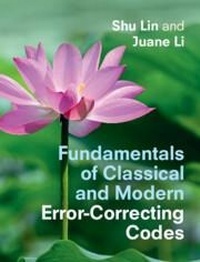
Fundamentals of Classical and Modern Error-Correcting Codes
Published on 9. December 2021
Book
Hardback
840 pages
978-1-316-51262-3 (ISBN)
Description
Using easy-to-follow mathematics, this textbook provides comprehensive coverage of block codes and techniques for reliable communications and data storage. It covers major code designs and constructions from geometric, algebraic, and graph-theoretic points of view, decoding algorithms, error control additive white Gaussian noise (AWGN) and erasure, and dataless recovery. It simplifies a highly mathematical subject to a level that can be understood and applied with a minimum background in mathematics, provides step-by-step explanation of all covered topics, both fundamental and advanced, and includes plenty of practical illustrative examples to assist understanding. Numerous homework problems are included to strengthen student comprehension of new and abstract concepts, and a solutions manual is available online for instructors. Modern developments, including polar codes, are also covered. An essential textbook for senior undergraduates and graduates taking introductory coding courses, students taking advanced full-year graduate coding courses, and professionals working on coding for communications and data storage.
Reviews / Votes
'... masterfully provides a comprehensive treatment of both traditional codes as well as new and most promising coding families and decoding algorithms ...' Bane Vasic, University of Arizona ' an excellent, unique, and valuable contribution to the teaching of the subject.' Ian Blake, University of British Columbia 'A highly readable introduction into the theory of block codes, including classical code constructions, an extensive treatment of LDPC codes, with emphasis on quasi-cyclic constructions, and an introduction to polar codes. Recommended for a beginning graduate course in coding, with enough material for either one or two semesters. Numerous examples and problems make the book very student friendly.' Daniel Costello, University of Notre Dame 'The book truly explains these highly mathematical subjects to a level that can be accessed and applied with as little background in mathematics as possible. It provides step-by-step explanation of all covered topics, both more theoretical or applied, and includes sufficient illustrative examples to assist understanding.' Nikolay Yankov, zbMATHMore details
Language
English
Place of publication
Cambridge
United Kingdom
Target group
Professional and scholarly
College/higher education
Illustrations
Worked examples or Exercises
Dimensions
Height: 195 mm
Width: 252 mm
Thickness: 47 mm
Weight
1856 gr
ISBN-13
978-1-316-51262-3 (9781316512623)
Copyright in bibliographic data and cover images is held by Nielsen Book Services Limited or by the publishers or by their respective licensors: all rights reserved.
Schweitzer Classification
Other editions
Additional editions
Shu Lin | Juane Li
Fundamentals of Classical and Modern Error-Correcting Codes
E-Book
01/2022
Cambridge University Press
€78.99
Available for download
Persons
Shu Lin is an Adjunct Professor in the Department of Electrical and Computer Engineering at the University of California, Davis, and an IEEE Life Fellow. He has authored and co-authored several books, including LDPC Codes Designs, Constructions, and Unification and Channel Codes: Classical and Modern (Cambridge 2016, 2009).
Content
Preface; Acknowledgments; 1. Coding for reliable digital information transmission and storage; 2. Some elements of modern algebra and graphs; 3. Linear block codes; 4.Binary cyclic codes; 5. BCH codes; 6. Nonbinary BCH codes and Reed-Solomon codes; 7. Finite geometries, cyclic finite geometry codes, and majority-logic decoding; 8. Reed-Muller codes; 9. Some coding techniques; 10. Correction of error-bursts and erasures; 11. Introduction to low-density parity-check codes; 12. Cyclic and quasi-cyclic LDPC codes on finite geometries; 13. Partial geometries and their associated QC-LDPC codes; 14. Quasi-cyclic LDPC codes based on finite fields; 15. Graph-theoretic LDPC codes; 16. Collective encoding and soft-decision decoding of cyclic codes of prime lengths in Galois Fourier transform domain; 17. Polar codes; Appendices.