

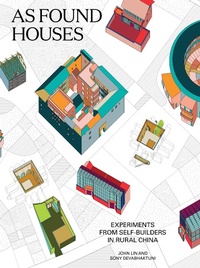
As Found Houses
Experiments from self-builders in rural China
Published on 1. February 2021
Book
Paperback/Softback
200 pages
978-1-943532-79-7 (ISBN)
Description
In rural China, an informal wave of
building catalysed by economic and social developments has rendered some
villages unrecognisable. This building boom, taking place in a context
of limited regulations, has created densities more often found in urban
areas. At the same time, the rapid transformation of rural villages has
generated some remarkable hybrid experiments where rural builders use
generic construction methods to adapt, modify, graft, cleave and wrap
traditional vernacular typologies. These typologies have existed for
hundreds of years and represent an accretion of localised building
knowledge and cultural identity. Where often these typologies are
preserved and maintained as tourist destinations, this book looks at
those instances where families transform them to account for new ways of
living.
By looking closely at these transformations, As Found Houses
identifies innovative, informal design responses that negotiate between
traditional housing forms and the changing conditions of the rural
village. The book presents the intelligent and surprising solutions
applied to house typologies conceived by builders in 4 regions of rural
China. Using photographs, axonometric drawings and interviews with the
villagers who live in these hybrid experiments, the book situates design
solutions within the context of their larger human narratives, thereby
challenging ossified understandings of vernacular architecture that
treat historical and cultural tradition as static.
The book argues
that the manifold evolution of the vernacular is part of the every-day
practice of the villagers' lives, and that architecture for them is very
much still a home. As Found Houses is a guide
to the surprising design decisions found in the domestic architecture
of rural China and a resource for thinking about contemporary design.
building catalysed by economic and social developments has rendered some
villages unrecognisable. This building boom, taking place in a context
of limited regulations, has created densities more often found in urban
areas. At the same time, the rapid transformation of rural villages has
generated some remarkable hybrid experiments where rural builders use
generic construction methods to adapt, modify, graft, cleave and wrap
traditional vernacular typologies. These typologies have existed for
hundreds of years and represent an accretion of localised building
knowledge and cultural identity. Where often these typologies are
preserved and maintained as tourist destinations, this book looks at
those instances where families transform them to account for new ways of
living.
By looking closely at these transformations, As Found Houses
identifies innovative, informal design responses that negotiate between
traditional housing forms and the changing conditions of the rural
village. The book presents the intelligent and surprising solutions
applied to house typologies conceived by builders in 4 regions of rural
China. Using photographs, axonometric drawings and interviews with the
villagers who live in these hybrid experiments, the book situates design
solutions within the context of their larger human narratives, thereby
challenging ossified understandings of vernacular architecture that
treat historical and cultural tradition as static.
The book argues
that the manifold evolution of the vernacular is part of the every-day
practice of the villagers' lives, and that architecture for them is very
much still a home. As Found Houses is a guide
to the surprising design decisions found in the domestic architecture
of rural China and a resource for thinking about contemporary design.
More details
Language
English
Place of publication
San Rafael
United States
Publishing group
Oro Editions
Product notice
Paperback (trade)
Illustrations
150 Illustrations, color
Dimensions
Height: 241 mm
Width: 174 mm
Thickness: 17 mm
Weight
517 gr
ISBN-13
978-1-943532-79-7 (9781943532797)
Copyright in bibliographic data and cover images is held by Nielsen Book Services Limited or by the publishers or by their respective licensors: all rights reserved.
Schweitzer Classification
Persons
John Lin is
an architect and an Associate Professor in the department of
architecture at The University of Hong Kong. With Joshua Bolchover he is
the director of Rural Urban Framework (RUF), a non-profit research and
design collaboration. Their projects integrate local and traditional
construction practices with contemporary sustainable technologies.
Sony Devabhaktuni
is an Assistant Professor in the department of architecture at the
University of Hong Kong. His research focuses on the capacity of
architectural representation to address cultural, socio-political and
economic issues.
an architect and an Associate Professor in the department of
architecture at The University of Hong Kong. With Joshua Bolchover he is
the director of Rural Urban Framework (RUF), a non-profit research and
design collaboration. Their projects integrate local and traditional
construction practices with contemporary sustainable technologies.
Sony Devabhaktuni
is an Assistant Professor in the department of architecture at the
University of Hong Kong. His research focuses on the capacity of
architectural representation to address cultural, socio-political and
economic issues.