

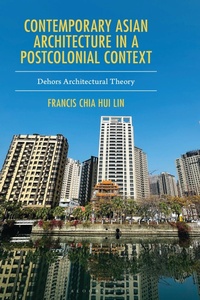
Contemporary Asian Architecture in a Postcolonial Context
Dehors Architectural Theory
Will be published approx. on 1. October 2026
Book
Hardback
288 pages
978-1-6669-7391-4 (ISBN)
Description
Offering a broader understanding of contemporary architecture and urbanism in Asia, Francis Chia Hui Lin raises questions from 'non-conventional' ('non-Western') perspectives that can adapt and enrich conventional understanding in an Asian context.
With a strategic focus on urban maritime Asia, this book highlights key postcolonial concepts, locales, and the agency of the postcolonial condition of Asian architecture in a global context. Addressing the conventional ideologies by which architecture is assessed, the author outlines an epistemic bridge that situates the colonial character of Asian architecture within a global historical and theoretical context.
Contemporary Asian architectural histories are marked not only by the influence of the Western architectural canon but also by a sense of temporality that reflects an ongoing process of subjectivation. Providing insight into these histories, the author proposes a methodology that extends the notion of the postcolonial comportment beyond its conventional historical context and into the spatial register of theorisation. By interviewing critical postcolonial theory with empirical analysis of contemporary Asian architecture and urbanisation, this book offers a critical lens for understanding Asia not simply as a site of architectural production, but as a theoretical interlocutor in the global rethinking of space, time and power.
With a strategic focus on urban maritime Asia, this book highlights key postcolonial concepts, locales, and the agency of the postcolonial condition of Asian architecture in a global context. Addressing the conventional ideologies by which architecture is assessed, the author outlines an epistemic bridge that situates the colonial character of Asian architecture within a global historical and theoretical context.
Contemporary Asian architectural histories are marked not only by the influence of the Western architectural canon but also by a sense of temporality that reflects an ongoing process of subjectivation. Providing insight into these histories, the author proposes a methodology that extends the notion of the postcolonial comportment beyond its conventional historical context and into the spatial register of theorisation. By interviewing critical postcolonial theory with empirical analysis of contemporary Asian architecture and urbanisation, this book offers a critical lens for understanding Asia not simply as a site of architectural production, but as a theoretical interlocutor in the global rethinking of space, time and power.
Reviews / Votes
In Contemporary Asian Architecture in a Postcolonial Context, Francis Chia Hui Lin formulates an exciting intersection between postcolonial theory, played out across a wide range of buildings and cities in Singapore, Malaysia, Hong Kong, Taiwan, Japan and Australia. His Foucauldian 'postcolonial comportment' allows for sophisticated theoretical nuances to interplay with detailed empirical studies, and creates an intense, erudite and suggestive publication. Highly recommended. * Iain Borden, Professor of Architecture and Urban Culture, University College London, UK *More details
Language
English
Place of publication
United States
Publishing group
Bloomsbury Publishing Plc
Target group
Professional and scholarly
Product notice
sewn/stitched
Cloth over boards
With dust jacket
Illustrations
20 b&w photos and 4 b&w illus
Dimensions
Height: 229 mm
Width: 152 mm
Thickness: 25 mm
Weight
454 gr
ISBN-13
978-1-6669-7391-4 (9781666973914)
Copyright in bibliographic data and cover images is held by Nielsen Book Services Limited or by the publishers or by their respective licensors: all rights reserved.
Schweitzer Classification
Person
Francis Chia Hui Lin is Associate Professor in the Graduate Institute of Building and Planning at the National Taiwan University, Taiwan.
Content
List of Figures
Preface
Acknowledgments
Introduction: Colony architecture as an episteme
1 Architectural Orientalism in Singapore: Display and postcolonial governmentality
2 The double consciousness of Malaysia's subaltern urbanism: Ethnicity and spatial negotiation
3 The colonial culture of Japanese architecture: Imperial modernity and translation
4 Australia, a geography of vernacular cosmopolitanism: Migration and belonging
5 The spatio-tectonic imperatives in Hong Kong: Infrastructure and colonial capitalism
6 The heteroglossic formalism of Taiwan's urban/rural politics: Development and identity
7 The imagined subjectivation of urban Asia: Representation and citizenship
8 The musealised fluidity of Asia's postcolonial geopolitics: Heritage and mobility
9 Postcoloniality, architectural pedagogy and the Asian curriculum development: Epistemic translation
10 The Asian postcolonial heterotopias of the post-pandemic Anthropocene: Governance and exception
Epilogue: A Foucauldian common divisor and those yet to be mentioned
Bibliography
Index
About the Author
Preface
Acknowledgments
Introduction: Colony architecture as an episteme
1 Architectural Orientalism in Singapore: Display and postcolonial governmentality
2 The double consciousness of Malaysia's subaltern urbanism: Ethnicity and spatial negotiation
3 The colonial culture of Japanese architecture: Imperial modernity and translation
4 Australia, a geography of vernacular cosmopolitanism: Migration and belonging
5 The spatio-tectonic imperatives in Hong Kong: Infrastructure and colonial capitalism
6 The heteroglossic formalism of Taiwan's urban/rural politics: Development and identity
7 The imagined subjectivation of urban Asia: Representation and citizenship
8 The musealised fluidity of Asia's postcolonial geopolitics: Heritage and mobility
9 Postcoloniality, architectural pedagogy and the Asian curriculum development: Epistemic translation
10 The Asian postcolonial heterotopias of the post-pandemic Anthropocene: Governance and exception
Epilogue: A Foucauldian common divisor and those yet to be mentioned
Bibliography
Index
About the Author