

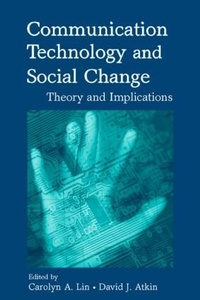
Communication Technology and Social Change
Theory and Implications
1st Edition
Published on 15. November 2006
Book
Paperback/Softback
348 pages
978-0-8058-5614-9 (ISBN)
Description
Communication Technology and Social Change is a distinctive collection that provides current theoretical, empirical, and legal analyses for a broader understanding of the dynamic influences of communication technology on social change. With a distinguished panel of contributors, the volume presents a systematic discussion of the role communication technology plays in shaping social, political, and economic influences in society within specific domains and settings. Its integrated focus expands and complements the scope of existing literature on this subject.
Each chapter is organized around a specific structure, covering:
*Background-offering an introduction of relevant communication technology that outlines its technical capabilities, diffusion, and uses;
*Theory-featuring a discussion of relevant theories used to study the social impacts of the communication technology in question;
*Empirical Findings-providing an analysis of recent academic and relevant practical work that explains the impact of the communication technology on social change; and
*Social Change Implications-proposing a summary of the real world implications for social change that stems from synthesizing the relevant theories and empirical findings presented throughout the book.
Communication Technology and Social Change will serve scholars, researchers, upper-division undergraduate students, and graduate students examining the relationship between communication and technology and its implications for society.
Each chapter is organized around a specific structure, covering:
*Background-offering an introduction of relevant communication technology that outlines its technical capabilities, diffusion, and uses;
*Theory-featuring a discussion of relevant theories used to study the social impacts of the communication technology in question;
*Empirical Findings-providing an analysis of recent academic and relevant practical work that explains the impact of the communication technology on social change; and
*Social Change Implications-proposing a summary of the real world implications for social change that stems from synthesizing the relevant theories and empirical findings presented throughout the book.
Communication Technology and Social Change will serve scholars, researchers, upper-division undergraduate students, and graduate students examining the relationship between communication and technology and its implications for society.
Reviews / Votes
"A feast of important and interesting information, well worth consideration in a continuing climate of rapid sociotechnical advancement." -CHOICE, July 2007 'Communication Technology and Social Change: Theory and Implications.. is a book about the air we breathe.' - Moshe Landsman, PsycCRITIQUES"A feast of important and interesting information, well worth consideration in a continuing climate of rapid sociotechnical advancement." - CHOICE, July 2007
More details
Series
Language
English
Place of publication
New York
United States
Publishing group
Taylor & Francis Inc
Target group
Professional and scholarly
Dimensions
Height: 229 mm
Width: 152 mm
Weight
476 gr
ISBN-13
978-0-8058-5614-9 (9780805856149)
Copyright in bibliographic data and cover images is held by Nielsen Book Services Limited or by the publishers or by their respective licensors: all rights reserved.
Schweitzer Classification
Other editions
Additional editions
E-Book
04/2014
1st Edition
Routledge
€65.99
Available for download
E-Book
04/2014
Routledge
€65.99
Available for download
Book
11/2006
1st Edition
Routledge
€230.27
Shipment within 10-20 days
Persons
Carolyn A. Lin, David J. Atkin
Content
Contents: Preface. Part I:Introduction. C.A. Lin, Communication Technology and Social Change. C. Ogan, Communication Technology and Global Change. Part II: Individual and Social Setting. S.E. Caplan, E.M. Perse, J.E. Gennaria, Computer-Mediated Technology and Social Interaction. M. Krcmar, Y. Strizhakova, Computer-Mediated Technology and Children. Part III: Work and Organizational Setting. D.J. Atkin, T.Y. Lau, Information Technology and Organizational Telework. R.E. Rice, S. Schneider, Information Technology: Analyzing Paper and Electronic Desktop Artifacts. Part IV: Surveillance Setting. L.W. Jeffres, Media Technology and Civic Life. E.P. Bucy, W. Gantz, Z. Wang, Media Technology and the 24-Hour News Cycle. Part V: Entertainment Setting.A.E. Grant, Video Technology and Home Entertainment. J. Reagan, M.J. Lee, Online Technology, Edutainment, and Infotainment. Part VI: Consumer Setting. C.A. Lin, Interactive Media Technology and Electronic Shopping. P. Whitten, Interactive Media Technology and Telemedicine. Part VII:Legal and Regulatory Setting. J. Lipshultz, Digital Media Technology and Fair Use. L.T. Lee, Digital Media Technology and Individual Privacy. Part VIII:Summary. C.A. Lin, An Integrated Communication Technology and Social Change Typology.