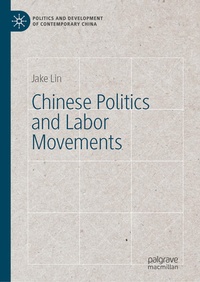
Chinese Politics and Labor Movements
Description
Reviews / Votes
"Jake Lin has written a well-researched and interesting book that promises to become a controversial must-read for all those interested in China's contemporary laboring classes. In addition to lamenting the anti-labor and anti-union repressive political regime that frames the field's theoretical framework, Lin also apportions responsibility to the working class-its inability to surmount the cognitive trap that prevents it from consolidating a collective consciousness of resistance." (Anita Chan, Editor, The China Journal)".a truly innovative study of Chinese workers and the 'psychic trap' they are in. Worker's resistance can sometimes take conservative forms with resistance becoming part of the state development process. Too often we assume oppressionand exploitation leads to organizing and counter-hegemony and do not ask: why do workers not rebel? Jake Lin has produced a magnificent study based on extensive fieldwork. A must-read for China and labor studies scholars everywhere." (Ronaldo Munck, Head of Civic Engagement, Dublin City University, Ireland)
"Lin's book of signal importance is its grounding in international relations and political economy, a focus on collective agency, and its potential contribution to social change through the use of an innovative form of 'cognitive research.' This book is a crucial contribution to the emerging literature on the nature of class in China in the twenty-first century and essential reading for students of the comparative political economy of China and East Asia." (Immanuel Ness, Professor of Political Science, City University of New York, USA)
"Jake Lin's Chinese Politics and Labor Movements demands that we think again about China, about where the country has come from, where it is going, and with what consequences for labor. Ambiguity informs the engagement of labor and the state: confrontational and conforming at the same time. Through his argument that the Chinese working class has fallen into a 'psychic trap', Lin sheds explanatory light on the paradox of resistance in a one party state, and the puzzle of why labor activism has failed to engender transformative change. These issues are a matter of supreme importance for China, and no little significance for the world." (Jonathan Rigg, Chair in Human Geography, School of Geographical Sciences, University of Bristol, UK)
More details
Other editions
Additional editions