

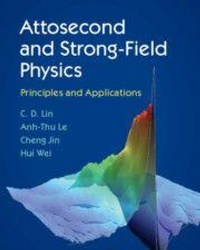
Attosecond and Strong-Field Physics
Principles and Applications
Published on 10. May 2018
Book
Hardback
416 pages
978-1-107-19776-3 (ISBN)
Description
Probing and controlling electrons and nuclei in matter at the attosecond timescale became possible with the generation of attosecond pulses by few-cycle intense lasers, and has revolutionized our understanding of atomic structure and molecular processes. This book provides an intuitive approach to this emerging field, utilizing simplified models to develop a clear understanding of how matter interacts with attosecond pulses of light. An introductory chapter outlines the structure of atoms and molecules and the properties of a focused laser beam. Detailed discussion of the fundamental theory of attosecond and strong-field physics follows, including the molecular tunnelling ionization model (MO-ADK theory), the quantitative rescattering (QRS) model, and the laser induced electronic diffraction (LIED) theory for probing the change of atomic configurations in a molecule. Highlighting the cutting-edge developments in attosecond and strong field physics, and identifying future opportunities and challenges, this self-contained text is invaluable for students and researchers in the field.
Reviews / Votes
'This is the book we were waiting for...Definitely a must-have!' Jens Biegert, The Institute of Photonic Sciences (ICFO) '... a very accessible introduction to the emerging fields of attosecond science and strong field laser physics ... This book will be a valuable resource for both new students and experienced researchers in the field.' Mark Vrakking, Max Born Institute, Berlin 'The first reference in the attosecond and strong field community.' Katsumi Midorikawa, Director, RIKEN Center for Advanced Photonics 'This is a textbook dedicated to graduate students who wish to understand strong laser fields and attosecond physics. The book is very clearly written and beautifully illustrated, the majority of figures being in color. Exercises and references are found at the end of all chapters ... Since attosecond pulses are a booming area of research, with many applications, this book is a must for university libraries and can be read easily by students and experts in the field. Daniela Dragoman, Optics & Photonics NewsMore details
Language
English
Place of publication
Cambridge
United Kingdom
Target group
Professional and scholarly
Product notice
sewn/stitched
Cloth over boards
Illustrations
Worked examples or Exercises; 13 Tables, black and white; 86 Plates, color; 93 Line drawings, black and white
Dimensions
Height: 255 mm
Width: 195 mm
Thickness: 24 mm
Weight
1057 gr
ISBN-13
978-1-107-19776-3 (9781107197763)
Copyright in bibliographic data and cover images is held by Nielsen Book Services Limited or by the publishers or by their respective licensors: all rights reserved.
Schweitzer Classification
Other editions
Additional editions
E-Book
05/2018
Cambridge University Press
€58.99
Available for download
E-Book
05/2018
Cambridge University Press
€70.99
Available for download
Persons
C. D. Lin is a University Distinguished Professor at Kansas State University. His group has made important contributions to the field of attosecond science including the development of the molecular tunnelling Ionization model (MO-ADK theory) and the quantitative rescattering (QRS) model. Anh-Thu Le is a Research Professor at Kansas State University. He has over twenty years' research experience in atomic, molecular and optical physics and together with Dr C. D. Lin he developed the quantitative rescattering theory (QRS) for high-order harmonic generation. Cheng Jin is a Professor at Nanjing University of Science and Technology, China. His research interests include optimization of the generation of isolated attosecond pulses by synthesis of multicolor laser waveforms in the gas medium. Hui Wei is a postdoctoral fellow at Kansas State University. His research interests include characterization and applications of attosecond pulses to molecules and solids.
Content
Preface; 1. Elements of atoms, molecules and wave propagation; 2. Basic formulation of interactions between an intense laser pulse and atoms; 3. Strong field ionization and low-energy electron spectra of atoms and molecules; 4. Rescattering and laser-induced electron diffraction; 5. Fundamentals of high-order harmonic generation; 6. Applications of high-order harmonics: HHG spectroscopy and optimization of harmonics; 7. Generation and characterization of attosecond pulses; 8. Probing electron dynamics with isolated attosecond pulses; List of books; Solutions to selected problems; Index.