

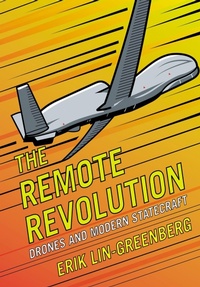
The Remote Revolution
Drones and Modern Statecraft
Published on 15. November 2025
Book
Hardback
252 pages
978-1-5017-8383-8 (ISBN)
Description
Cowinner of the APSA Conflict Processes Section Book Award
In The Remote Revolution Erik Lin-Greenberg shows that drones are rewriting the rules of international security - but not in ways one would expect.
Emerging technologies like drones are often believed to increase the likelihood of crises and war. By lowering the potential risks and human costs of military operations, they encourage decision-makers to deploy military force. Yet as Lin-Greenberg contends, operations involving drones are in fact less likely to evolve into broader, more intense conflicts than similar operations involving traditionally crewed assets. Even as drones increase the frequency of conflict, the decreased costs of their operations reduces the likelihood of conflict escalation.
Leveraging diverse types of evidence from original wargames, survey experiments, and cases of US and Israeli drone operations, Lin-Greenberg explores how drone operations lower risks of escalation. First, they enable states to gather more or better intelligence that may avert or reduce the chances of high-stakes conflict. Second, drone attacks are less likely to affront a target state's honor and therefore less likely to provoke aggressive responses. Lastly, leaders are less likely to take escalatory actions when drones are attacked than they are with incidents involving inhabited assets.
Lin-Greenberg's findings prove conclusively that drones are far less destabilizing than commonly argued. Drones add rungs to the proverbial "escalation ladder" and, in doing so, have brought about a fundamental change - a revolution - in the character of statecraft. With the use of unmanned technologies only set to grow in coming times, The Remote Revolution is critical reading about their possibilities and politics.
In The Remote Revolution Erik Lin-Greenberg shows that drones are rewriting the rules of international security - but not in ways one would expect.
Emerging technologies like drones are often believed to increase the likelihood of crises and war. By lowering the potential risks and human costs of military operations, they encourage decision-makers to deploy military force. Yet as Lin-Greenberg contends, operations involving drones are in fact less likely to evolve into broader, more intense conflicts than similar operations involving traditionally crewed assets. Even as drones increase the frequency of conflict, the decreased costs of their operations reduces the likelihood of conflict escalation.
Leveraging diverse types of evidence from original wargames, survey experiments, and cases of US and Israeli drone operations, Lin-Greenberg explores how drone operations lower risks of escalation. First, they enable states to gather more or better intelligence that may avert or reduce the chances of high-stakes conflict. Second, drone attacks are less likely to affront a target state's honor and therefore less likely to provoke aggressive responses. Lastly, leaders are less likely to take escalatory actions when drones are attacked than they are with incidents involving inhabited assets.
Lin-Greenberg's findings prove conclusively that drones are far less destabilizing than commonly argued. Drones add rungs to the proverbial "escalation ladder" and, in doing so, have brought about a fundamental change - a revolution - in the character of statecraft. With the use of unmanned technologies only set to grow in coming times, The Remote Revolution is critical reading about their possibilities and politics.
Reviews / Votes
"Lin-Greenberg brings a distinctive professional background to the subject of drone warfare." - Space DailyMore details
Series
Language
English
Place of publication
Ithaca
United States
Target group
College/higher education
Product notice
Paper over boards
Illustrations
5 charts, 1 graph - 1 Graphs - 5 Charts
Dimensions
Height: 235 mm
Width: 159 mm
Thickness: 24 mm
Weight
550 gr
ISBN-13
978-1-5017-8383-8 (9781501783838)
Copyright in bibliographic data and cover images is held by Nielsen Book Services Limited or by the publishers or by their respective licensors: all rights reserved.
Schweitzer Classification
Other editions
Additional editions
E-Book
11/2025
Cornell University Press
€32.99
Available for download
Person
Erik Lin-Greenberg is Associate Professor of Political Science at the Massachusetts Institute of Technology.
Content
Introduction: Introduction
1. The Remote Revolution
2. Evidence from Wargames
3. Evidence from Surveys
4. U.S. Cold War Aerial Reconnaissance
5. Israel's Drone Use and the Campaign Between Wars
6. Conclusion
1. The Remote Revolution
2. Evidence from Wargames
3. Evidence from Surveys
4. U.S. Cold War Aerial Reconnaissance
5. Israel's Drone Use and the Campaign Between Wars
6. Conclusion