

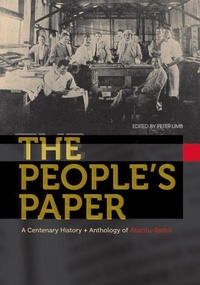
The People's Paper
A Centenary History and Anthology of Abantu-Batho
Published on 1. September 2012
Book
Paperback/Softback
560 pages
978-1-86814-571-3 (ISBN)
Description
This much-awaited volume uncovers the long-lost pages of the major African multilingual newspaper, Abantu-Batho.
Founded in 1912 by African National Congress (ANC) convenor Pixley Seme, with assistance from the Swazi Queen, it was published up until 1931, attracting the cream of African politicians, journalists and poets Mqhayi, Nontsisi Mgqweth, and Grendon. In its pages burning issues of the day were articulated alongside cultural by-ways. The People's Paper - comprising both essays and an anthology - explores the complex movements and individuals that emerged in the almost twenty years of its publication. The essays contribute rich, new material to provide clearer insights into South African politics and intellectual life. The anthology unveils a judicious selection of never-before published columns from the paper spanning every year of its life and drawn from repositories on three continents. Abantu-Batho had a regional and international focus, and by examining all these dynamics across boundaries and disciplines, The People's Paper transcends established historiographical frontiers to fill a lacuna that scholars have long lamented.
Founded in 1912 by African National Congress (ANC) convenor Pixley Seme, with assistance from the Swazi Queen, it was published up until 1931, attracting the cream of African politicians, journalists and poets Mqhayi, Nontsisi Mgqweth, and Grendon. In its pages burning issues of the day were articulated alongside cultural by-ways. The People's Paper - comprising both essays and an anthology - explores the complex movements and individuals that emerged in the almost twenty years of its publication. The essays contribute rich, new material to provide clearer insights into South African politics and intellectual life. The anthology unveils a judicious selection of never-before published columns from the paper spanning every year of its life and drawn from repositories on three continents. Abantu-Batho had a regional and international focus, and by examining all these dynamics across boundaries and disciplines, The People's Paper transcends established historiographical frontiers to fill a lacuna that scholars have long lamented.
More details
Language
English
Place of publication
Johannesburg
South Africa
Target group
Professional and scholarly
Product notice
Paperback (trade)
Dimensions
Height: 239 mm
Width: 170 mm
Thickness: 36 mm
Weight
998 gr
ISBN-13
978-1-86814-571-3 (9781868145713)
Copyright in bibliographic data and cover images is held by Nielsen Book Services Limited or by the publishers or by their respective licensors: all rights reserved.
Schweitzer Classification
Other editions
Additional editions
E-Book
09/2012
Abingdon Press
€40.99
Available for download
Persons
Peter Limb is an adjunct associate professor and Africana bibliographer at Michigan State University. His recent books include A. B. Xuma's Autobiography and Selected Works (VRS, 2012), The ANC's Early Years (Unisa Press, 2010),
Grappling with the Beast (Brill, 2010) and Nelson Mandela: A Biography (Greenwood, 2008).
Grappling with the Beast (Brill, 2010) and Nelson Mandela: A Biography (Greenwood, 2008).
Content
Introduction: A Centenary History of Abantu-Batho, the People's Paper
Peter Limb
Chapter 1 'Only the Bolder Spirits': Politics, Racism, Solidarity and War in Abantu-Batho
Peter Limb
Chapter 2 'They Must Go to the Bantu Batho': Economics and Education, Religion and Gender, Love and Leisure in the People's Paper
Peter Limb
Chapter 3 Pixley Seme and Abantu-Batho
Chris Saunders
Chapter 4 Queen Labotsibeni and Abantu-Batho
Sarah Mkhonza
Chapter 5 'We of Abantu Batho': Robert Grendon's Brief and Controversial Editorship
Grant Christison
Chapter 6 The Swazi Royalty and the Founding of Abantu-Batho in a Regional Context 174
Chris Lowe
Chapter 7 Abantu-Batho and the Xhosa Poets 201
Jeff Opland
Chapter 8 African Royalty, Popular History and Abantu-Batho
Sifiso Mxolisi Ndlovu and Peter Limb
Chapter 9 'Johannesburg in Flames': The 1918 Shilling Campaign,
Abantu-Batho and Early African Nationalism in South Africa
Paul Landau
Chapter 10 Garveyism, Abantu-Batho and the Radicalisation of the African National Congress during the 1920s
Robert Trent Vinson
Chapter 11 An African Newspaper in Central Johannesburg: The Journalistic and Associational Context of Abantu-Batho
Peter Limb
Conclusion Assessing the Decline and Legacy of Abantu-Batho
Peter Limb
Peter Limb
Chapter 1 'Only the Bolder Spirits': Politics, Racism, Solidarity and War in Abantu-Batho
Peter Limb
Chapter 2 'They Must Go to the Bantu Batho': Economics and Education, Religion and Gender, Love and Leisure in the People's Paper
Peter Limb
Chapter 3 Pixley Seme and Abantu-Batho
Chris Saunders
Chapter 4 Queen Labotsibeni and Abantu-Batho
Sarah Mkhonza
Chapter 5 'We of Abantu Batho': Robert Grendon's Brief and Controversial Editorship
Grant Christison
Chapter 6 The Swazi Royalty and the Founding of Abantu-Batho in a Regional Context 174
Chris Lowe
Chapter 7 Abantu-Batho and the Xhosa Poets 201
Jeff Opland
Chapter 8 African Royalty, Popular History and Abantu-Batho
Sifiso Mxolisi Ndlovu and Peter Limb
Chapter 9 'Johannesburg in Flames': The 1918 Shilling Campaign,
Abantu-Batho and Early African Nationalism in South Africa
Paul Landau
Chapter 10 Garveyism, Abantu-Batho and the Radicalisation of the African National Congress during the 1920s
Robert Trent Vinson
Chapter 11 An African Newspaper in Central Johannesburg: The Journalistic and Associational Context of Abantu-Batho
Peter Limb
Conclusion Assessing the Decline and Legacy of Abantu-Batho
Peter Limb