

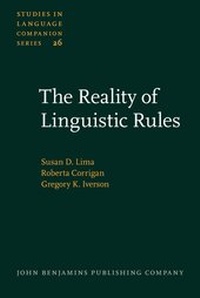
The Reality of Linguistic Rules
Published on 24. November 1994
Book
Hardback
480 pages
978-90-272-3029-4 (ISBN)
Description
This volume presents a selection of the best papers from the 21st Annual University of Wisconsin-Milwaukee Linguistics Symposium. Researchers from linguistics, psychology, computer science, and philosophy, using many different methods and focusing on many different facts of language, addressed the question of the existence of linguistic rules. Are such rules best seen as convenient tools for the description of languages, or are rules actually invoked by individual language users? Perhaps the most serious challenge to date to the linguistic rule is the development of connectionist architecture. Indeed, these systems must be viewed as a serious challenge to the foundations of all of contemporary linguistics.
Four broad themes emerged from the Milwaukee conference, corresponding to the four parts of the volume. Part I centers on arguments for the existence of symbolic rules in linguistic competence and performance. Part II contains arguments against symbolic rules, presenting connectionist models and other alternatives to the symbolic paradigm. Parts III and IV take up two issues that are central to a number of language researchers: Language acquisition and learnability, and modularity. These issues are addressed from within both rule-based and non-rule-based perspectives.
Contributors: Farrell Ackerman, Michael Barlow, Catherine Best, David Corina, Roberta Corrigan, Kim Daugherty, Bruce Derwing, Jeff Elman, Alice Faber, John Goldsmith, Helen Goodluck, Neil Jacobs, Richard Janda, Brian Joseph, Michael Kac, Alan Kawamoto, Suzanne Kemmer, Susan Lima, Brian MacWhinney, Steven Pinker, Alan Prince, Gerald Sanders, Hinrich Schutze, Mark Seidenberg, Royal Skousen, Nicholas Sobin, Joseph Stemberger, Gregory Stone, Ann Thyme, Robert Van Valin.
Four broad themes emerged from the Milwaukee conference, corresponding to the four parts of the volume. Part I centers on arguments for the existence of symbolic rules in linguistic competence and performance. Part II contains arguments against symbolic rules, presenting connectionist models and other alternatives to the symbolic paradigm. Parts III and IV take up two issues that are central to a number of language researchers: Language acquisition and learnability, and modularity. These issues are addressed from within both rule-based and non-rule-based perspectives.
Contributors: Farrell Ackerman, Michael Barlow, Catherine Best, David Corina, Roberta Corrigan, Kim Daugherty, Bruce Derwing, Jeff Elman, Alice Faber, John Goldsmith, Helen Goodluck, Neil Jacobs, Richard Janda, Brian Joseph, Michael Kac, Alan Kawamoto, Suzanne Kemmer, Susan Lima, Brian MacWhinney, Steven Pinker, Alan Prince, Gerald Sanders, Hinrich Schutze, Mark Seidenberg, Royal Skousen, Nicholas Sobin, Joseph Stemberger, Gregory Stone, Ann Thyme, Robert Van Valin.
More details
Series
Language
English
Place of publication
Amsterdam
Netherlands
Target group
College/higher education
Professional and scholarly
Dimensions
Height: 245 mm
Width: 164 mm
Weight
800 gr
ISBN-13
978-90-272-3029-4 (9789027230294)
Copyright in bibliographic data and cover images is held by Nielsen Book Services Limited or by the publishers or by their respective licensors: all rights reserved.
Schweitzer Classification
Other editions
Additional editions
Susan D. Lima | Roberta Corrigan | Gregory Iverson
The Reality of Linguistic Rules
E-Book
11/1994
1st Edition
John Benjamins Publishing Company
€172.99
Available for download
Persons
Content
1. Contributors; 2. The Reality of Linguistic Rules: Introduction (by Corrigan, Roberta); 3. I For the Existence of Symbolic Rules; 4. On the Typology of Grammatical Principles (by Sanders, Gerald A.); 5. A Schema-Based Approach to Grammatical Description (by Barlow, Michael); 6. A Nonpsychological Realist Conception of Linguistic Rules (by Kac, Michael B.); 7. An Acceptable Ungrammatical Construction (by Sobin, Nicholas); 8. Systematic Hyperforeignisms as Maximally External Evidence for Linguistic Rules (by Janda, Richard D.); 9. II Alternatives to Rules; 10. Grammar within a Neural Network (by Goldsmith, John A.); 11. The Induction of Prosodic Constraints: Implications for Phonological Theory and Mental Representation (by Corina, David P.); 12. Rule-Less Morphology at the Phonology-Lexicon Interface (by Stemberger, Joseph P.); 13. Towards Connectionist Lexical Semantics (by Schutze, Hinrich); 14. Productivity and the English Past Tense: Testing Skousen's Analogy Model (by Derwing, Bruce L.); 15. III Language Acquisition and Learnability; 16. Current Grammars vs. Rule Driven Guessing in Children's Interpretations of some Complex Sentence Types (by Goodluck, Helen); 17. Extraction Restrictions, Competing Theories and the Argument from the Poverty of the Stimulus (by Van Valin Jr., Robert D.); 18. The Perceptual Infrastructure of Early Phonological Development (by Faber, Alice); 19. IV Modularity and Related Issues; 20. The Dinosaurs and the Ring (by MacWhinney, Brian); 21. Regular and Irregular Morphology and the Psychological Status of Rules of Grammar (by Pinker, Steven); 22. Beyond Rules and Exceptions: A Connectionist Approach to Inflectional Morphology (by Daugherty, Kim G.); 23. One System or Two to Handle Regulars and Exceptions: How Time-Course of Processing can Inform this Debate (by Kawamoto, Alan H.); 24. Combining Connectionist and Symbolic Properties in a Single Process (by Stone, Gregory O.); 25. Finnish Nominal Inflection: Paradigmatic Patterns and Token Analogy (by Thyme, Ann); 26. Author Index; 27. Subject Index