

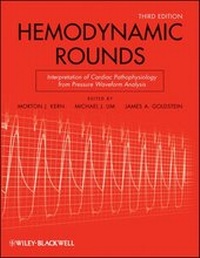
Hemodynamic Rounds
Interpretation of Cardiac Pathophysiology from Pressure Waveform Analysis
3rd Edition
Published on 3. July 2009
Book
Paperback/Softback
496 pages
978-0-470-08576-9 (ISBN)
Description
Hemodynamic Rounds
Third Edition
Interpretation of Cardiac Pathophysiology from Pressure Waveform Analysis
Edited By
Morton J. Kern
Michael J. Lim
James A. Goldstein
The essential resource on cardiac hemodynamics-now in a new edition
Hemodynamic Rounds, Third Edition is intended to help cardiologists and other members ofthe medical community enhance their understanding of cardiac physiology and its associatedhemodynamic presentations in health and disease, including the basic principles of flow andpressure measurements; systemic as well as coronary hemodynamics in normal and diseased states; and changes in hemodynamics following interventional procedures ranging from valvuloplasty to stent placement.
Like its popular predecessors, this new edition draws on case studies to illustrate characteristiccardiac hemodynamic findings and discuss the essential methods used in interpreting pressure waveforms as a diagnostic and monitoring tool.
The text is organized into chapters on specific areas of the heart, common cardiac anomalies, and hemodynamic situations resulting from different therapeutic procedures, and includes both normal and abnormal pressure waveforms. This new edition includes thoroughly revised and updatedchapters on specific topics, including:
* Mitral stenosis and mitral valvuloplasty
* Low-gradient aortic valve stenosis
* Pitfalls of right heart hemodynamics
* Aortic and pulmonary balloon valvuloplasty
* Coronary hemodynamics for angioplasty and stenting
* Hemodynamic evaluation of stenotic bioprosthetic mitral valves
* Evaluation of hypertrophic obstructive cardiomyopathies
* Understanding cardiac pathophysiology from bedside hemodynamic study
Hemodynamic Rounds, Third Edition is the only book on the market that specifically addresses comprehensive cardiac hemodynamic findings, reviewing blood pressure tracings collectedfrom the cardiac catheterization lab on all aspects of cardiovascular disease, as well as normal cardiac function. It is an indispensable tool for all physicians, nurses, and students measuring and interpreting cardiac waveforms in cardiac diagnosis and monitoring.
Third Edition
Interpretation of Cardiac Pathophysiology from Pressure Waveform Analysis
Edited By
Morton J. Kern
Michael J. Lim
James A. Goldstein
The essential resource on cardiac hemodynamics-now in a new edition
Hemodynamic Rounds, Third Edition is intended to help cardiologists and other members ofthe medical community enhance their understanding of cardiac physiology and its associatedhemodynamic presentations in health and disease, including the basic principles of flow andpressure measurements; systemic as well as coronary hemodynamics in normal and diseased states; and changes in hemodynamics following interventional procedures ranging from valvuloplasty to stent placement.
Like its popular predecessors, this new edition draws on case studies to illustrate characteristiccardiac hemodynamic findings and discuss the essential methods used in interpreting pressure waveforms as a diagnostic and monitoring tool.
The text is organized into chapters on specific areas of the heart, common cardiac anomalies, and hemodynamic situations resulting from different therapeutic procedures, and includes both normal and abnormal pressure waveforms. This new edition includes thoroughly revised and updatedchapters on specific topics, including:
* Mitral stenosis and mitral valvuloplasty
* Low-gradient aortic valve stenosis
* Pitfalls of right heart hemodynamics
* Aortic and pulmonary balloon valvuloplasty
* Coronary hemodynamics for angioplasty and stenting
* Hemodynamic evaluation of stenotic bioprosthetic mitral valves
* Evaluation of hypertrophic obstructive cardiomyopathies
* Understanding cardiac pathophysiology from bedside hemodynamic study
Hemodynamic Rounds, Third Edition is the only book on the market that specifically addresses comprehensive cardiac hemodynamic findings, reviewing blood pressure tracings collectedfrom the cardiac catheterization lab on all aspects of cardiovascular disease, as well as normal cardiac function. It is an indispensable tool for all physicians, nurses, and students measuring and interpreting cardiac waveforms in cardiac diagnosis and monitoring.
More details
Edition
3. Auflage
Language
English
Place of publication
Hoboken
United Kingdom
Publishing group
John Wiley and Sons Ltd
Target group
Professional and scholarly
Illustrations
Photos: 80 B&W, 0 Color; Drawings: 50 B&W, 0 Color; Screen captures: 125 B&W, 0 Color; Graphs: 25 B&W, 0 Color
Dimensions
Height: 28 cm
Width: 22 cm
Thickness: 2.3 cm
Weight
1104 gr
ISBN-13
978-0-470-08576-9 (9780470085769)
Schweitzer Classification
Other editions
New editions
Morton J. Kern | Michael J. Lim | James A. Goldstein
Hemodynamic Rounds
Interpretation of Cardiac Pathophysiology from Pressure Waveform Analysis
Book
04/2018
4th Edition
Wiley
€123.50
Article not available at the moment
Additional editions
Michael J. Lim | James A. Goldstein | Morton J. Kern
Hemodynamic Rounds
Interpretation of Cardiac Pathophysiology from Pressure Waveform Analysis
E-Book
10/2011
3rd Edition
Wiley-Blackwell
€103.99
Available for download
Michael J. Lim | James A. Goldstein | Morton J. Kern
Hemodynamic Rounds
Interpretation of Cardiac Pathophysiology from Pressure Waveform Analysis
E-Book
08/2010
3rd Edition
Wiley-Blackwell
€103.99
Available for download
Previous edition
Morton J. Kern
Hemodynamic Rounds
Interpretation of Cardiac Pathophysiology from Pressure Waveform Analysis
Book
08/1999
2nd Edition
Wiley
€99.90
Article exhausted; check for reprint
Persons
Bruce R. Hopkins is a senior partner with the firm Polsinelli Shughart PC. He is also the author or coauthor of more than twenty-five books, all published by Wiley, including The Law of Tax-Exempt Organizations, Ninth Edition; The New Form 990; and Nonprofit Law Made Easy. Hopkins earned his juris doctorate and master of laws degrees at The George Washington University. He has practiced law for forty years and is a member of the District of Columbia and Missouri bars.
Virginia C. Gross is a shareholder of Polsinelli Shughart PC. Ms. Gross concentrates her practice in the field of nonprofit law and is a frequent writer and speaker on nonprofit issues. She is listed in The Best Lawyers in America for nonprofit organizations/charity law for 2008 and 2009. She is a coauthor of The New Form 990, published by Wiley. Ms. Gross earned her juris doctorate at the University of Texas. She is a member of the District of Columbia, Texas, Missouri, and Kansas bars.
Virginia C. Gross is a shareholder of Polsinelli Shughart PC. Ms. Gross concentrates her practice in the field of nonprofit law and is a frequent writer and speaker on nonprofit issues. She is listed in The Best Lawyers in America for nonprofit organizations/charity law for 2008 and 2009. She is a coauthor of The New Form 990, published by Wiley. Ms. Gross earned her juris doctorate at the University of Texas. She is a member of the District of Columbia, Texas, Missouri, and Kansas bars.
Content
SECTION I: FUNDAMENTALS OF HEMODYNAMIC WAVEFORMS.
PART 1: HEMODYNAMIC WAVEFORMS: NORMAL AND PATHOLOGIC.
1.1 Pressure Waves: Measurement systems and Artifacts.
1.2 Right Heart Hemodynamics.
1.3 The Tricuspid V Wave.
1.4 Left-Sided V Wave.
1.5 The LVEDP.
1.6 Simultaneous RV and LV pressure.
1.7 The effects of NTG.
1.8 Pulsus Alternans.
PART 2: VALVULAR HEMODYNAMICS.
2.1 Aortic Valve.
2.1.1 The Stenotic Aortic Valve.
2.1.2 Low-Gradient Aortic Valve Stenosis.
2.1.3 The Regurgitant Aortic Valve.
2.1.4 Aortic Regurgitation.
2.1.5 Prosthetic Aortic Root And Valve.
2.1.6 Acute Aortic Insufficiency.
2.2 The Mitral Valve.
2.2.1 Mitral Valve Gradients.
2.2.2 Multivalvular Regurgitant Lesions.
2.3 The Pulmonary Valve.
PART 3: VALVULOPLASTY.
3.1.1 Percutaneous Aortic Balloon Valvuloplasty.
3.1.2 Percutaneous Mitral Balloon Valvuloplasty.
3.1.3 Percutaneous Pulmonic Balloon Valvuloplasty.
PART 4: CONSTRICTIVE PHYSIOLOGY.
4.1 Pericardial Compressive Hemodynamics.
4.2 Dynamics of Ventricular Pressure Interactions.
4.3 Criteria of Constrictive Physiology.
4.4 Cardiac Tamponade.
PART 5: ARRHYTHMIAS.
5.1 Cardiac Arrhythmias.
5.2 Pacemaker Arrhythmias.
PART 6: HOCM.
PART 7: CORONARY HEMODYNAMICS.
PART 8: ADULT CONGENTIAL ANOMALIES AND HEMODYANMICS.
PART 9: EXTRA HEARTS.
PART 10: RIGHT VENTRICULAR INFARCTION.
SECTION II: CLINICAL AND BEDSIDE APPLICATIONS OF HEMODYNAMICS.
1. Evaluation of Dyspnea.
2. Evaluation of Edema and Anasarca.
3. Evaluation of Syncope.
4. Evaluation of Hypotension, low cardiac output.
PART 1: HEMODYNAMIC WAVEFORMS: NORMAL AND PATHOLOGIC.
1.1 Pressure Waves: Measurement systems and Artifacts.
1.2 Right Heart Hemodynamics.
1.3 The Tricuspid V Wave.
1.4 Left-Sided V Wave.
1.5 The LVEDP.
1.6 Simultaneous RV and LV pressure.
1.7 The effects of NTG.
1.8 Pulsus Alternans.
PART 2: VALVULAR HEMODYNAMICS.
2.1 Aortic Valve.
2.1.1 The Stenotic Aortic Valve.
2.1.2 Low-Gradient Aortic Valve Stenosis.
2.1.3 The Regurgitant Aortic Valve.
2.1.4 Aortic Regurgitation.
2.1.5 Prosthetic Aortic Root And Valve.
2.1.6 Acute Aortic Insufficiency.
2.2 The Mitral Valve.
2.2.1 Mitral Valve Gradients.
2.2.2 Multivalvular Regurgitant Lesions.
2.3 The Pulmonary Valve.
PART 3: VALVULOPLASTY.
3.1.1 Percutaneous Aortic Balloon Valvuloplasty.
3.1.2 Percutaneous Mitral Balloon Valvuloplasty.
3.1.3 Percutaneous Pulmonic Balloon Valvuloplasty.
PART 4: CONSTRICTIVE PHYSIOLOGY.
4.1 Pericardial Compressive Hemodynamics.
4.2 Dynamics of Ventricular Pressure Interactions.
4.3 Criteria of Constrictive Physiology.
4.4 Cardiac Tamponade.
PART 5: ARRHYTHMIAS.
5.1 Cardiac Arrhythmias.
5.2 Pacemaker Arrhythmias.
PART 6: HOCM.
PART 7: CORONARY HEMODYNAMICS.
PART 8: ADULT CONGENTIAL ANOMALIES AND HEMODYANMICS.
PART 9: EXTRA HEARTS.
PART 10: RIGHT VENTRICULAR INFARCTION.
SECTION II: CLINICAL AND BEDSIDE APPLICATIONS OF HEMODYNAMICS.
1. Evaluation of Dyspnea.
2. Evaluation of Edema and Anasarca.
3. Evaluation of Syncope.
4. Evaluation of Hypotension, low cardiac output.