

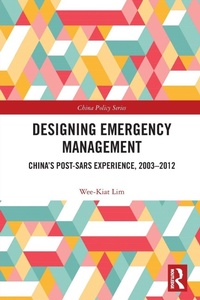
Designing Emergency Management
China's Post-SARS Experience, 2003-2012
1st Edition
Published on 30. May 2022
Book
Paperback/Softback
172 pages
978-0-367-64255-6 (ISBN)
Description
This book looks at the then-nascent emergency management sector in China, specifically the 2003-2012 period, that arose from the 2003 SARS crisis and subsequently set the stage for its responses to the COVID-19 pandemic.
Covering not only the amended and new laws and regulations at the national level, the book also includes the rearrangement and creation of the organizational structures, as well as the response plans for individual emergencies that were either recrafted or created during this period. Beyond chronicling the milestones and products of this transformation, this book highlights the key ideas and ideals that guided the various stakeholders, from the governing elites to the policy experts during this process.
The book demonstrates how definitions of emergency management and emergency categories, as well as other ideational objects, were initially either absent or weakly developed, but were refined to the extent that they helped corral disparate actors into China's new organizational field of emergency management.
Covering not only the amended and new laws and regulations at the national level, the book also includes the rearrangement and creation of the organizational structures, as well as the response plans for individual emergencies that were either recrafted or created during this period. Beyond chronicling the milestones and products of this transformation, this book highlights the key ideas and ideals that guided the various stakeholders, from the governing elites to the policy experts during this process.
The book demonstrates how definitions of emergency management and emergency categories, as well as other ideational objects, were initially either absent or weakly developed, but were refined to the extent that they helped corral disparate actors into China's new organizational field of emergency management.
More details
Series
Language
English
Place of publication
London
United Kingdom
Publishing group
Taylor & Francis Ltd
Target group
College/higher education
Postgraduate and Undergraduate
Illustrations
3 s/w Abbildungen, 3 s/w Zeichnungen, 7 s/w Tabellen
7 Tables, black and white; 3 Line drawings, black and white; 3 Illustrations, black and white
Dimensions
Height: 234 mm
Width: 156 mm
Thickness: 10 mm
Weight
272 gr
ISBN-13
978-0-367-64255-6 (9780367642556)
Copyright in bibliographic data and cover images is held by Nielsen Book Services Limited or by the publishers or by their respective licensors: all rights reserved.
Schweitzer Classification
Other editions
Additional editions
Book
11/2020
1st Edition
Routledge
€205.90
Shipment within 15-20 days
E-Book
11/2020
1st Edition
Routledge
€59.49
Available for download
E-Book
11/2020
1st Edition
Routledge
€59.49
Available for download
Person
Wee-Kiat LIM is Associate Director, Centre for Management Practice at Singapore Management University. Since 2006, Wee-Kiat has been investigating how organizations make sense of, prepare for, and respond to sociotechnical disruptions. His research interests lie at the intersection of risk, disaster, and organization. Besides academic research, he has written and taught cases on organizations that are based in China, Indonesia, and Singapore, covering issues related to innovation, entrepreneurship, crisis management, and governance. Wee-Kiat holds a PhD in Sociology from University of Colorado Boulder, specializing in sociology of disaster and a Bachelor of Communication Studies (Hons.) from Nanyang Technological University, Singapore
Content
Prologue Designing Through Distress: Creating A New Organizational Field of Emergency Management in Post-SARS China. Chapter 1 Assembling the Theoretical Toolkit: Conceptualizing the Field and Its Formation. Chapter 2 Intensive Institutionalization (2002-2007). Chapter 3 Consolidation and Stabilization (2008-2012). Chapter 4 Risk Governance as A Framework for Emergency Management. Chapter 5 Taming Rivers, Saving Sheep, And Using Science: Legitimizing Claims Using Cultural Knowledge and Party-State Ideologies. Chapter 6 Governmentalization Of Emergency Management. Chapter 7 "Field" Work: Building A New Emergency Management in China. Epilogue Going Forward. Appendix - Research Methods