

Remote Sensing and Image Interpretation
4th Edition
Published on 1. November 1999
Book
Hardback
XII, 724 pages
978-0-471-25515-4 (ISBN)
Description
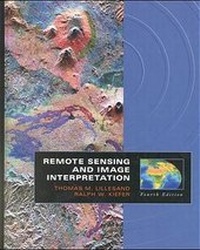
The image to the right shows a volcanic landscape in central Africa, including parts of Rwanda, Uganda, and the Democratic Republic of the Congo (formerly Zaire). This image was obtained from the SIR-C multi-wavelength radar remote sensing system, operated on the space shuttle Endeavor in 1994. SIR-C monitors the earth's surface using wave-lengths of energy that are much longer than the visible light seen by the human eye; thus, the hues in this "false color" radar image have little to no relationship to what would be seen in ordinary visible light. The volcano at top center of the image is Karisimba, 4500 m high. The green patch on the lower slopes of Karisimba volcano, to the right of its peak, is an area of bamboo forest-one of the world's few remaining habitats for mountain gorillas. Only some 600-700 mountain gorillas still remain on earth. Because the SIR-C radar is virtually unaffected by weather conditions, it is an ideal tool for capturing images over the cloudy and misty volcanic areas where mountain gorillas live.
Nyiragongo volcano (3465 m elevation) dominates the lower portion of the image some of the lava flows that surround it have a distinctive purple appearance in this image. As shown here, remote sensing in wavelengths of energy outside the range of visible light can often reveal aspects of our environment that complement what can be detected by the unaided eye. (This image covers a 24 km by 60 km area.) The global image (inset, below) is a composite view of vegetation cover on land and chlorophyll concentration in the oceans. This image was derived from data collected by the SeaWiFS global ocean color monitoring mission. Wide field-of-view sensors such as SeaWiFS permit continuous, long-term monitoring of the environment on a global scale, providing an important contribution to our understanding of the earth system as a single, integrated whole.
Nyiragongo volcano (3465 m elevation) dominates the lower portion of the image some of the lava flows that surround it have a distinctive purple appearance in this image. As shown here, remote sensing in wavelengths of energy outside the range of visible light can often reveal aspects of our environment that complement what can be detected by the unaided eye. (This image covers a 24 km by 60 km area.) The global image (inset, below) is a composite view of vegetation cover on land and chlorophyll concentration in the oceans. This image was derived from data collected by the SeaWiFS global ocean color monitoring mission. Wide field-of-view sensors such as SeaWiFS permit continuous, long-term monitoring of the environment on a global scale, providing an important contribution to our understanding of the earth system as a single, integrated whole.
Reviews / Votes
"It remains an excellent book and to have it updated is very valuable...It is nice to see a good book being updated." (Int Journal of Remote Sensing, Vol 21/16, 2000)More details
Edition
4., Aufl.
Language
English
Place of publication
New York
United States
Publishing group
John Wiley and Sons Ltd
Target group
College/higher education
Edition type
Revised edition
Illustrations
Illustrations (some col.), maps (some col.)
Dimensions
Height: 24.5 cm
Width: 19.6 cm
Weight
1480 gr
ISBN-13
978-0-471-25515-4 (9780471255154)
Schweitzer Classification
Other editions
New editions
Thomas M. Lillesand | Ralph W. Kiefer | Jonathan W. Chipman
Remote Sensing and Image Interpretation
International Edition
Book
01/2004
5th Edition
Wiley
€49.90
Article exhausted; check for reprint
Previous edition

Thomas M. Lillesand | Ralph W. Kiefer
Remote Sensing and Image Interpretation
Book
01/1994
3rd Edition
Wiley
€33.42
Article exhausted; check for reprint
Content
Concepts and Foundations of Remote Sensing. Elements of Photographic Systems. Basic Principles of Photogrammetry. Introduction to Visual Image Interpretation. Multispectral, Thermal, and Hyperspectral Sensing. Earth Resource Satellites Operating in the Optical Spectrum. Digital Image Processing. Microwave Sensing.