

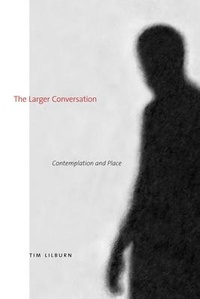
The Larger Conversation
Contemplation and Place
Published on 9. November 2017
Book
Paperback/Softback
296 pages
978-1-77212-299-2 (ISBN)
Description
This volume, the final in Tim Lilburn's decades-long meditation on philosophy and environmental consequences, traces a relationship between mystic traditions and the political world. Struck by the realization that he did not know how to be where he found himself, Lilburn embarked on a personal attempt at decolonization, seeking to uncover what is wrong within Canadian culture and to locate a possible path to recovery. He proposes a new epistemology leading to an ecologically responsible and spiritually acute relationship between settler Canadians, Indigenous peoples, and the land we inhabit. The Larger Conversation is a bold statement: a vital text for readers of environmental philosophy and for anyone interested in building toward conversation between Indigenous peoples and settlers.
Reviews / Votes
"It takes a poet to see the extraordinary in the mundane.... This is reading for the joy of it." [Full review at https://www.blacklocks.ca/book-review-going-home] -- Holly Doan * Blacklock's Reporter * "In a series of essays, lectures, confessions, and interviews, all based on years of reading and research, Lilburn shares not new but old, reclaimed ways of thinking-long-ignored riches from the Christian, Judaic and Islamic contemplative wisdom traditions.... In order to undo the Western extractive, colonial approach to land-one that uses, warehouses, and dominates-we have to return to our former strengths, what Lilburn calls 'cognitive rebar.' What justice asks of us is that we do the work to prepare for conversation." [Full article at http://www.focusonvictoria.ca/novdec2017/the-larger-conversation-contemplation-and-place-r5/] -- Amy Reiswig * Focus Magazine * "This book is exactly what I think is required in the emerging scholarly and literary work on decolonization in Canada. This isn't a dry and heavy academic text marking up conceptual territory: territorializing knowledge with confusing title and jargon... This book is much more in the traditions of mystical contemplative philosophy." -- Cary Campbell * SubTerrain * "This collection of essays is the third in a series of books in which Lilburn reflects on his own sense of rootlessness, often as a cultural phenomenon. The current book's emphasis on the colonial condition is new...[The] construal at the heart of the book is individual and specific: North Americans of European descent suffer from a colonial malaise consisting significantly of a malformed relation to place." -- Carolyn Richardson * The Fiddlehead * "[Lilburn] feels that beneath 'the smoothness, the relative fine running of late capitalism,' there's a disturbing hunger... And why? Because, argues Lilburn, through chapters on philosophical inquiry, spiritual struggle, deep ecological concern, and unsparing self-confession, we have not truly learned how to live on this land so relatively new to us, a land acquired in many ways through violence and dishonesty... What Lilburn attempts in this larger conversation is to find a way back, through earnest inquiry with philosophers, mystics, poets, and saints stretching back thousands of years, to the 'essence of nature'..." [Full review at https://thestarphoenix.com/entertainment/books/book-reviews-lilburn-searches-for-meaning-peeteetuce-creates-scathing-depiction-of-phoniness] -- Bill Robertson * Saskatoon StarPhoenix * "In 1999, writer and poet Tim Lilburn published the non-fiction work Living in the World as if It Were Home, a meditation on humanity's relationship with the natural environment that has become a classic and was the first book in a loose trilogy examining the connections between politics, environmentalism, philosophy, and modernity. Eighteen years later, the final part of the trilogy, a volume of contemplative essays, is available from UAP." * Quill & Quire * "The Larger Conversation is a beautiful, patient, and persistent philosophical work.... Lilburn suggests that in entering a relationship with place, with any specific place that we care about, we can be seen by place and thus be given our identity-indeed our Being-through a kind of grace. I love this argument and line of thought for its beauty and practicality. It offers a true way to move forward from the colonial past by first making changes to how we perceive reality-a reality that we constantly misunderstand-about how and why and who we are in place." [Full review at http://canlit.ca/article/being-seen-by-place/] -- Susie DeCoste * Canadian Literature 236 * "One of Lilburn's primary interests has always been the relationship - the dialogue - between poetry and philosophy, including their common roots and common objectives.... At the same time, some of this writing is deeply personal, even confessional; here, the writer is more candid than usual about his own life, including childhood memories, illness and aging, faith and doubt." Kelly Shepherd, UTP Quarterly 2017 [Full review at DOI 10.3138/utq.88.3.hr79]More details
Language
English
Place of publication
Edmonton
Canada
Product notice
Paperback (trade)
Dimensions
Height: 229 mm
Width: 152 mm
Thickness: 18 mm
Weight
454 gr
ISBN-13
978-1-77212-299-2 (9781772122992)
Copyright in bibliographic data and cover images is held by Nielsen Book Services Limited or by the publishers or by their respective licensors: all rights reserved.
Schweitzer Classification
Person
With The Larger Conversation, Tim Lilburn completes a manifesto on poetics, eros, philosophy, and enviro-politics that began with the classic Living in the World As If It Were Home (Cormorant Books). A Governor General's Award winner and the first Canadian to win the European Medal of Poetry and Art, he lives and teaches in Victoria, British Columbia.
Content
Introduction
I
1 The Ethical Significance of the Human Relationship to Place
2 The Start of Real Thinking
3 On Scholem, Ruusbroec and Exegesis
4 Imagination, Psychagogy and Ontology
5 Mostly on Prayer
6 Seeing into Things: Suhrawardi and Mandelstam
II
7 A Mandelstamian Generation in China
8 Poetry as Pneumatic Force
9 Fresh Coherence
10 Turning the Soul Around: The Ascetical Practice of Philosophy in the Republic
11 Negative Theological Meditations: Apophasis and Its Politics
12 Thinking the Rule of Benedict within Modernity
13 Thomas Merton's Novitiate Talks on Cistercian Usages and Richard Kearney's Theandrism
III
14 A Poetics of Decolonization
15 Contemplative Experience; Autochthonous Practice
16 Faith and Land
17 Nothingness
Epilogue: At the Foot of WMIETEN
Dramatis Personae
Glossary
Acknowledgements
Reading
Permissions
Index
I
1 The Ethical Significance of the Human Relationship to Place
2 The Start of Real Thinking
3 On Scholem, Ruusbroec and Exegesis
4 Imagination, Psychagogy and Ontology
5 Mostly on Prayer
6 Seeing into Things: Suhrawardi and Mandelstam
II
7 A Mandelstamian Generation in China
8 Poetry as Pneumatic Force
9 Fresh Coherence
10 Turning the Soul Around: The Ascetical Practice of Philosophy in the Republic
11 Negative Theological Meditations: Apophasis and Its Politics
12 Thinking the Rule of Benedict within Modernity
13 Thomas Merton's Novitiate Talks on Cistercian Usages and Richard Kearney's Theandrism
III
14 A Poetics of Decolonization
15 Contemplative Experience; Autochthonous Practice
16 Faith and Land
17 Nothingness
Epilogue: At the Foot of WMIETEN
Dramatis Personae
Glossary
Acknowledgements
Reading
Permissions
Index