

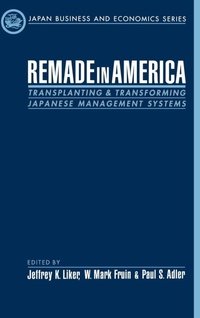
Remade in America
Transplanting and Transforming Japanese Management Systems
Published on 29. July 1999
Book
Hardback
432 pages
978-0-19-511815-5 (ISBN)
Description
Over the last two decades, Japanese firms have challenged U.S. dominance in many manufacturing industries. This challenge has increasingly come in the form of transplant operations, and recognition has spread that their success owes a great deal to superior manufacturing management. Despite the ups and downs of the business cycle in Japan, there remains a core of world-class Japanese companies that have developed manufacturing management systems that companies throughout the world strive to emulate.
In this edited volume, a team of eminent scholars uses case studies and large-scale surveys to explain in depth the process of transferring and transforming the best Japanese Management Systems (JMS) by both Japanese- and U.S.-owned firms. While the most successful of the Japanese manufacturing transplants rely, to varying degrees, on home country management techniques, they have had to adapt them to fit U.S. conditions. Similarly, the growing number of U.S. firms that are adopting these techniques to strengthen their own positions face a considerable challenge in transforming them to fit local conditions. A new environment necessarily compels the transformation of JMS. But despite the hurdles firms face, the evidence presented here and elsewhere strongly indicates that key aspects of JMS are remarkably transferable and successful in the United States.
Combining scientific data with clear and engaging prose,Remade in America is a rich analytical resource for manufacturing professionals, as well as scholars and students of management and business.
In this edited volume, a team of eminent scholars uses case studies and large-scale surveys to explain in depth the process of transferring and transforming the best Japanese Management Systems (JMS) by both Japanese- and U.S.-owned firms. While the most successful of the Japanese manufacturing transplants rely, to varying degrees, on home country management techniques, they have had to adapt them to fit U.S. conditions. Similarly, the growing number of U.S. firms that are adopting these techniques to strengthen their own positions face a considerable challenge in transforming them to fit local conditions. A new environment necessarily compels the transformation of JMS. But despite the hurdles firms face, the evidence presented here and elsewhere strongly indicates that key aspects of JMS are remarkably transferable and successful in the United States.
Combining scientific data with clear and engaging prose,Remade in America is a rich analytical resource for manufacturing professionals, as well as scholars and students of management and business.
Reviews / Votes
This book will appeal strongly to several types of audiences. The authors have done an exceptional job of putting flesh on the bones of theoretical constructs. Remade in America belongs in the library of anyone studying or working in or around transplant operations. * Academy of Management Executive *More details
Series
Language
English
Place of publication
New York
United States
Target group
Professional and scholarly
Illustrations
18 figures
Dimensions
Height: 235 mm
Width: 157 mm
Thickness: 30 mm
Weight
854 gr
ISBN-13
978-0-19-511815-5 (9780195118155)
Copyright in bibliographic data and cover images is held by Nielsen Book Services Limited or by the publishers or by their respective licensors: all rights reserved.
Schweitzer Classification
Other editions
Additional editions
Jeffrey K. Liker | W. Mark Fruin | Paul S. Adler
Remade in America
Transplanting and Transforming Japanese Management Systems
E-Book
07/1999
1st Edition
OUP eBook
€94.99
Available for download
Persons
Jeffrey Liker is Associate Professor of Industrial and Operations Engineering at the University of Michigan.
Mark Fruin is Visiting Professor in the Faculty of Business Administration at Keio University and Visiting Professor of Corporate Strategy and Technology Management in the College of Business at San Jose State University.
Paul Adler is Associate Professor of Management at the University of Southern California
Mark Fruin is Visiting Professor in the Faculty of Business Administration at Keio University and Visiting Professor of Corporate Strategy and Technology Management in the College of Business at San Jose State University.
Paul Adler is Associate Professor of Management at the University of Southern California
Editor
Director of the Value Chain Analysis Program and the Japan Management ProgramDirector of the Value Chain Analysis Program and the Japan Management Program, University of Michigan
Visiting Professor in the Faculty of Business Administration at Keio University; and Visiting Professor of Corporate Strategy and Technology Management in the College of Business AdministrationVisiting Professor in the Faculty of Business Administration at Keio University; and Visiting Professor of Corporate Strategy and Technology Management in the College of Business Administration, San Jose State University
Professor in the Department of Management, Marshall School of BusinessProfessor in the Department of Management, Marshall School of Business, University of Southern California
Content
Contributors
1: Jeffrey K. Liker, W. Mark Fruin, and Paul S. Adler: Bringing Japanese Management Systems to the United States: Transplantation or Transformation?
Part I. Automotive and Automotive Parts
2: Frits K. Pil and John Paul MacDuffie: Transferring Competitive Advantage across Borders: A Study of Japanese Auto Transplants in North America
3: Paul S. Adler: Hybridization: Human Resource Management at Two Toyota Transplants
4: Mary Yoko Brannen, Jeffrey K. Liker, and W. Mark Fruin: Recontextualization and Factory-to-Factory Knowledge Transfer from Japan to the United States: The Case of NSK
5: John Paul MacDuffie and Susan Helper: Creating Lean Suppliers: Diffusing Lean Production through the Supply Chain
Part II. Electronics and Related Products
6: Robert E. Cole: Japanese Quality Technology: Transferred and Transformed at Hewlett-Packard
7: W. Mark Fruin: Site-Specific Organization Learning in International Technology Transfer: Example from Toshiba
8: Martin Kenney: Transplantation? A Comparison of Japanese Television Assembly Plants in Japan and the United States
9: Mark F. Peterson, T.K. Peng, and Peter B. Smith: Using Expatriate Supervisors to Promote Cross-Border Management Practice Transfer: The Experience of a Japanese Electronics Company
Part III. Surveys across Industries
10: Davis Jenkins and Richard Florida: Work System Innovation among Japanese Transplants in the United States
11: Masao Nakamura, Sadao Sakakibara, and Roger G. Schroeder: Just-in-Time and Other Manufacturing Practices: Implications for U.S. Manufacturing Performance
12: D. Eleanor Westney: Organization Theory Perspectives on the Cross-Border Transfer of Organizational Patterns
Index
1: Jeffrey K. Liker, W. Mark Fruin, and Paul S. Adler: Bringing Japanese Management Systems to the United States: Transplantation or Transformation?
Part I. Automotive and Automotive Parts
2: Frits K. Pil and John Paul MacDuffie: Transferring Competitive Advantage across Borders: A Study of Japanese Auto Transplants in North America
3: Paul S. Adler: Hybridization: Human Resource Management at Two Toyota Transplants
4: Mary Yoko Brannen, Jeffrey K. Liker, and W. Mark Fruin: Recontextualization and Factory-to-Factory Knowledge Transfer from Japan to the United States: The Case of NSK
5: John Paul MacDuffie and Susan Helper: Creating Lean Suppliers: Diffusing Lean Production through the Supply Chain
Part II. Electronics and Related Products
6: Robert E. Cole: Japanese Quality Technology: Transferred and Transformed at Hewlett-Packard
7: W. Mark Fruin: Site-Specific Organization Learning in International Technology Transfer: Example from Toshiba
8: Martin Kenney: Transplantation? A Comparison of Japanese Television Assembly Plants in Japan and the United States
9: Mark F. Peterson, T.K. Peng, and Peter B. Smith: Using Expatriate Supervisors to Promote Cross-Border Management Practice Transfer: The Experience of a Japanese Electronics Company
Part III. Surveys across Industries
10: Davis Jenkins and Richard Florida: Work System Innovation among Japanese Transplants in the United States
11: Masao Nakamura, Sadao Sakakibara, and Roger G. Schroeder: Just-in-Time and Other Manufacturing Practices: Implications for U.S. Manufacturing Performance
12: D. Eleanor Westney: Organization Theory Perspectives on the Cross-Border Transfer of Organizational Patterns
Index