

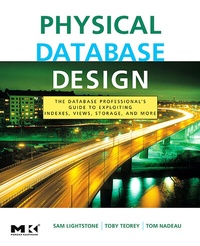
Physical Database Design
The Database Professional's Guide to Exploiting Indexes, Views, Storage, and More
Published on 5. June 2007
Book
Paperback/Softback
448 pages
978-0-12-369389-1 (ISBN)
Description
The rapidly increasing volume of information contained in relational databases places a strain on databases, performance, and maintainability: DBAs are under greater pressure than ever to optimize database structure for system performance and administration.
Physical Database Design discusses the concept of how physical structures of databases affect performance, including specific examples, guidelines, and best and worst practices for a variety of DBMSs and configurations. Something as simple as improving the table index design has a profound impact on performance. Every form of relational database, such as Online Transaction Processing (OLTP), Enterprise Resource Management (ERP), Data Mining (DM), or Management Resource Planning (MRP), can be improved using the methods provided in the book.
Physical Database Design discusses the concept of how physical structures of databases affect performance, including specific examples, guidelines, and best and worst practices for a variety of DBMSs and configurations. Something as simple as improving the table index design has a profound impact on performance. Every form of relational database, such as Online Transaction Processing (OLTP), Enterprise Resource Management (ERP), Data Mining (DM), or Management Resource Planning (MRP), can be improved using the methods provided in the book.
Reviews / Votes
"I highly recommend Physical Database Design by Lightstone, Teorey, and Nadeau. The book covers fine aspects of physical design -- issues such as the effects of different approaches to indexes, tradeoffs in materializing views, and details of physical data layout. Unlike other books, it does not focus on a particular product, but instead covers the deep principles that cut across products. The book addresses both transaction intensive applications (OLTP) as well as data warehouses (OLAP). Their new book is a welcome addition to the literature." --Michael Blaha, OMT Associates, Inc."This is an excellent book on physical database design, giving pragmatic models and advice. It has a wealth of information for both the student and for the practitioner -- presenting analytic models and practical tips that are demonstrated with examples using Oracle, DB2, and Microsoft SQL Server." --Jim Gray, Microsoft Research
More details
Series
Language
English
Place of publication
San Francisco
United States
Publishing group
Elsevier Science & Technology
Target group
Professional and scholarly
Database designers and database administrators working with large databases and data warehouses, who want to improve processing time for transactions and information access, resolve storage issues, and make life better for all of us.
Dimensions
Height: 235 mm
Width: 191 mm
Weight
900 gr
ISBN-13
978-0-12-369389-1 (9780123693891)
Copyright in bibliographic data and cover images is held by Nielsen Book Services Limited or by the publishers or by their respective licensors: all rights reserved.
Schweitzer Classification
Other editions
Additional editions
Sam S. Lightstone | Toby J. Teorey | Tom Nadeau
Physical Database Design
The Database Professional's Guide to Exploiting Indexes, Views, Storage, and More
E-Book
07/2010
Morgan Kaufmann
€47.95
Available for download
Persons
Sam Lightstone is a Senior Technical Staff Member and Development Manager with IBM's DB2 product development team. His work includes numerous topics in autonomic computing and relational database management systems. He is cofounder and leader of DB2's autonomic computing R&D effort. He is Chair of the IEEE Data Engineering Workgroup on Self Managing Database Systems and a member of the IEEE Computer Society Task Force on Autonomous and Autonomic Computing. In 2003 he was elected to the Canadian Technical Excellence Council, the Canadian affiliate of the IBM Academy of Technology.
He is an IBM Master Inventor with over 25 patents and patents pending; he has published widely on autonomic computing for relational database systems. He has been with IBM since 1991. Toby J. Teorey is a professor in the Electrical Engineering and Computer Science Department at the University of Michigan, Ann Arbor. He received his B.S. and M.S. degrees in electrical engineering from the University of Arizona, Tucson, and a Ph.D. in computer sciences from the University of Wisconsin, Madison. He was general chair of the 1981 ACM SIGMOD Conference and program chair for the 1991 Entity-Relationship Conference. Professor Teorey's current research focuses on database design and data warehousing, OLAP, advanced database systems, and performance of computer networks. He is a member of the ACM and the IEEE Computer Society. Tom Nadeau is the founder of Aladdin Software (aladdinsoftware.com) and works in the area of data and text mining. He received his B.S. degree in computer science and M.S. and Ph.D. degrees in electrical engineering and computer science from the University of Michigan, Ann Arbor. His technical interests include data warehousing, OLAP, data mining and machine learning. He won the best paper award at the 2001 IBM CASCON Conference.
He is an IBM Master Inventor with over 25 patents and patents pending; he has published widely on autonomic computing for relational database systems. He has been with IBM since 1991. Toby J. Teorey is a professor in the Electrical Engineering and Computer Science Department at the University of Michigan, Ann Arbor. He received his B.S. and M.S. degrees in electrical engineering from the University of Arizona, Tucson, and a Ph.D. in computer sciences from the University of Wisconsin, Madison. He was general chair of the 1981 ACM SIGMOD Conference and program chair for the 1991 Entity-Relationship Conference. Professor Teorey's current research focuses on database design and data warehousing, OLAP, advanced database systems, and performance of computer networks. He is a member of the ACM and the IEEE Computer Society. Tom Nadeau is the founder of Aladdin Software (aladdinsoftware.com) and works in the area of data and text mining. He received his B.S. degree in computer science and M.S. and Ph.D. degrees in electrical engineering and computer science from the University of Michigan, Ann Arbor. His technical interests include data warehousing, OLAP, data mining and machine learning. He won the best paper award at the 2001 IBM CASCON Conference.
Content
1 Introduction to Physical Database Design2 Basic Indexing Methods3 Query Optimization and Plan Selection4 Selecting Indexes5 Selecting Materialized Views6 Shared-nothing Partitioning7 Range Partitioning8 Multidimensional Clustering9 The Interdependence Problem10 Counting and Data Sampling in Physical Design Exploration11 Query Execution Plans and Physical Design12 Automated Physical Database Design13 Down to the Metal: Server Resources and Topology14 Physical Design for Decision Support, Warehousing, and OLAP15 Denormalization16 Distributed Data AllocationAppendix A A Simple Performance Model for DatabasesAppendix B Technical Comparison of DB2 HADR with Oracle Data Guard for Database Disaster Recovery