

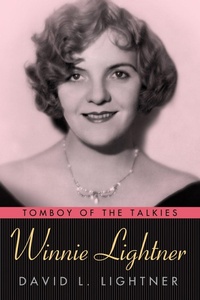
Winnie Lightner
Tomboy of the Talkies
Published on 30. December 2016
Book
Hardback
288 pages
978-1-4968-0983-4 (ISBN)
Description
Winnie Lightner (1899-1971) stood out as the first great female comedian of the talkies. Blessed with a superb singing voice and a gift for making wisecracks and rubber faces, she rose to stardom in vaudeville and on Broadway. Then, at the dawn of the sound era, she became the first person in motion picture history to have her spoken words, the lyrics to a song, censored.
In Winnie Lightner: Tomboy of the Talkies, David L. Lightner shows how Winnie Lightner's hilarious performance in the 1929 musical comedy Gold Diggers of Broadway made her an overnight sensation. She went on to star in seven other Warner Bros. features. In the best of them, she was the comic epitome of a strident feminist, dominating men and gleefully spurning conventional gender norms and moral values. So tough was she, the studio billed her as ""the tomboy of the talkies.""
When the Great Depression rendered moviegoers hostile toward feminism, Warner Bros. tried to craft a new image of her as glamorous and sexy. Executives assigned her contradictory roles in which she was empowered in the workplace but submissive to her male partner at home. The new persona flopped at the box office, and Lightner's stardom ended. In four final movies, she played supporting roles as the loudmouthed roommate and best friend of actresses Loretta Young, Joan Crawford, and Mona Barrie.
Following her retirement in 1934, Lightner faded into obscurity. Many of her films were damaged or even lost entirely. At long last, this biography gives Winnie Lightner the recognition she deserves as a notable figure in film history, in women's history, and in the history of show business.
In Winnie Lightner: Tomboy of the Talkies, David L. Lightner shows how Winnie Lightner's hilarious performance in the 1929 musical comedy Gold Diggers of Broadway made her an overnight sensation. She went on to star in seven other Warner Bros. features. In the best of them, she was the comic epitome of a strident feminist, dominating men and gleefully spurning conventional gender norms and moral values. So tough was she, the studio billed her as ""the tomboy of the talkies.""
When the Great Depression rendered moviegoers hostile toward feminism, Warner Bros. tried to craft a new image of her as glamorous and sexy. Executives assigned her contradictory roles in which she was empowered in the workplace but submissive to her male partner at home. The new persona flopped at the box office, and Lightner's stardom ended. In four final movies, she played supporting roles as the loudmouthed roommate and best friend of actresses Loretta Young, Joan Crawford, and Mona Barrie.
Following her retirement in 1934, Lightner faded into obscurity. Many of her films were damaged or even lost entirely. At long last, this biography gives Winnie Lightner the recognition she deserves as a notable figure in film history, in women's history, and in the history of show business.
More details
Series
Language
English
Place of publication
Jackson
United States
Target group
College/higher education
Professional and scholarly
Product notice
sewn/stitched
Cloth over boards
With dust jacket
Illustrations
43 b&w illustrations, filmography
Dimensions
Height: 234 mm
Width: 157 mm
Thickness: 25 mm
Weight
544 gr
ISBN-13
978-1-4968-0983-4 (9781496809834)
Copyright in bibliographic data and cover images is held by Nielsen Book Services Limited or by the publishers or by their respective licensors: all rights reserved.
Schweitzer Classification
Other editions
Additional editions
E-Book
12/2016
Penguin Random House South Africa
€24.49
Available for download
Person
David L. Lightner, Edmonton, Alberta, Canada, is professor emeritus of history at the University of Alberta. He is the author of Slavery and the Commerce Power: How the Struggle against the Interstate Slave Trade Led to the Civil War; Asylum, Prison, and Poorhouse: The Writings and Reform Work of Dorothea Dix in Illinois; and Labor on the Illinois Central Railroad, 1852-1900: The Evolution of an Industrial Environment. He became interested in Winnie Lightner because of their shared surname, but he is not related to her.