

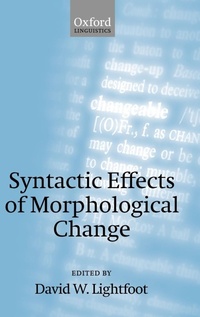
Syntactic Effects of Morphological Change
Published on 27. June 2002
Book
Hardback
424 pages
978-0-19-925068-4 (ISBN)
Description
This book presents the latest thinking on the nature and causes of language change. The authors consider how far changes in morphology (e.g. inflectional word endings) cause changes in syntax (e.g. word order). They examine such phenomena from the perspective of current syntactic and psycholinguistic theory, in particular addressing the issues raised by the hypothesis that grammatical change is driven by how children acquire language. Theoretical questions are discussed in the context of change in a wide variety of languages over a range of periods. The authors are distinguished scholars from the USA, Canada, Japan, Brazil, Australia, Portugal, Italy, Greece, and the UK.
More details
Language
English
Place of publication
Oxford
United Kingdom
Target group
College/higher education
Professional and scholarly
Illustrations
numerous figures and tables
Dimensions
Height: 240 mm
Width: 161 mm
Thickness: 27 mm
Weight
798 gr
ISBN-13
978-0-19-925068-4 (9780199250684)
Copyright in bibliographic data and cover images is held by Nielsen Book Services Limited or by the publishers or by their respective licensors: all rights reserved.
Schweitzer Classification
Other editions
Additional editions
David W. Lightfoot
Syntactic Effects of Morphological Change
Book
06/2002
Oxford University Press
€72.20
Shipment within 15-20 days
Person
David W. Lightfoot is Dean of the Graduate School at Georgetown University. Until recently he was Professor of Linguistics and Associate Director of the Neural and Cognitive Science Program at the University of Maryland with a joint appointment as Professor of Linguistics at the University of Reading. His books include Principles of Diachronic Syntax (CUP 1979), The Language Lottery: Toward a Biology of Grammars (MIT Press, 1982), How to Set Parameters: Arguments from Language Change (MIT Press, 1991), and The Development of Language: Acquisition, Change, and Evolution (Blackwell, 1999).
Content
1. Introduction ; PART I: MORPHOLOGICALLY DRIVEN CHANGES ; 2. The History of the Future ; 3. Case and Middle English Genitive Noun Phrases ; 4. Split Constituents Within NP in the History of English: Commentary on Allen ; 5. Inflectional Morphology and the Loss of Verb-Second in English ; 6. The Rise of the to Dative in Middle English ; 7. Double Objects and Morphological Triggers for Syntactic Case ; 8. Cue-Based Change: Inflection and Subjects in the History of Portuguese Infinitives ; 9. Loss of Verbal Morphology and the Status of Referential Null Subjects in Brazilian Portuguese ; 10. Loss of Overt Wh-Movement in Old Japanese ; 11. Changes in Subject Case Marking in Icelandic ; PART II: INDIRECT LINKS BETWEEN MORPHOLOGY AND SYNTAX ; 12. A Reinterpretation of the loss of verb-second in Welsh ; 13. The Loss of IP-Scrambling in Portuguese: Clause Structure, Word Order Variation and Change ; PART III: INDEPENDENT CHANGES IN MOVEMENT OPERATIONS ; 14. Residual V-to-I ; 15. Syntax and Morphology are Different: Commentary on Jonas ; 16. Verb-Object Order in Old English: Variation as Grammatical Competition ; 17. VO or OV? That's the Underlying Question: Commentary on Pintzuk ; 18. Movement, Morphology, and Learnability ; 19. Object Shift and Holmberg's Generalization in the History of Norwegian ; PART IV: COMPUTER SIMULATIONS ; 20. The Computational Study of Diachronic Linguistics ; 21. Grammar Competition and Language Change