

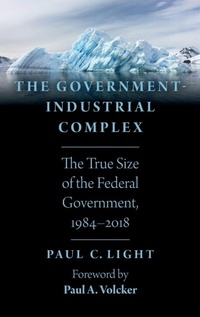
The Government-Industrial Complex
The True Size of the Federal Government, 1984-2018
Published on 31. January 2019
Book
Hardback
256 pages
978-0-19-085179-8 (ISBN)
Description
In his 1961 Farewell Address, President Eisenhower famously referred to the emergence of a "military-industrial complex" so powerful that it threatened to warp America's political institutions and economy. However, the military was not the only part of government that was growing by leaps and bounds. Over the next half century, the size of the federal government expanded at a breakneck pace in almost every category, and today the government as a whole is genuinely elephantine.
In The Government-Industrial Complex, government-reform expert Paul Light not only traces the expansion of the federal government over the past few decades, but also explains why it has taken the shape that it has. In marked contrast to governments in other wealthy countries, America's relies heavily on private contractors over actual government employees. Drawing upon Eisenhower's description of the military-industrial complex, Light shows that the federal government now depends on more than 9 million contract employees to faithfully execute the laws. To do this, he offers short histories of the roles of various presidents and the impacts of war on the changing size of government. He also highlights the Trump administration's early strategies on downsizing and deconstructing government.
In this landmark account of the nature and scope of national governance in the United States, Light stresses that achieving the right balance between public and private responsibilities is key in making government both more efficient and more responsive.
In The Government-Industrial Complex, government-reform expert Paul Light not only traces the expansion of the federal government over the past few decades, but also explains why it has taken the shape that it has. In marked contrast to governments in other wealthy countries, America's relies heavily on private contractors over actual government employees. Drawing upon Eisenhower's description of the military-industrial complex, Light shows that the federal government now depends on more than 9 million contract employees to faithfully execute the laws. To do this, he offers short histories of the roles of various presidents and the impacts of war on the changing size of government. He also highlights the Trump administration's early strategies on downsizing and deconstructing government.
In this landmark account of the nature and scope of national governance in the United States, Light stresses that achieving the right balance between public and private responsibilities is key in making government both more efficient and more responsive.
Reviews / Votes
This is an impressive and highly engaging contribution. Scholars should view it as a call to (research) arms; much more attention is clearly needed to unpack the who of government work. * Rachewl Augustine Potter, University of Virginia, Congress & the Presidency *More details
Language
English
Place of publication
New York
United States
Target group
College/higher education
Professional and scholarly
Illustrations
2 illustrations
Dimensions
Height: 240 mm
Width: 161 mm
Thickness: 18 mm
Weight
546 gr
ISBN-13
978-0-19-085179-8 (9780190851798)
Copyright in bibliographic data and cover images is held by Nielsen Book Services Limited or by the publishers or by their respective licensors: all rights reserved.
Schweitzer Classification
Other editions
Additional editions
E-Book
11/2018
OUP eBook
€12.49
Available for download
E-Book
11/2018
OUP eBook
€16.49
Available for download
Person
Paul C. Light is the Paulette Goddard Professor of Public Service at New York Universityas Robert F. Wagner School of Public Service as well as a nonresident senior fellow at the Volcker Alliance and a nonresident senior fellow at the Brookings Institution. Before joining NYU, he was vice president and director of governmental studies at the Brookings Institution and founding director of its Center for Public Service. He has held teaching posts at the University of Virginia, University of Minnesota, and Harvard Universityas John F. Kennedy School of Government. He was also senior adviser to the U.S. Senate Governmental Affairs Committee, associate dean of the Hubert H. Humphrey School of Public Affairs, director of the public policy grant program at the Pew Charitable Trusts from 1995-1998. Light has written 25 books, and is a recognized expert on government reform, legislative history, social innovation, and government by investigation.
Content
Preface
Chapter One: A Warning Renewed
Chapter Two: The True Size of Government
Chapter Three: Pressures on the Dividing Line
Chapter Four: A Proper Blending
Conclusion: The Next-Gen Public Service
Appendix 1: Options for Reform
Endnotes
Chapter One: A Warning Renewed
Chapter Two: The True Size of Government
Chapter Three: Pressures on the Dividing Line
Chapter Four: A Proper Blending
Conclusion: The Next-Gen Public Service
Appendix 1: Options for Reform
Endnotes