

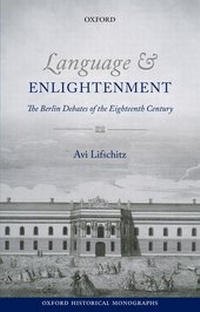
Language and Enlightenment
The Berlin Debates of the Eighteenth Century
Published on 18. February 2016
Book
Paperback/Softback
244 pages
978-0-19-877764-9 (ISBN)
Description
What is the role of language in human cognition? Could we attain self-consciousness and construct our civilization without language? Such were the questions at the basis of eighteenth-century debates on the joint evolution of language, mind, and culture. Language and Enlightenment highlights the importance of language in the social theory, epistemology, and aesthetics of the Enlightenment. While focusing on the Berlin Academy under Frederick the Great, Avi Lifschitz situates the Berlin debates within a larger temporal and geographical framework. He argues that awareness of the historicity and linguistic rootedness of all forms of life was a mainstream Enlightenment notion rather than a feature of the so-called 'Counter-Enlightenment'.
Enlightenment authors of different persuasions investigated whether speechless human beings could have developed their language and society on their own. Such inquiries usually pondered the difficult shift from natural signs like cries and gestures to the artificial, articulate words of human language. This transition from nature to artifice was mirrored in other domains of inquiry, such as the origins of social relations, inequality, the arts, and the sciences. By examining a wide variety of authors - Leibniz, Wolff, Condillac, Rousseau, Michaelis, and Herder, among others - Language and Enlightenment emphasises the open and malleable character of the eighteenth-century Republic of Letters. The language debates demonstrate that German theories of culture and language were not merely a rejection of French ideas. New notions of the genius of language and its role in cognition were constructed through a complex interaction with cross-European currents, especially via the prize contests at the Berlin Academy.
Enlightenment authors of different persuasions investigated whether speechless human beings could have developed their language and society on their own. Such inquiries usually pondered the difficult shift from natural signs like cries and gestures to the artificial, articulate words of human language. This transition from nature to artifice was mirrored in other domains of inquiry, such as the origins of social relations, inequality, the arts, and the sciences. By examining a wide variety of authors - Leibniz, Wolff, Condillac, Rousseau, Michaelis, and Herder, among others - Language and Enlightenment emphasises the open and malleable character of the eighteenth-century Republic of Letters. The language debates demonstrate that German theories of culture and language were not merely a rejection of French ideas. New notions of the genius of language and its role in cognition were constructed through a complex interaction with cross-European currents, especially via the prize contests at the Berlin Academy.
Reviews / Votes
This impressive monograph provides a powerful and original contribution to the cultural history of Prussia and sustains its author's claim that 'The Academy became a major centre of intellectual regeneration in Germany'. * Tim Blanning, English Historical Review * Lifschitz has made an important contribution to our understanding of the Aufklaerung. His book will be required reading for anyone who now wishes to study the subject. At the same time his work will have much to say to scholars of the European Enlightenment and to anyone interested in the history of linguistic thought in the eighteenth century. * Joachim Whaley, History * Successfully combining the larger picture with thick description of local contexts, Language and Enlightenment is a rich book that will be read with profit by those interested in the philosophy of langugae, the history of ideas, and cultural history alike. * Iwan-Michelangelo D'Aprile, Bulletin of the German Historical Institute, London * Lifschitz's extensive and patient historical analysis ... enriches in many ways our knowledge of the Berlin debates and helps us think in new ways about the authors and works that characterize the age of Enlightenment. * Stefano Gensini, Historiographia Linguistica * This excellent, lucid and stimulating volume compellingly demonstrates the multifaceted complexity and fascination of eighteenth-century grapplings with language in Berlin and beyond ... Language & Enlightenment is a masterly work of intellectual history, taking ideas seriously and summarising them with great lucidity, while always relating them to cultural, social and political aspects. * Adam Sutcliffe, Journal for Eighteenth-Century Studies * Concise and powerful book ... This book does justice to both the general and the particular and as such is a rare find indeed. * Jonathan Sheehan, Journal of Modern History *More details
Series
Language
English
Place of publication
Oxford
United Kingdom
Target group
College/higher education
Dimensions
Height: 216 mm
Width: 140 mm
Thickness: 14 mm
Weight
316 gr
ISBN-13
978-0-19-877764-9 (9780198777649)
Copyright in bibliographic data and cover images is held by Nielsen Book Services Limited or by the publishers or by their respective licensors: all rights reserved.
Schweitzer Classification
Other editions
Additional editions
Book
09/2012
1st Edition
Oxford University Press
€184.80
Shipment within 15-20 days
Person
Avi Lifschitz is Senior Lecturer in European History at University College London (UCL). He has held research fellowships at the Wissenschaftskolleg in Berlin, the Lichtenberg-Kolleg at the University of Goettingen, and the Clark Library at UCLA. He is editor of Engaging with Rousseau (2016) and co-editor of Epicurus in the Enlightenment (2009).
Content
Introduction
1: The mutual emergence of language, mind, and society: an Enlightenment debate
2: Symbolic cognition from Leibniz to the 1760s: theology, aesthetics, and history
3: The evolution and genius of language: debates in the Berlin Academy
4: J. D. Michaelis on language and vowel points: from confessional controversy to naturalism
5: A point of convergence and new departures: the 1759 contest on language and opinions
6: Language and cultural identity: the controversy over Premontval's Preservatif
7: Tackling the naturalistic conundrum: instincts and conjectural history to 1771
8: Conclusion and a glimpse into the future
1: The mutual emergence of language, mind, and society: an Enlightenment debate
2: Symbolic cognition from Leibniz to the 1760s: theology, aesthetics, and history
3: The evolution and genius of language: debates in the Berlin Academy
4: J. D. Michaelis on language and vowel points: from confessional controversy to naturalism
5: A point of convergence and new departures: the 1759 contest on language and opinions
6: Language and cultural identity: the controversy over Premontval's Preservatif
7: Tackling the naturalistic conundrum: instincts and conjectural history to 1771
8: Conclusion and a glimpse into the future