

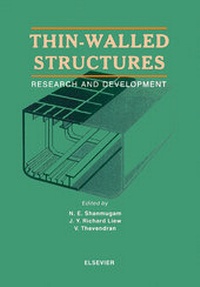
Thin-Walled Structures
Research and Development
Published on 27. November 1998
Book
Hardback
826 pages
978-0-08-043003-4 (ISBN)
Description
Thin-plated structures are used extensively in building construction, automobile, aircraft, shipbuilding and other industries because of a number of favourable factors such as high strength-weight ratio, development of new materials and processes and the availability of efficient analytical methods. This class of structure is made by joining thin plates together at their edges and they rely for their rigidity and strength upon the tremendous stiffness and load-carrying capacity of the flat plates from which they are made. Many of the problems encountered in these structures arise because of the effects of local buckling. The knowledge of various facets of this phenomenon has increased dramatically since the 1960s. Problem areas which were hitherto either too complex for rigorous analysis or whose subtleties were not fully realized have in these years been subjected to intensive study. Great advances have been made in the areas of inelastic buckling. The growth in use of lightweight strong materials, such as fibre-reinforced plastics has also been a contributory factor towards the need for advances in the knowledge of the far post-buckling range. The conference is a sequel to the international conference organised by the University of Strathclyde in December 1996 and this international gathering will provide the opportunity for discussion of recent developments and trends in design of thin-walled structures.
More details
Language
English
Place of publication
Oxford
United Kingdom
Publishing group
Elsevier Science & Technology
Target group
Professional and scholarly
Dimensions
Height: 244 mm
Width: 175 mm
Weight
1490 gr
ISBN-13
978-0-08-043003-4 (9780080430034)
Copyright in bibliographic data and cover images is held by Nielsen Book Services Limited or by the publishers or by their respective licensors: all rights reserved.
Schweitzer Classification
Other editions
Additional editions
E-Book
11/1998
Elsevier
€290.00
Available for download
Persons
J. Y. Richard Liew is a professor in the Department of Civil and Environmental Engineering at the National University of Singapore, Singapore. He is also a chartered engineer in the UK, a professional engineer in Singapore, and a chartered professional engineer of the Association of Southeast Asian Nations. He has co-authored 5 books, more than 400 technical publications, sits on the boards of international journals, holds several honorary positions, and is a key person responsible for the development of Singapore's national annexes for the design and steel and composite structures using Eurocodes 3 and 4.
Content
Section headings and selected papers: Keynote Papers. Smart thin-walled structures (K.P. Chong, B.K. Wada). Light gauge steel framing for house construction (J.M. Davies). Design of steel arches (N.S. Trahair et al.). General Session Papers. Section I: Aluminum. Buckling of aluminum plates (M. Langseth et al.). Section II: Cold-Formed and Light Gauge Steel Structures. Local failures in trapezoidal steel claddings (M. Mahendran, R.B. Tang). Section III: Composite and Ferrocement. Lateral distortional buckling of composite cantilevers (M.A. Bradford). The dynamic response of filled thin-walled steel sections (H.D. Wright, A.W. Mohamed). Section IV: Compression Members. Design procedures for stub-columns (K.Y. Teo, S.M. Chou). Influences of welding imperfections on buckling/ultimate strength of ship bottom plating subjected to combined bi-axial thrust & lateral pressure (T. Yao et al.). Section V: Analysis and Design. A rectangular plate element for ultimate strength analysis (K. Masaoka et al.). Investigation of collapsed rack storage systems (R.H.R. Tide, F.A. Calabrese). Section VI: Perforated Members. Design of perforated plates under in-plane compression (V. Thevendran et al.). Section VII: Shells and Pressure Vessels. Inelastic buckling of a layered conical shell (J. Zielnica). Strength of reticulated shells designed by second-order elastic analysis (S. Kato et al.). Section VIII: Shear and Bending. Dynamic equilibriums of nonprismatic thin-walled beams considering the effects of transverse shear deformations defined on an arbitrary coordinate system (C.N. Chen). Section IX: Tubular Members and Bridge Piers. Cyclic loading test of steel octagonal section pier models (M. Suzuki, T. Aoki). Elasto-plastic instability of steel compression tubular members subjected to cyclically applied bi-directional horizontal loads (E. Watanabe et al.). Author index. Keyword index.