

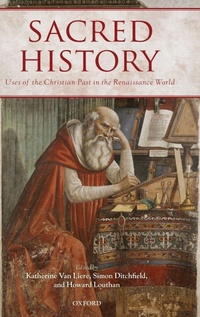
Sacred History
Uses of the Christian Past in the Renaissance World
Published on 24. May 2012
Book
Hardback
368 pages
978-0-19-959479-5 (ISBN)
Description
This volume provides the first geographically broad, comparative survey of early modern 'sacred history', or writing on the history of the Christian Church, its leaders and saints, and its institutional and doctrinal developments, in the two centuries from c. 1450-1650. With deep medieval roots, ecclesiastical history was generally a conservative enterprise, often serving to reinforce confessional, national, regional, dynastic, or local identities. But writers of sacred history innovated in research methods and in techniques of scholarly production, especially after the advent of print. The demand for sacred history was particularly acute in the various movements for religious reform, in both Catholic and Protestant traditions. After the Renaissance, many writers sought to apply humanist critical principles to writing about the church, but the sceptical thrust of humanist historiography threatened to undermine many ecclesiastical traditions, and religious historians often had to wrestle with tensions between criticism and piety.
Thirteen thematic chapters examine the influence of Renaissance humanism, religious reform, and other political, intellectual, and social developments of these two centuries on the writing of ecclesiastical history in its various forms. These diverse genres, inherited from medieval culture, included saints' lives, diocesan histories, national chronicles, and travel accounts. Early chapters examine Catholic and Protestant traditions of sacred historiography in western Europe, especially Italy and Switzerland. Subsequent chapters examine particular instances of sacred historiography in Germany, central Europe, Spain, England, Ireland, France, and Portuguese India; and developments in Christian art historiography and Holy Land antiquarianism.
Thirteen thematic chapters examine the influence of Renaissance humanism, religious reform, and other political, intellectual, and social developments of these two centuries on the writing of ecclesiastical history in its various forms. These diverse genres, inherited from medieval culture, included saints' lives, diocesan histories, national chronicles, and travel accounts. Early chapters examine Catholic and Protestant traditions of sacred historiography in western Europe, especially Italy and Switzerland. Subsequent chapters examine particular instances of sacred historiography in Germany, central Europe, Spain, England, Ireland, France, and Portuguese India; and developments in Christian art historiography and Holy Land antiquarianism.
Reviews / Votes
This volume offers an outstanding review of the emergent asacreda historical writing of the age. It provides indispensable resourcesaand fascinating reading for scholars of early modernity. James M. Weiss, Journal of the American Academy of ReligionMore details
Language
English
Place of publication
Oxford
United Kingdom
Target group
College/higher education
Professional and scholarly
Illustrations
2 maps, 8 black and white images
Dimensions
Height: 240 mm
Width: 161 mm
Thickness: 24 mm
Weight
710 gr
ISBN-13
978-0-19-959479-5 (9780199594795)
Copyright in bibliographic data and cover images is held by Nielsen Book Services Limited or by the publishers or by their respective licensors: all rights reserved.
Schweitzer Classification
Other editions
Additional editions
Katherine van Liere | Simon Ditchfield | Howard Louthan
Sacred History
Uses of the Christian Past in the Renaissance World
E-Book
05/2012
OUP eBook
€79.49
Available for download
Persons
Katherine Van Liere is professor of history at Calvin College in Grand Rapids, Michigan. She specializes in the intellectual and cultural history of early modern Spain, and has published numerous articles on Renaissance humanism, education, and historiography. Her current research focuses on the historical writings of Ambrosio de Morales and Antonio Agustin.
Simon Ditchfield is reader in history at the University of York, England. He specialises in Roman Catholic history writing and uses of the past in early modern society (especially Italy). He is currently completing a history about the making of Roman Catholicism as a world religion for the Oxford History of the Christian Church series to be published by OUP. His next project will be a study of the world history of the Society of Jesus by Daniello Bartoli (1608-85).; Howard Louthan is professor of history at the University of Florida. He specializes in the cultural and intellectual history of early modern central Europe. His most recent book examines the Catholic Reformation in seventeenth and eighteenth-century Bohemia. His current research focuses on the Reformation in Poland.
Simon Ditchfield is reader in history at the University of York, England. He specialises in Roman Catholic history writing and uses of the past in early modern society (especially Italy). He is currently completing a history about the making of Roman Catholicism as a world religion for the Oxford History of the Christian Church series to be published by OUP. His next project will be a study of the world history of the Society of Jesus by Daniello Bartoli (1608-85).; Howard Louthan is professor of history at the University of Florida. He specializes in the cultural and intellectual history of early modern central Europe. His most recent book examines the Catholic Reformation in seventeenth and eighteenth-century Bohemia. His current research focuses on the Reformation in Poland.
Content
PART I: CHURCH HISTORY IN THE RENAISSANCE AND REFORMATION; PART II: NATIONAL HISTORY AND SACRED HISTORY; PART III: USES OF SACRED HISTORY IN THE EARLY MODERN CATHOLIC WORLD