

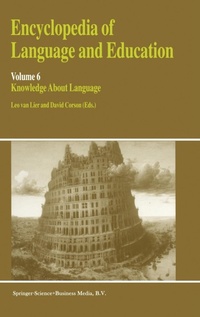
Encyclopedia of Language and Education
Volume 6: Knowledge about Language
1st Edition
Published on 31. December 1999
Book
Hardback
272 pages
978-0-7923-4641-8 (ISBN)
Description
This book contains a collection of more than twenty state-of-the-art overviews of a variety of aspects of language awareness and the role of metalinguistic knowledge in language development and education. The contributions come from more than a dozen countries and offer a balanced perspective on a range of topics, including first and second language acquisition, classroom talk, language use in the multicultural work place, translation, Esperanto, whole language, historical perspectives from the UK and the Netherlands, critical pedagogy, the education of language teachers, the teaching of grammar, phonology, and writing, and others. In all, the book offers a comprehensive perspective on metalinguistic knowledge and processes, and presents a coherent argument for building an element of language awareness into the language curriculum at all educational levels. TOC:From the contents: Introduction.- Part One: Historical and Theoretical Issues.- Part Two: Knowledge about Language and the Langauge Learner.- Part Three: Knowledge about Language, the Curriculum and the Classroom.- Part Four: Teacher Development.- Part Five: Critical Language Awareness.- Index.
More details
Edition
1., Ed.
Language
English
Place of publication
United States
Target group
College/higher education
Professional and scholarly
Research
Product notice
sewn/stitched
Cloth over boards
Illustrations
index
Dimensions
Height: 241 mm
Width: 160 mm
Thickness: 23 mm
Weight
647 gr
ISBN-13
978-0-7923-4641-8 (9780792346418)
Schweitzer Classification
Other editions
Additional editions
Book
05/1999
Kluwer Academic Publishers
€53.49
Shipment within 15-20 days
Content
Part 1 Historical and theoretical issues: language awareness and knowledge about language - an overview, A. van Essen; pedagogical grammar - from prescriptive to descriptive, J. Walmsley; the history of language awareness in the UK, G. Donmall-Hicks; the theory and practice of argument in education, P. Costello. Part 2 Knowledge about language and the language learner: metalinguistic development in first-language acquisition, J.-E. Gombert; phonological awareness and learning to read, T. Nicholson; language awareness and learning styles, S. Jones. Part 3 Knowledge about language, the curriculum and the classroom: whole language - the whole story, K. Goodman; language awareness at the International High School, A. de Fazio; task-based grammar work in second language classes, R. Ellis; language awareness and translation, P. Zabalbeascoa; language awareness and language switching, S. Papaeftyhmiou-Lytra; morphological awareness and the second language learner, D. Sandra; literacy and genre, A. Freedman, P. Richardson; Esperanto and language awareness, M. Fettes. Part 4 Teacher development: the teacher as educational linguist, C. Brumfit; fostering language awareness through in-service teacher education, T. Wright, R. Bolitho; awareness raising about classroom interaction, A. Tsui; assessors' language awareness in the evaluation of academic writing, B. Maylath; the teaching, learning and assessment of argument, S. Mitchell. Part 5 Critical language awareness: critical discourse analysis and educational change, R. Clark, R. Ivanic; awareness of non-standard varieties in the schools, D. Corson; the role of language awareness in critical pedagogy, C.A. Wallace; language awareness, power, and administrator/teacher discourse, D. Waite; the commodification of classroom discourse in postmodern contexts, S. Wortham; language use and awareness in the multicultural work place, K. Malcolm.