

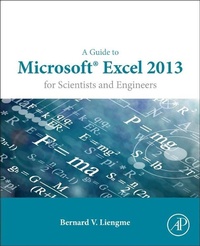
A Guide to Microsoft Excel 2013 for Scientists and Engineers
Published on 16. March 2015
Book
Paperback/Softback
382 pages
978-0-12-802817-9 (ISBN)
Description
Completely updated guide for students, scientists and engineers who want to use Microsoft Excel 2013 to its full potential. Electronic spreadsheet analysis has become part of the everyday work of researchers in all areas of engineering and science. Microsoft Excel, as the industry standard spreadsheet, has a range of scientific functions that can be utilized for the modeling, analysis and presentation of quantitative data. This text provides a straightforward guide to using these functions of Microsoft Excel, guiding the reader from basic principles through to more complicated areas such as formulae, charts, curve-fitting, equation solving, integration, macros, statistical functions, and presenting quantitative data.
More details
Language
English
Place of publication
San Diego
United States
Publishing group
Elsevier Science Publishing Co Inc
Target group
College/higher education
Undergraduate science and engineering students; professional scientists and engineers
Product notice
Paperback (trade)
Unsewn / adhesive bound
Dimensions
Height: 236 mm
Width: 189 mm
Thickness: 25 mm
Weight
804 gr
ISBN-13
978-0-12-802817-9 (9780128028179)
Copyright in bibliographic data and cover images is held by Nielsen Book Services Limited or by the publishers or by their respective licensors: all rights reserved.
Schweitzer Classification
Other editions
Additional editions
Bernard Liengme
A Guide to Microsoft Excel 2013 for Scientists and Engineers
E-Book
03/2015
Academic Press
€30.99
Available for download
Person
Dr. Bernard Liengme attended Imperial College in London and received a BSc & Ph.D. in Chemistry. He also received post-docs at Carnegie-Mellon University in Pittsburgh and the University of British Columbia. He has conducted extensive research in surface chemistry and Mossbauer Effect. He has been at St Francis Xavier University in Canada since 1968 as professor, Associate Dean, and Registrar as well as teaching chemistry and computer science. He is the author of four previous versions of "A Guide to Microsoft Excel for Scientists and Engineers,? most recently the Excel 2013 version.
Content
1. Welcome to Microsoft Excel 2013
2. Basic Operations
3. Printing in Excel
4. Using Functions
5. Decision Functions
6. Data Mining
7. Charting
8. Regression Analysis
9. VBA User-Defined Functions
10. VBA Subroutines
11. Modeling I
12. Using Solver
13. Numerical Integration
14. Differential Equations
15. Modeling II
16. Statistics for Experimenters
2. Basic Operations
3. Printing in Excel
4. Using Functions
5. Decision Functions
6. Data Mining
7. Charting
8. Regression Analysis
9. VBA User-Defined Functions
10. VBA Subroutines
11. Modeling I
12. Using Solver
13. Numerical Integration
14. Differential Equations
15. Modeling II
16. Statistics for Experimenters