

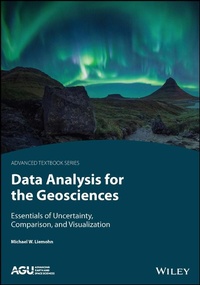
Data Analysis for the Geosciences
Description
Data Analysis for the Geosciences: Essentials of Uncertainty, Comparison, and Visualization is a textbook for upper-level undergraduate STEM students, designed to be their statistics course in a degree program.
This volume provides a comprehensive introduction to data analysis, visualization, and data-model comparisons and metrics, within the framework of the uncertainty around the values. It offers a learning experience based on real data from the Earth, ocean, atmospheric, space, and planetary sciences.
Volume highlights include:
Serves as an initial course in scientific data analysis and hypothesis testing
Focuses on the methods of data processing
Introduces a wide range of analysis techniques
Describes the many ways to compare data with models
Centers on applications rather than derivations
Explains how to select appropriate statistics for meaningful decisions
Explores the importance of the concept of uncertainty
Uses examples from real geoscience observations
Homework problems at the end of chapters
The American Geophysical Union promotes discovery in Earth and space science for the benefit of humanity. Its publications disseminate scientific knowledge and provide resources for researchers, students, and professionals.
<b>An initial course in scientific data analysis and hypothesis testing designed for students in all science, technology, engineering, and mathematics disciplines</b>
<i>Data Analysis for the Geosciences: Essentials of Uncertainty, Comparison, and Visualization</i> is a textbook for upper-level undergraduate STEM students, designed to be their statistics course in a degree program.
This volume provides a comprehensive introduction to data analysis, visualization, and data-model comparisons and metrics, within the framework of the uncertainty around the values. It offers a learning experience based on real data from the Earth, ocean, atmospheric, space, and planetary sciences.
Volume highlights include:
<ul><li>Serves as an initial course in scientific data analysis and hypothesis testing</li><li>Focuses on the methods of data processing</li><li>Introduces a wide range of analysis techniques</li><li>Describes the many ways to compare data with models</li><li>Centers on applications rather than derivations</li><li>Explains how to select appropriate statistics for meaningful decisions</li><li>Explores the importance of the concept of uncertainty</li><li>Uses examples from real geoscience observations</li><li>Homework problems at the end of chapters</li></ul><i>The American Geophysical Union promotes discovery in Earth and space science for the benefit of humanity. Its publications disseminate scientific knowledge and provide resources for researchers, students, and professionals.</i>
More details
Other editions
Additional editions
Person
<b>Michael W. Liemohn, </b>University of Michigan, USA
Content
Preface
Acknowledgments
1 Assessment and Uncertainty: Examples of introductory concepts
2 Plotting Data: Visualizing sets of numbers
3 Uncertainty Analysis: Techniques for propagating uncertainty
4 Centroids and Spreads: Analyzing a set of numbers
5 Assessing Normality: Tests for assessing the Gaussian nature of a distribution
6 Correlating Two Data Sets: Analyzing two sets of numbers together
7 Curve Fitting: Fitting a line between two sets of numbers
8 Data-Moel Comparison Basics: Philosophies of calculating and categorizing metrics
9 Fit Performance Metrics: Data-model comparisons based on exact observed and model values
10 Event Detection Metrics: Comparing observed and modeled number sets when only even status matters
11 Sliding Thresholds; Event detection metrics with a variable event identification
12 Applications of Metrics an Uncertainty: Final advice and introductions to advanced topics
Index