

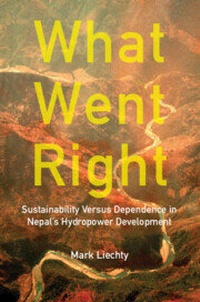
What Went Right
Sustainability Versus Dependence in Nepal's Hydropower Development
Will be published approx. on 31. May 2026
Book
Paperback/Softback
978-1-009-08896-1 (ISBN)
Unfortunately, price unknown
Not yet published
Not available
Description
This book explores why Nepal's hydropower sector is one of its few development success stories. Unlike most other 'developing' countries, in Nepal local firms design and build hydropower facilities using Nepali engineers, builders and labor. Nepal has largely avoided the trap whereby most poor countries are forced to accept energy infrastructure projects that are foreign designed, funded and built - typically resulting in debt, dependency and unsustainability. It traces the struggle between two competing development paradigms: one that emphasizes gradual national human capacity building - at the expense of speed and efficiency - and another that emphasizes rapid, large-scale infrastructure building - at the risk of unsustainability and dependency. At stake is whether what passes for 'development' benefits the countries in which it occurs, or the banks and investors that finance capital-intensive projects. What Went Right brings a vision for sustainable development into vigorous conversation with development strategies that have proven to be less productive.
More details
Other editions
Additional editions
Book
approx. 08/2022
Cambridge University Press
€122.50
Not yet published
E-Book
06/2022
Cambridge University Press
€111.99
Available for download
Person
Author
University of Illinois, Chicago
Mark Liechty is Professor of Anthropology and History at the University of Illinois at Chicago. He is a South Asianist by training with a research specialization in the modern culture and history of Nepal. He is the author of Far Out: Countercultural Seekers and the Tourist Encounter in Nepal, which received the 2017 Kekoo Naoroji Book Award for Himalayan Literature. His work at UIC focuses on world history, South Asian colonial history, culture theory, youth culture, and cultures of the body. He is the co-editor, with Michael Hutt and Stephanie Lotter, of Epicentre to Aftermath: Rebuilding and Remembering in the Wake of Nepal's Earthquakes, forthcoming with the Press in 2021.
Mark Liechty is Professor of Anthropology and History at the University of Illinois at Chicago. He is a South Asianist by training with a research specialization in the modern culture and history of Nepal. He is the author of Far Out: Countercultural Seekers and the Tourist Encounter in Nepal, which received the 2017 Kekoo Naoroji Book Award for Himalayan Literature. His work at UIC focuses on world history, South Asian colonial history, culture theory, youth culture, and cultures of the body. He is the co-editor, with Michael Hutt and Stephanie Lotter, of Epicentre to Aftermath: Rebuilding and Remembering in the Wake of Nepal's Earthquakes, forthcoming with the Press in 2021.
Content
Preface; 1. A corporate vision: Business as development philosophy; 2. Butwal Technical Institute, Tinau, and the origins of the Butwal Power Company; 3. Andhi Khola; 4. Jhimruk; 5. The 'Great Upheaval': Khimti and the limits of the Hoftun hydropower vision; 6. Melamchi and the rush to privatization; 7. Privatization, the long haul; 8. The new BPC: Cultures in conflict; 9. Conclusion: From seed, to plant, to seed; Bibliography, Index.