

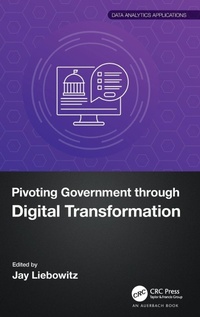
Pivoting Government through Digital Transformation
1st Edition
Published on 16. August 2023
Book
Hardback
218 pages
978-1-032-43990-7 (ISBN)
Description
Affecting every sector and country in the world, digital technology is changing the way citizens engage in society, companies conduct business, and governments deliver public services. The COVID-19 pandemic accelerated the pace of digitalization and exposed such vulnerabilities as inadequate infrastructure, weak regulations, and a scarcity of skilled professionals capable of digitally transforming government. Not immune to the digital revolution, governments are slowly adapting to a digital world. Governments are implementing digital solutions to deliver services to their citizens, make payments, and engage the public.
Focusing on how government can transition more effectively through digital transformation, Pivoting Government Through Digital Transformation covers the following key components:
Setting the stage during the Great Resignation period
Filling the digital talent pipeline
Best practices and vignettes for applying digital transformation in government
Looking ahead towards the future
Key chapter contributors from U.S. and foreign governments, as well as state and local governments, discuss how they are coping with today's environment and how they are using digital transformation efforts to enhance their organization's effectiveness and digital talent pipeline.
With chapters on theory and practice, this groundbreaking book offers an in-depth analysis of the most innovative approaches to e-government and discusses case studies from local, state, and federal government perspectives. This is an essential guide for government employees, scholars, and regular citizens who want to make government work more effectively and democratically in the digital age.
Focusing on how government can transition more effectively through digital transformation, Pivoting Government Through Digital Transformation covers the following key components:
Setting the stage during the Great Resignation period
Filling the digital talent pipeline
Best practices and vignettes for applying digital transformation in government
Looking ahead towards the future
Key chapter contributors from U.S. and foreign governments, as well as state and local governments, discuss how they are coping with today's environment and how they are using digital transformation efforts to enhance their organization's effectiveness and digital talent pipeline.
With chapters on theory and practice, this groundbreaking book offers an in-depth analysis of the most innovative approaches to e-government and discusses case studies from local, state, and federal government perspectives. This is an essential guide for government employees, scholars, and regular citizens who want to make government work more effectively and democratically in the digital age.
More details
Series
Language
English
Place of publication
London
United Kingdom
Publishing group
Taylor & Francis Ltd
Target group
Professional and scholarly
Professional Practice & Development
Illustrations
29 s/w Abbildungen, 29 s/w Zeichnungen, 15 s/w Tabellen
15 Tables, black and white; 29 Line drawings, black and white; 29 Illustrations, black and white
Dimensions
Height: 240 mm
Width: 161 mm
Thickness: 18 mm
Weight
529 gr
ISBN-13
978-1-032-43990-7 (9781032439907)
Copyright in bibliographic data and cover images is held by Nielsen Book Services Limited or by the publishers or by their respective licensors: all rights reserved.
Schweitzer Classification
Other editions
Additional editions
Jay Liebowitz
Pivoting Government through Digital Transformation
E-Book
08/2023
1st Edition
Auerbach
€63.49
Available for download
Jay Liebowitz
Pivoting Government through Digital Transformation
Book
08/2023
1st Edition
Auerbach
€69.30
Shipment within 10-20 days
Jay Liebowitz
Pivoting Government through Digital Transformation
E-Book
08/2023
1st Edition
Auerbach
€63.49
Available for download
Person
Dr. Jay Liebowitz is the Executive-in-Residence for Public Service at Columbia University's Data Science Institute. He was previously a Visiting Professor in the Stillman School of Business and the MS-Business Analytics Capstone & Co-Program Director (External Relations) at Seton Hall University. He previously served as the Distinguished Chair of Applied Business and Finance at Harrisburg University of Science and Technology. Before HU, he was the Orkand Endowed Chair of Management and Technology in the Graduate School at the University of Maryland University College (UMUC). He served as a Full Professor in the Carey Business School at Johns Hopkins University. He was ranked one of the top 10 knowledge management researchers/practitioners out of 11,000 worldwide, and was ranked second in KM Strategy worldwide according to the January 2010 Journal of Knowledge Management. At Johns Hopkins University, he was the founding Program Director for the Graduate Certificate in Competitive Intelligence and the Capstone Director of the MS-Information and Telecommunications Systems for Business Program, where he engaged over 30 organizations in industry, government, and not-for-profits in capstone projects.
Content
1. Digital Government: The Future is Already Here, It's Just Unevenly Distributed 2. Developing a Pipeline and Ecosystem for Digital Transformation: Our Federal Government 3. Capacity Building: The Federal Government's Efforts to Hire and Develop Analytics Staff 4. How Did the Great Resignation Impact Government Jobs? 5. Neurodiversity: An Important Contributor to the Government's Pivot Through Digital Transformation 6. Promoting and Developing Digital Transformation Toward 2030 7. Developing Students from All Backgrounds in Data Science for the Government 8. Data Science Mentoring without Borders 9. Data Science and Technology Trends for Official Statistics: Opportunities and Challenges 10. Challenges Posed by the Digital Transformation Paths of the Online Access Act in Germany: Implementation and the Need to Raise Awareness 11. The Future of Work in Federal Government Requires Telework 12. State and Local Governments as Employers, Information and Communications Technology Roles, and Developing the Future Public Workforce 13. Data Ethics and Social Responsibility