

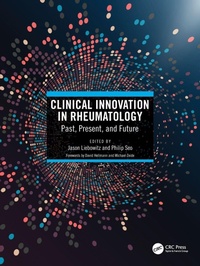
Clinical Innovation in Rheumatology
Past, Present, and Future
1st Edition
Published on 4. October 2022
Book
Paperback/Softback
198 pages
978-1-032-07491-7 (ISBN)
Description
Tremendous advances have been made in the field of rheumatology, profoundly changing our understanding of many rheumatologic conditions and creating a new frontier for effective treatments. This book explains the most significant advances in research and care and speculates as to what will be the future of rheumatology over the next several decades, including challenges and lessons learned from past experiences in the field. It highlights landmark research articles and scientific discoveries, discusses how big data, personalized medicine, new biomarkers for disease, and other technological revolutions will shape the future, making it a must-have resource for physicians from all regions of the world.
Key Features
* Includes concise yet thorough description of the landmark studies and scientific breakthroughs coupled with easy-to-follow organizational structure of chapters that are accessible to readers at different levels of training.
* Brings together world-leading experts to provide a fresh perspective to trainees such as residents and fellows-in-training, as well as more senior clinicians and researchers across the field of rheumatology and in specialties such as cardiology, dermatology, pulmonology, nephrology, and neurology, all of whom care for patients with rheumatologic conditions.
* Allows the authors to imagine and speculate about the evolution of the field of rheumatology in the coming decades. Examples of such speculative possibilities include use of synovial biopsy to predict response to treatment in rheumatoid arthritis, replacement of renal biopsy with urinary proteomics in diagnosing and classifying lupus nephritis, use of new therapeutics to obviate the need for steroids in the treatment of ANCA-associated vasculitis, and the use of machine learning to evaluate subtle changes in imaging for management of inflammatory arthritis.
Key Features
* Includes concise yet thorough description of the landmark studies and scientific breakthroughs coupled with easy-to-follow organizational structure of chapters that are accessible to readers at different levels of training.
* Brings together world-leading experts to provide a fresh perspective to trainees such as residents and fellows-in-training, as well as more senior clinicians and researchers across the field of rheumatology and in specialties such as cardiology, dermatology, pulmonology, nephrology, and neurology, all of whom care for patients with rheumatologic conditions.
* Allows the authors to imagine and speculate about the evolution of the field of rheumatology in the coming decades. Examples of such speculative possibilities include use of synovial biopsy to predict response to treatment in rheumatoid arthritis, replacement of renal biopsy with urinary proteomics in diagnosing and classifying lupus nephritis, use of new therapeutics to obviate the need for steroids in the treatment of ANCA-associated vasculitis, and the use of machine learning to evaluate subtle changes in imaging for management of inflammatory arthritis.
More details
Language
English
Place of publication
London
United Kingdom
Publishing group
Taylor & Francis Ltd
Target group
College/higher education
Professional and scholarly
Postgraduate, Professional, and Professional Reference
Illustrations
5 s/w Abbildungen, 10 farbige Abbildungen, 4 s/w Photographien bzw. Rasterbilder, 5 Farbfotos bzw. farbige Rasterbilder, 1 s/w Zeichnung, 5 farbige Zeichnungen, 27 s/w Tabellen, 5 farbige Tabellen
5 Tables, color; 27 Tables, black and white; 5 Line drawings, color; 1 Line drawings, black and white; 5 Halftones, color; 4 Halftones, black and white; 10 Illustrations, color; 5 Illustrations, black and white
Dimensions
Height: 280 mm
Width: 210 mm
Thickness: 13 mm
Weight
739 gr
ISBN-13
978-1-032-07491-7 (9781032074917)
Copyright in bibliographic data and cover images is held by Nielsen Book Services Limited or by the publishers or by their respective licensors: all rights reserved.
Schweitzer Classification
Other editions
Additional editions
E-Book
10/2022
1st Edition
CRC Press
€81.99
Available for download
E-Book
10/2022
1st Edition
CRC Press
€81.99
Available for download
Book
10/2022
1st Edition
CRC Press
€230.27
Shipment within 10-20 days
Persons
Dr. Jason Liebowitz, MD, attended Johns Hopkins University for his undergraduate studies and was inducted into Phi Beta Kappa. He attended medical school at Johns Hopkins University School of Medicine and completed his Internal Medicine residency at Johns Hopkins Bayview Medical Center, where he was selected as Chief Resident. He completed his rheumatology fellowship at Johns Hopkins University was nominated for the 2019 Distinguished Fellow Award from the American College of Rheumatology.
Dr. Philip Seo is an Associate Professor in the Division of Rheumatology. A graduate of Harvard College and the College of Physicians and Surgeons at Columbia University, Dr. Seo completed his Internal Medicine training as a member of the Osler Medical Service at the Johns Hopkins Hospital. Since then, he has worked at Johns Hopkins in several capacities, including as a hospitalist at Johns Hopkins Bayview Medical Center, and as an Assistant Chief of Service of the Department of Medicine at the Johns Hopkins Hospital, before joining the Division of Rheumatology. Dr. Seo is the Director of the Johns Hopkins Vasculitis Center and Director of the Johns Hopkins Rheumatology Fellowship Program.
Dr. Philip Seo is an Associate Professor in the Division of Rheumatology. A graduate of Harvard College and the College of Physicians and Surgeons at Columbia University, Dr. Seo completed his Internal Medicine training as a member of the Osler Medical Service at the Johns Hopkins Hospital. Since then, he has worked at Johns Hopkins in several capacities, including as a hospitalist at Johns Hopkins Bayview Medical Center, and as an Assistant Chief of Service of the Department of Medicine at the Johns Hopkins Hospital, before joining the Division of Rheumatology. Dr. Seo is the Director of the Johns Hopkins Vasculitis Center and Director of the Johns Hopkins Rheumatology Fellowship Program.
Content
Chapter 1: Rheumatoid Arthritis
Chapter 2: Axial Spondyloarthritis
Chapter 3: Psoriatic arthritis
Chapter 4: Crystalline Arthritis
Chapter 5: Osteoarthritis
Chapter 6: Systemic Lupus Erythematosus
Chapter 7: Sjogren's Disease
Chapter 8: Scleroderma
Chapter 9: Myositis
Chapter 10: Vasculitis
Chapter 11: Osteoporosis
Chapter 12: Immune-related Adverse Events: A Novel Paradigm of the Immune System
Chapter 13: Complementary and Alternative Medicine Use in Rheumatic Disease
Chapter 14: COVID-19 and MIS-C
Chapter 2: Axial Spondyloarthritis
Chapter 3: Psoriatic arthritis
Chapter 4: Crystalline Arthritis
Chapter 5: Osteoarthritis
Chapter 6: Systemic Lupus Erythematosus
Chapter 7: Sjogren's Disease
Chapter 8: Scleroderma
Chapter 9: Myositis
Chapter 10: Vasculitis
Chapter 11: Osteoporosis
Chapter 12: Immune-related Adverse Events: A Novel Paradigm of the Immune System
Chapter 13: Complementary and Alternative Medicine Use in Rheumatic Disease
Chapter 14: COVID-19 and MIS-C