

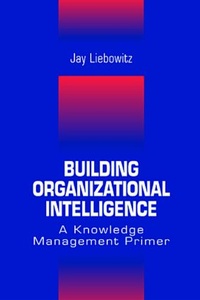
Building Organizational Intelligence
A Knowledge Management Primer
1st Edition
Published on 21. July 1999
Book
Hardback
150 pages
978-0-8493-2036-1 (ISBN)
Description
"Sharing knowledge is power." If ever there were a field to which this applies, it is the knowledge management industry. And in today's highly-competitive, fast-paced business world, corporations, businesses and organizations in both the public and private sectors are constantly searching for new cutting-edge methods and techniques for creating, storing, capturing, managing, organizing, distributing, combining, and retrieving knowledge. But the task of accomplishing such functions is not as simple as it sounds. Jay Liebowitz's Building Organizational Intelligence: A Knowledge Management Primer gives executives, managers, systems analysts, and other knowledge-management professionals the competitive edge they need in achieving that task. In a concise and easy-to-read format, the book describes the concepts, techniques, methodologies, and tools associated with those functions, and includes mini-case studies and vignettes of how industry is developing and applying these functions towards building organizational intelligence.
What's more, the book is packaged with a limited functionality version of "WisdomBuilder," the first in a family of knowledge-management tools that provide a fully integrated solution to the information management and analysis dilemma. Able to run under Windows 95, 98 and NT, "WisdomBuilder" solves the information overload problem by reducing the time and cost of extracting information and other research knowledge from disorganized repositories of heterogeneous data.
What's more, the book is packaged with a limited functionality version of "WisdomBuilder," the first in a family of knowledge-management tools that provide a fully integrated solution to the information management and analysis dilemma. Able to run under Windows 95, 98 and NT, "WisdomBuilder" solves the information overload problem by reducing the time and cost of extracting information and other research knowledge from disorganized repositories of heterogeneous data.
Reviews / Votes
"Written in simple, matter-of-fact language that puts the entire KM movement in an action-oriented context."-Carol H. Tucker
"...As the sub-title says, this is a knowledge primer, written for those who don't have a lot of time to dwell on elaborate explanations, but could use enough guidance to organize their efforts."
- Insite Reviews
More details
Language
English
Place of publication
Bosa Roca
United States
Publishing group
Taylor & Francis Inc
Target group
College/higher education
Professional and scholarly
Professional Practice & Development
Dimensions
Height: 234 mm
Width: 156 mm
Weight
434 gr
ISBN-13
978-0-8493-2036-1 (9780849320361)
Schweitzer Classification
Other editions
Additional editions
Book
07/2020
1st Edition
CRC Press
€85.00
Shipment within 15-20 days
E-Book
08/2019
1st Edition
CRC Press
€78.99
Available for download
E-Book
08/2019
1st Edition
CRC Press
€78.99
Available for download
Person
Dr. Jay Liebowitz is the Robert W. Deutsch Distinguished Professor of Information Systems at the University of Maryland - Baltimore County, and formerly served as Professor of Management Science in the School of Business and Public Management at George Washington University in Washington, D.C. He recently served as Chaired Professor in Artificial Intelligence at the U.S. Army War College. He was selected as the 1996 Computer Educator of the Year by the International Association for Computer Information Systems. He is the Editor-in-Chief of the international journals Expert Systems with Applications (Elsevier) and Failure & Lessons Learned in Information Technology Management (Cognizant Communication Corporation). Liebowitz is the founder and Chair of the World Congress on Expert Systems, and a Fulbright Scholar and recipient of the IEEE-USA FCC Executive Fellowship. Dr. Liebowitz can be reached at liebowit@umbc.edu.
Content
What is Organizational Intelligence? Creating Knowledge. Capturing and Storing Knowledge. Transforming Individual Learning Into Organizational Learning. Combining, Transferring, and Distributing Knowledge. Building A Continuous Learning Culture. Culture: The Key Ingredient. Developing A Knowledge Management Capability
Assessing Knowledge Management Through A Knowledge Audit. Augmenting Organizational Intelligence. Role and Skills for Knowledge Management-Questionnaire. Appendix A: The Intelligent Agent-Based Knowledge Management System for Supporting Multimedia Systems Design on The Web. Appendices
Assessing Knowledge Management Through A Knowledge Audit. Augmenting Organizational Intelligence. Role and Skills for Knowledge Management-Questionnaire. Appendix A: The Intelligent Agent-Based Knowledge Management System for Supporting Multimedia Systems Design on The Web. Appendices