

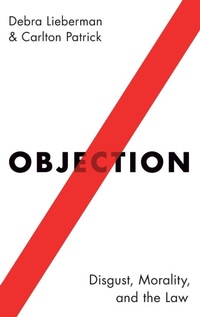
Objection
Disgust, Morality, and the Law
Published on 16. August 2018
Book
Hardback
264 pages
978-0-19-049129-1 (ISBN)
Description
Why do we consider incest wrong, even when it occurs between consenting adults unable to have children? Why are words that gross us out more likely to be deemed "obscene" and denied the protection of the First Amendment? In a world where a gruesome photograph can decisively influence a jury and homosexual behavior is still condemned by some as "unnatural," it is worth asking: is our legal system really governed by the power of reason? Or do we allow a primitive human emotion, disgust, to guide us in our lawmaking?
In Objection, psychologists Debra Lieberman and Carlton Patrick examine disgust and its impact on the legal system to show why the things that we find stomach-turning so often become the things that we render unlawful. Shedding light on the evolutionary and psychological origins of disgust, the authors reveal how ancient human intuitions about what is safe to eat or touch, or who would make an advantageous mate, have become co-opted by moral systems designed to condemn behavior and identify groups of people ripe for marginalization. Over time these moral stances have made their way into legal codes, and disgust has thereby served as the impetus for laws against behaviors almost universally held to be "disgusting" (corpse desecration, bestiality) - and as the implicit justification for more controversial prohibitions (homosexuality, use of pornography). Written with a critical eye on current events, Lieberman and Patrick build a case for a more reasoned approach to lawmaking in a system that often confuses "gross" with "wrong."
In Objection, psychologists Debra Lieberman and Carlton Patrick examine disgust and its impact on the legal system to show why the things that we find stomach-turning so often become the things that we render unlawful. Shedding light on the evolutionary and psychological origins of disgust, the authors reveal how ancient human intuitions about what is safe to eat or touch, or who would make an advantageous mate, have become co-opted by moral systems designed to condemn behavior and identify groups of people ripe for marginalization. Over time these moral stances have made their way into legal codes, and disgust has thereby served as the impetus for laws against behaviors almost universally held to be "disgusting" (corpse desecration, bestiality) - and as the implicit justification for more controversial prohibitions (homosexuality, use of pornography). Written with a critical eye on current events, Lieberman and Patrick build a case for a more reasoned approach to lawmaking in a system that often confuses "gross" with "wrong."
Reviews / Votes
Objection presents a fascinating exposition of the properties, functions, and consequences of disgust, particularly with respect to moral judgment, law, and legal policy. * Keelah E. G. Williams, Academic Studies Press *More details
Language
English
Place of publication
New York
United States
Dimensions
Height: 240 mm
Width: 161 mm
Thickness: 19 mm
Weight
567 gr
ISBN-13
978-0-19-049129-1 (9780190491291)
Copyright in bibliographic data and cover images is held by Nielsen Book Services Limited or by the publishers or by their respective licensors: all rights reserved.
Schweitzer Classification
Other editions
Persons
Debra Lieberman is a Professor of Psychology at the University of Miami, where she is co-director of the Evolution and Human Behavior Laboratory. Dr. Lieberman is a leading researcher in the area of human cognition and behavior from an evolutionary perspective.
Carlton Patrick, JD, PhD, is an Assistant Professor of Legal Studies at the University of Central Florida.
Carlton Patrick, JD, PhD, is an Assistant Professor of Legal Studies at the University of Central Florida.
Content
Foreword by Owen Jones
Part I: Introductions
Chapter 1 Disgust and the Law
Chapter 2 Tools for Excavation: The Evolutionary Framework
Chapter 3 The Emotions
Part II: Disgust
Chapter 4 What to Eat?
Chapter 5 What to Touch?
Chapter 6 With whom to Mate?
Chapter 7 A New Model
Part III: Morality
Chapter 8 Disgust and Morality
Part IV: From Intuitions to Institutions
Chapter 9 Don't Eat, Don't Touch, Don't Mate
Chapter 10 Obscenity
Chapter 11 Disgust as Moral Weapon
Chapter 12 Relationships
Chapter 13 Closing Arguments
Part I: Introductions
Chapter 1 Disgust and the Law
Chapter 2 Tools for Excavation: The Evolutionary Framework
Chapter 3 The Emotions
Part II: Disgust
Chapter 4 What to Eat?
Chapter 5 What to Touch?
Chapter 6 With whom to Mate?
Chapter 7 A New Model
Part III: Morality
Chapter 8 Disgust and Morality
Part IV: From Intuitions to Institutions
Chapter 9 Don't Eat, Don't Touch, Don't Mate
Chapter 10 Obscenity
Chapter 11 Disgust as Moral Weapon
Chapter 12 Relationships
Chapter 13 Closing Arguments