

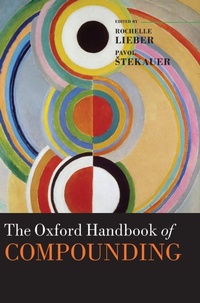
The Oxford Handbook of Compounding
Published on 29. January 2009
Book
Hardback
712 pages
978-0-19-921987-2 (ISBN)
Description
This book presents a comprehensive review of theoretical work on the linguistics and psycholinguistics of compound words and combines it with a series of surveys of compounding in a variety of languages from a wide range of language families.
Compounding is an effective way to create and express new meanings. Compound words are segmentable into their constituents so that new items can often be understood on first presentation. However, as keystone, keynote, and keyboard, and breadboard, sandwich-board, and mortarboard show, the relation between components is often far from straightforward. The question then arises, as to how far compound sequences are analysed at each encounter and how far they are stored in the brain as single lexical items? The nature and processing of compounds thus offer an unusually direct route to how language operates in the mind, as well as providing the means of investigating important aspects of morphology, and lexical semantics, and insights to child language acquisition and the organization of the mental lexicon. This book is the first to report on the state of the art on these and other central topics, including the classification and typology of compounds, and cross-linguistic research on the subject in different frameworks and from synchronic and diachronic perspectives.
Compounding is an effective way to create and express new meanings. Compound words are segmentable into their constituents so that new items can often be understood on first presentation. However, as keystone, keynote, and keyboard, and breadboard, sandwich-board, and mortarboard show, the relation between components is often far from straightforward. The question then arises, as to how far compound sequences are analysed at each encounter and how far they are stored in the brain as single lexical items? The nature and processing of compounds thus offer an unusually direct route to how language operates in the mind, as well as providing the means of investigating important aspects of morphology, and lexical semantics, and insights to child language acquisition and the organization of the mental lexicon. This book is the first to report on the state of the art on these and other central topics, including the classification and typology of compounds, and cross-linguistic research on the subject in different frameworks and from synchronic and diachronic perspectives.
More details
Series
Language
English
Place of publication
Oxford
United Kingdom
Target group
College/higher education
Illustrations
Line drawings, Tables
Dimensions
Height: 250 mm
Width: 175 mm
Thickness: 42 mm
Weight
1387 gr
ISBN-13
978-0-19-921987-2 (9780199219872)
Copyright in bibliographic data and cover images is held by Nielsen Book Services Limited or by the publishers or by their respective licensors: all rights reserved.
Schweitzer Classification
Other editions
Additional editions
Rochelle Lieber | Pavol Stekauer
The Oxford Handbook of Compounding
Book
07/2011
Oxford University Press
€54.46
Shipment within 15-20 days
Rochelle Lieber | Pavol Stekauer
The Oxford Handbook of Compounding
E-Book
07/2011
1st Edition
OUP eBook
€29.49
Available for download
Persons
Rochelle Lieber is Professor of Linguistics in the English Department of the University of New Hampshire. She is the author of On the Organization of the Lexicon (1981), An Integrated Theory of Autosegmental Processes (1987), Deconstructing Morphology (1992), and Morphology and Lexical Semantics (2004). She is co-Editor in Chief of Blackwell's Language and Linguistics Compass.
Pavol Stekauer is Professor of English linguistics in the Department of British and US Studies, Safarik University, Kosice, Slovakia. He is the author of A Theory of Conversion in English (Frankfurt am Main: Peter Lang, 1996), An Onomasiological Theory of English Word-Formation (1998), and English Word-Formation: A History of Research (2000), and Meaning Predictability in Word-Formation (2005)
Professor Lieber and Professor Stekauer are joint editors of A Handbook of Word-Formation (2005).
Pavol Stekauer is Professor of English linguistics in the Department of British and US Studies, Safarik University, Kosice, Slovakia. He is the author of A Theory of Conversion in English (Frankfurt am Main: Peter Lang, 1996), An Onomasiological Theory of English Word-Formation (1998), and English Word-Formation: A History of Research (2000), and Meaning Predictability in Word-Formation (2005)
Professor Lieber and Professor Stekauer are joint editors of A Handbook of Word-Formation (2005).
Content
PART I; PART II