


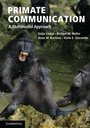
Primate Communication
A Multimodal Approach
Published on 28. November 2013
Book
Paperback/Softback
306 pages
978-0-521-17835-8 (ISBN)
Description
Primates communicate with each other using a wide range of signals: olfactory signals to mark territories, screams to recruit help while fighting, gestures to request food and facial expressions to initiate play. Primate Communication brings together research on all forms of interchange and discusses what we know about primate communication via vocal, gestural, facial, olfactory and integrated multimodal signals in relation to a number of central topics. It explores the morphological, neural and cognitive foundations of primate communication through discussion of cutting-edge research. By considering signals from multiple modalities and taking a unified multimodal approach, the authors offer a uniquely holistic overview of primate communication, discussing what we know, what we don't know and what we may currently misunderstand about communication across these different forms. It is essential reading for researchers interested in primate behaviour, communication and cognition, as well as students of primatology, psychology, anthropology and cognitive sciences.
Reviews / Votes
'Primate Communication is appropriate for a wide audience, from those beginning in the field, to those already immersed in it. ... [It] is an easily digestible, diverse, and thorough review of the importance of investigating - simultaneously - the multiple ways that primates communicate to each other. I highly recommend it for students, instructors and primate enthusiasts alike!' Alex K. Piel, Primate EyeMore details
Language
English
Place of publication
Cambridge
United Kingdom
Target group
College/higher education
Product notice
Paperback (trade)
Illustrations
8 Tables, black and white; 34 Halftones, unspecified; 30 Line drawings, unspecified
Dimensions
Height: 247 mm
Width: 178 mm
Thickness: 17 mm
Weight
618 gr
ISBN-13
978-0-521-17835-8 (9780521178358)
Copyright in bibliographic data and cover images is held by Nielsen Book Services Limited or by the publishers or by their respective licensors: all rights reserved.
Schweitzer Classification
Other editions
Additional editions
Book
11/2013
Cambridge University Press
€98.50
Shipment within 15-20 days
E-Book
11/2013
1st Edition
Cambridge University Press
€47.49
Available for download
Persons
Katja Liebal is Assistant Professor of Evolutionary Psychology at the Freie Universitaet Berlin, Berlin, Germany. Bridget Waller is Senior Lecturer in the Department of Psychology and Acting Director of the Centre for Comparative and Evolutionary Psychology at the University of Portsmouth, Portsmouth, UK. Katie Slocombe is Senior Lecturer in the Psychology Department at the University of York, York, UK and Scientific Director of the Budongo Trail Chimpanzee Exhibit at Edinburgh Zoo, Edinburgh, UK. Anne Burrows is an Associate Professor at Duquesne University, Pittsburgh, PA, USA.
Content
Foreword; Acknowledgements; Part I. Introduction to Primate Communication: 1. What is primate communication?; 2. The morphology of primate communication; 3. The neural substrates of primate communication; Part II. Approaches to Primate Communication: 4. The methods used in primate communication; 5. A multimodal approach to primate communication; Part III. Cognitive Characteristics of Primate Communication: 6. Acquisition; 7. Flexibility; 8. Intentionality; 9. Referentiality; Part IV. Approaches to the Evolution of Primate Communication: 10. A multimodal approach to the evolution of primate communication; Glossary; References; Appendix; Species index; Subject index.