

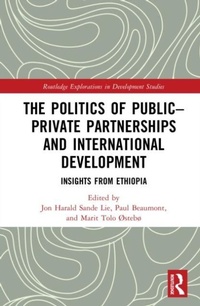
The Politics of Public-Private Partnerships and International Development
Insights from Ethiopia
1st Edition
Will be published approx. on 14. July 2026
Book
Hardback
198 pages
978-1-041-15319-1 (ISBN)
Description
With the launch of Agenda 2030, public-private partnerships (PPPs) were heralded as an important means of realising the UN Sustainable Development Goals and providing more sustainable development financing in the global south.
This book explores PPPs from the bottom up, drawing on extensive empirical research in Ethiopia to illuminate the diversity of practices, arrangements and contradictions that the PPP agenda enables, generates and occludes. Despite the omnipresence of PPP talk among governments and international organisations, donor and recipient agencies, and private actors, there exists no universally agreed definition of PPPs, and in practice they encompass a remarkable diversity of activities and arrangements. This book thoroughly examines PPPs in Ethiopia, considering what actors they bring together, what power dynamics they produce, how the dynamics alter them, what PPPs and such dynamics say about changing state-society relations and how the individual Ps of PPPs get infused with context-specific meaning. By investigating how PPPs play out in practice, the book sheds new light on how this ambiguous but proliferating discourse is changing the meanings, processes and mechanisms of international development.
This book illuminates the unseen consequences of translating bold sustainable development goals into practice and will be of interest to researchers and practitioners of international development.
This book explores PPPs from the bottom up, drawing on extensive empirical research in Ethiopia to illuminate the diversity of practices, arrangements and contradictions that the PPP agenda enables, generates and occludes. Despite the omnipresence of PPP talk among governments and international organisations, donor and recipient agencies, and private actors, there exists no universally agreed definition of PPPs, and in practice they encompass a remarkable diversity of activities and arrangements. This book thoroughly examines PPPs in Ethiopia, considering what actors they bring together, what power dynamics they produce, how the dynamics alter them, what PPPs and such dynamics say about changing state-society relations and how the individual Ps of PPPs get infused with context-specific meaning. By investigating how PPPs play out in practice, the book sheds new light on how this ambiguous but proliferating discourse is changing the meanings, processes and mechanisms of international development.
This book illuminates the unseen consequences of translating bold sustainable development goals into practice and will be of interest to researchers and practitioners of international development.
More details
Series
Language
English
Place of publication
London
United Kingdom
Publishing group
Taylor & Francis Ltd
Target group
College/higher education
Professional and scholarly
Academic and Postgraduate
Illustrations
3 s/w Tabellen, 4 s/w Abbildungen, 4 s/w Zeichnungen
3 Tables, black and white; 4 Line drawings, black and white; 4 Illustrations, black and white
Dimensions
Height: 234 mm
Width: 156 mm
ISBN-13
978-1-041-15319-1 (9781041153191)
Copyright in bibliographic data and cover images is held by Nielsen Book Services Limited or by the publishers or by their respective licensors: all rights reserved.
Schweitzer Classification
Persons
Jon Harald Sande Lie is a social anthropologist and research professor at the Norwegian Institute of International Affairs (NUPI) in Oslo, where he also heads the Research Group for Peace, Conflict and Development. Through his research focus on the international development apparatus and its effects and articulations in Ethiopia, Uganda and the World Bank, he explores issues related to state formation, politics, power and resistance, and partnerships and public-private relations. He is the project manager and principal investigator of the Public-Private Development Interfaces in Ethiopia project, funded by the Research Council of Norway (grant no. 315356).
Paul Beaumont is a senior researcher at NUPI and leads the European Research Council-funded research project Navigating the Era of Indicators (2025-2030). His research interests include the (dis)functioning of international institutions, dubious quantified performance indicators and hierarchies in world politics. Paul has published two monographs: Performing Nuclear Weapons: How Britain Made its Bomb Make Sense (2021) and The Grammar of Status Competition: International Hierarchies and Domestic Politics (2024).
Marit Tolo Ostebo is an associate professor of anthropology at the University of Florida. Her focal point of interest is the anthropology of policy, international development and critical global health. Her work explores the relationships between the normative frameworks, policies, models and stories that circulate within the policy world and the complex realities that exist on the ground. She integrates perspectives from multiple specialties including anthropology of policy, anthropology of religion, gender studies, digital anthropology, medical anthropology and science and technology studies and has focused on policy models and modelling communities, translations of gender equality, the interplay between religion and development, the relationship between politics and health research and - more recently - global oncology and PPPs. Her research is usually multi-sited and transnational in nature, with a primary geographical focus in Ethiopia, where she has conducted anthropological fieldwork since 2005.
Paul Beaumont is a senior researcher at NUPI and leads the European Research Council-funded research project Navigating the Era of Indicators (2025-2030). His research interests include the (dis)functioning of international institutions, dubious quantified performance indicators and hierarchies in world politics. Paul has published two monographs: Performing Nuclear Weapons: How Britain Made its Bomb Make Sense (2021) and The Grammar of Status Competition: International Hierarchies and Domestic Politics (2024).
Marit Tolo Ostebo is an associate professor of anthropology at the University of Florida. Her focal point of interest is the anthropology of policy, international development and critical global health. Her work explores the relationships between the normative frameworks, policies, models and stories that circulate within the policy world and the complex realities that exist on the ground. She integrates perspectives from multiple specialties including anthropology of policy, anthropology of religion, gender studies, digital anthropology, medical anthropology and science and technology studies and has focused on policy models and modelling communities, translations of gender equality, the interplay between religion and development, the relationship between politics and health research and - more recently - global oncology and PPPs. Her research is usually multi-sited and transnational in nature, with a primary geographical focus in Ethiopia, where she has conducted anthropological fieldwork since 2005.
Content
1 Unravelling the Ps in public-private partnerships for development; 2 Tracing the travels of a development model: PPPs and Ethiopia's selective learning; 3 The 'private' in Ethiopia's PPPs: a history of the present; 4 In search of alternative development funding: PPPs between technocratic restraint and political urgency; 5 Theorising points of convergence and divergence: Perspectives on PPPs and other public-private collaborations in Ethiopia; 6 The virus is good to think with: reimagining PPPs in Ethiopia and beyond; 7 From synergy to subsidy: the cultural problem of public-private partnerships in international development; 8 Industrialisation and industrial development policies in Ethiopia: the unfinished search for alternatives; 9 Productive boundaries: the public-private divide in Ethiopia's SEZs; 10 Conclusion: public-private relations in the wild