

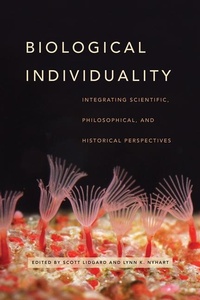
Biological Individuality
Integrating Scientific, Philosophical, and Historical Perspectives
Published on 24. May 2017
Book
Paperback/Softback
400 pages
978-0-226-44645-5 (ISBN)
Description
Individuals are things that everybody knows or thinks they do. Yet even scholars who practice or analyze the biological sciences often cannot agree on what an individual is and why. One reason for this disagreement is that the many important biological individuality concepts serve very different purposes defining, classifying, or explaining living structure, function, interaction, persistence, or evolution. Indeed, as the contributors to Biological Individuality reveal, nature is too messy for simple definitions of this concept, organisms too quirky in the diverse ways they reproduce, function, and interact, and human ideas about individuality too fraught with philosophical and historical meaning. Bringing together biologists, historians, and philosophers, this book provides a multifaceted exploration of biological individuality that identifies leading and less familiar perceptions of individuality both past and present, what they are good for, and in what contexts. Biological practice and theory recognize individuals at myriad levels of organization, from genes to organisms to symbiotic systems.
We depend on these notions of individuality to address theoretical questions about multilevel natural selection and Darwinian fitness; to illuminate empirical questions about development, function, and ecology; to ground philosophical questions about the nature of organisms and causation; and to probe historical and cultural circumstances that resonate with parallel questions about the nature of society. Charting an interdisciplinary research agenda that broadens the frameworks in which biological individuality is discussed, this book makes clear that in the realm of the individual, there is not and should not be a direct path from biological paradigms based on model organisms through to philosophical generalization and historical reification.
We depend on these notions of individuality to address theoretical questions about multilevel natural selection and Darwinian fitness; to illuminate empirical questions about development, function, and ecology; to ground philosophical questions about the nature of organisms and causation; and to probe historical and cultural circumstances that resonate with parallel questions about the nature of society. Charting an interdisciplinary research agenda that broadens the frameworks in which biological individuality is discussed, this book makes clear that in the realm of the individual, there is not and should not be a direct path from biological paradigms based on model organisms through to philosophical generalization and historical reification.
More details
Language
English
Place of publication
Chicago
United States
Publishing group
The University of Chicago Press
Target group
College/higher education
Professional and scholarly
Product notice
Paperback (trade)
Unsewn / adhesive bound
Dimensions
Height: 226 mm
Width: 149 mm
Thickness: 40 mm
Weight
505 gr
ISBN-13
978-0-226-44645-5 (9780226446455)
Copyright in bibliographic data and cover images is held by Nielsen Book Services Limited or by the publishers or by their respective licensors: all rights reserved.
Schweitzer Classification
Other editions
Additional editions
Lidgard Scott Lidgard | Nyhart Lynn K. Nyhart
Biological Individuality
Integrating Scientific, Philosophical, and Historical Perspectives
E-Book
05/2017
1st Edition
University of Chicago Press
€35.49
Available for download
Persons
Scott Lidgard is the MacArthur Associate Curator of Fossil Invertebrates in the Integrative Research Center at the Field Museum, Chicago, and a lecturer in the Committee on Evolutionary Biology at the University of Chicago. He is coeditor of Evolutionary Patterns: Growth, Form and Tempo in the Fossil Record, also published by the University of Chicago Press. He lives in Skokie, IL. Lynn K. Nyhart is the Vilas-Bablitch-Kelch Distinguished Achievement Professor of the History of Science at the University of Wisconsin Madison. She is the author, most recently, of Modern Nature: The Rise of the Biological Perspective in Germany, also published by the University of Chicago Press. She lives in Madison, WI.