

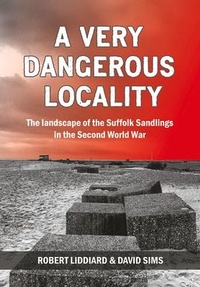
A Very Dangerous Locality
The Landscape of the Suffolk Sandlings in the Second World War
Published on 1. November 2018
Book
Paperback/Softback
320 pages
978-1-912260-08-9 (ISBN)
Description
This book examines the landscape archaeology of the Second World War on the section of the east coast of England known as the Suffolk Sandlings (the coastal strip from Lowestoft to Felixstowe), an area unusually rich in military archaeology. It was in the front line of Britain's defences against invasion throughout the war and as a training ground it was the setting for nationally important exercises in the lead-up to the D-Day landings. In 1944 it also played a major role in Operation 'Diver', the defence against the flying bomb. The Sandlings is therefore an ideal testbed for much wider questions about the militarisation of the landscape during the Second World War.
This important new study considers how this area was transformed in the course of the conflict by synthesising an extensive range of sources, including the physical remains of defences and training, aerial photographs, the war diaries of military units on the coast, oral history and artistic representations. What emerges is the most detailed account to date of a coastal landscape during the Second World War.
A highly innovative interdisciplinary study, this holistic approach reveals in astonishing detail the struggle to build defences in 1940, the dramatic reorganisation of those defences in 1941? 2 and the slow transformation of the military landscape from one of defence to one where troops prepared for the offensive. The reader is shown not just a new view of the wartime landscape, but a new methodology for the study of conflict landscapes more broadly; in this the book makes a major contribution to scholarship.
Richly illustrated with plans, maps and wartime photographs - many published for the first time - the book presents a vivid picture of a landscape in a crucial period in its history and will be of great interest to military historians, landscape archaeologists and all those with an interest in the area.
This important new study considers how this area was transformed in the course of the conflict by synthesising an extensive range of sources, including the physical remains of defences and training, aerial photographs, the war diaries of military units on the coast, oral history and artistic representations. What emerges is the most detailed account to date of a coastal landscape during the Second World War.
A highly innovative interdisciplinary study, this holistic approach reveals in astonishing detail the struggle to build defences in 1940, the dramatic reorganisation of those defences in 1941? 2 and the slow transformation of the military landscape from one of defence to one where troops prepared for the offensive. The reader is shown not just a new view of the wartime landscape, but a new methodology for the study of conflict landscapes more broadly; in this the book makes a major contribution to scholarship.
Richly illustrated with plans, maps and wartime photographs - many published for the first time - the book presents a vivid picture of a landscape in a crucial period in its history and will be of great interest to military historians, landscape archaeologists and all those with an interest in the area.
More details
Language
English
Place of publication
Hertford
United Kingdom
Product notice
Paperback (trade)
Unsewn / adhesive bound
Illustrations
160 maps and illustrations, both colour and black and white
Dimensions
Height: 241 mm
Width: 168 mm
Thickness: 25 mm
Weight
930 gr
ISBN-13
978-1-912260-08-9 (9781912260089)
Copyright in bibliographic data and cover images is held by Nielsen Book Services Limited or by the publishers or by their respective licensors: all rights reserved.
Schweitzer Classification
Persons
Robert Liddiard is Professor of History at the University of East Anglia and the author of many books on the history of both landscape and fortifications.
David Sims is an Honorary Research Fellow in History at the University of East Anglia.
David Sims is an Honorary Research Fellow in History at the University of East Anglia.
Content
1 A regional landscape
2 Crisis on the coastline, 1939-40
3 Consolidation and reorganisation, 1941-42
4 The landscape of air defence, 1939-1945
5 Training and defence works, 1940-43
6 Preparing for Overlord, 1943-44
7 The face of battle
8 The civilian landscape
9 From eyesore to archaeology
2 Crisis on the coastline, 1939-40
3 Consolidation and reorganisation, 1941-42
4 The landscape of air defence, 1939-1945
5 Training and defence works, 1940-43
6 Preparing for Overlord, 1943-44
7 The face of battle
8 The civilian landscape
9 From eyesore to archaeology