

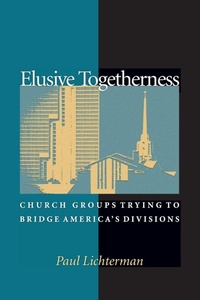
Elusive Togetherness
Church Groups Trying to Bridge America's Divisions
Published on 25. July 2005
Book
Paperback/Softback
344 pages
978-0-691-09651-3 (ISBN)
Description
Many scholars and citizens alike have counted on civic groups to create broad ties that bind society. Some hope that faith-based civic groups will spread their reach as government retreats. Yet few studies ask how, if at all, civic groups reach out to their wider community. Can religious groups--long central in civic America--create broad, empowering social ties in an unequal, diverse society? Over three years, Paul Lichterman studied nine liberal and conservative Protestant-based volunteering and advocacy projects in a mid-sized American city. He listened as these groups tried to create bridges with other community groups, social service agencies, and low-income people, just as the 1996 welfare reforms were taking effect. Counter to long-standing arguments, Lichterman discovered that powerful customs of interaction inside the groups often stunted external ties and even shaped religion's impact on the groups. Comparing groups, he found that successful bridges outward depend on group customs which invite reflective, critical discussion about a group's place amid surrounding groups and institutions.
Combining insights from Alexis de Tocqueville, John Dewey, and Jane Addams with contemporary sociology, Elusive Togetherness addresses enduring questions about civic and religious life that elude the popular "social capital" concept. To create broad civic relationships, groups need more than the right religious values, political beliefs, or resources. They must learn new ways of being groups.
Combining insights from Alexis de Tocqueville, John Dewey, and Jane Addams with contemporary sociology, Elusive Togetherness addresses enduring questions about civic and religious life that elude the popular "social capital" concept. To create broad civic relationships, groups need more than the right religious values, political beliefs, or resources. They must learn new ways of being groups.
Reviews / Votes
Winner of the 2006 Distinguished Book Award, Society for the Scientific Study of Religion Winner of the 2006 Distinguished Scholarly Book Award, Pacific Sociological Association Honorable Mention for the 2006 Book Award, Section on Sociology of Culture, American Sociological Association "This theory-driven ethnographic study demonstrates that there are different sets of cultural customs that enable and constrain what people do in faith-based civic groups, and that cultural discourses do not create meaning all by themselves, but are filtered through the style of the group using the discourse. A valuable addition to the fields of religion and community development."--Choice "In this detailed analysis of actual interaction in Protestant church groups, Paul Lichterman gives us reason to rethink conventional notions of social capital and the place of religion in civic life... This book is a thorough, insightful ethnography."--Katherine Cramer Walsh, Political Science QuarterlyMore details
Series
Language
English
Place of publication
New Jersey
United States
Target group
Professional and scholarly
College/higher education
Product notice
Paperback (trade)
Illustrations
4 tables.
Dimensions
Height: 234 mm
Width: 156 mm
Thickness: 21 mm
Weight
593 gr
ISBN-13
978-0-691-09651-3 (9780691096513)
Copyright in bibliographic data and cover images is held by Nielsen Book Services Limited or by the publishers or by their respective licensors: all rights reserved.
Schweitzer Classification
Other editions
Additional editions
E-Book
06/2015
1st Edition
Princeton University Press
€161.95
Available for download
Person
Paul Lichterman has been Assistant and Associate Professor at the University of Wisconsin-Madison and is now Associate Professor of Sociology and Religion at the University of Southern California. He is the author of "The Search for Political Community: American Activists Reinventing Commitment".
Content
List of Tables and Figures vii Acknowledgments ix Introduction 1 CHAPTER ONE: In Search of the Social Spiral 7 CHAPTER TWO: Studying the Social Spiral 42 CHAPTER THREE: Networkers and Volunteers Reaching Out 60 CHAPTER FOUR: Crying Out: Social Critics 99 CHAPTER FIVE: Christ-like Care: Social Servants 133 CHAPTER SIX: A Social Spiral Winds Outward: Partners 171 CHAPTER SEVEN: Doing Things with Religion in Local Civic Life 216 CHAPTER EIGHT: Doing Things Together: Lessons from Religious Community Service Groups 247 APPENDIX I: Theory and Evidence in a Study of Religious Community Service Groups 264 APPENDIX II: Studying Customs 274 Notes 281 References 303 Index 325