

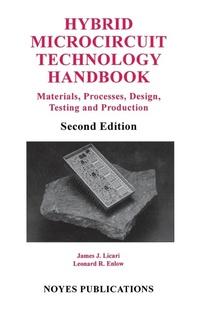
Hybrid Microcircuit Technology Handbook
Materials, Processes, Design, Testing and Production
2nd Edition
Published on 31. December 1998
Book
Hardback
600 pages
978-0-8155-1423-7 (ISBN)
Description
The Hybrid Microcircuit Technology Handbook integrates the many diverse technologies used in the design, fabrication, assembly, and testing of hybrid segments crucial to the success of producing reliable circuits in high yields. Among these are: resistor trimming, wire bonding, die attachment, cleaning, hermetic sealing, and moisture analysis. In addition to thin films, thick films, and assembly processes, important chapters on substrate selections, handling (including electrostatic discharge), failure analysis, and documentation are included. A comprehensive chapter of design guidelines will be of value to materials and process engineers, chemists, and electrical engineers who design and test hybrid circuits.
More details
Edition
2nd edition
Language
English
Place of publication
Norwich
United States
Target group
Professional and scholarly
Materials and process engineers, chemists, and electrical engineers who design and test hybrid circuits.
Product notice
Laminated cover
Dimensions
Height: 236 mm
Width: 158 mm
Thickness: 43 mm
Weight
965 gr
ISBN-13
978-0-8155-1423-7 (9780815514237)
Copyright in bibliographic data and cover images is held by Nielsen Book Services Limited or by the publishers or by their respective licensors: all rights reserved.
Schweitzer Classification
Other editions
Additional editions
James J. Licari
Hybrid Microcircuit Technology Handbook
Materials, Processes, Design, Testing and Production
E-Book
12/1998
2nd Edition
William Andrew
€155.00
Available for download
Previous edition

James J. Licari | Leonard R. Enlow
Hybrid Microcircuit Technology Handbook
Materials, Processes, Design, Testing and Production
Book
12/1988
Noyes Publications
€96.55
Article exhausted; check for reprint
Person
has his own consulting firm, AvanTeco, specializing in materials and processes for electronics. He holds a BS in Chemistry from Fordham University and a PhD in Chemistry from Princeton University, where he was a DuPont Senior Fellow. His areas of expertise include materials and processes for electronic applications, primarily for high reliability systems, hybrid microcircuits, printed wiring circuits, and other interconnect packaging technologies. He is an expert on polymeric materials including adhesives, coatings, encapsulants, insulation, reliability based on failure modes and mechanisms. Dr. Licari has had a forty-year career dedicated to the study and advancement of microelectronic materials and processes. Notable achievements throughout this career include conducting the first studies on the reliability and use of die-attach adhesives for microcircuits, which he did in the mid-1970s through the early 1980s, making industry and the government aware of the degrading effects of trace amounts of ionic contaminants in epoxy resins. He conducted early exploratory development on the use of non-noble metal (Cu) thick-film conductor pastes for thick-film ceramic circuits. He carried out the first studies on the use of Parylene as a dielectric and passivation coating for MOS devices and as a particle immobilizer for hybrid microcircuits. He developed the first photo-definable thick-film conductor and resistor pastes that were the forerunners of DuPont's Fodel process, for which he received a patent was granted in England. And he developed the first photocurable epoxy coating using cationic photoinitiation by employing a diazonium salt as the catalytic agent (U.S. 3205157) . The work was referenced as pioneering work in a review article by J.V. Crivello "The Discovery ad Development of Onium Salt Cationic Photoinitiators,? J. Polymer Chemistry (1999)
Content
IntroductionSubstratesThin Film ProcessesThick Film ProcessesResistor TrimmingParts SelectionAssembly ProcessesTestingHandling and Clean RoomsDesign GuidelinesDocumentation and SpecificationsFailure AnalysisMultichip Modules: A New Breed of Hybrid MicrocircuitsReferencesIndex