

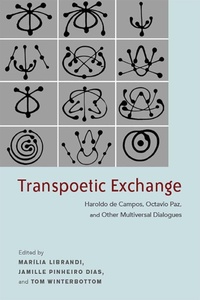
Transpoetic Exchange
Haroldo De Campos, Octavio Paz, and Other Multiversal Dialogues
Published on 12. June 2020
Book
Hardback
190 pages
978-1-68448-217-7 (ISBN)
Description
Transpoetic Exchange illuminates the poetic interactions between Octavio Paz (1914-1998) and Haroldo de Campos (1929-2003) from three perspectives--comparative, theoretical, and performative. The poem Blanco by Octavio Paz, written when he was ambassador to India in 1966, and Haroldo de Campos' translation (or what he calls a "transcreation") of that poem, published as Transblanco in 1986, as well as Campos' GalAxias, written from 1963 to 1976, are the main axes around which the book is organized.
The volume is divided into three parts. "Essays" unites seven texts by renowned scholars who focus on the relationship between the two authors, their impact and influence, and their cultural resonance by exploring explore the historical background and the different stylistic and cultural influences on the authors, ranging from Latin America and Europe to India and the U.S. The second section, "Remembrances," collects four experiences of interaction with Haroldo de Campos in the process of transcreating Paz's poem and working on Transblanco and GalAxias. In the last section, "Poems," five poets of international standing--Jerome Rothenberg, Antonio Cicero, Keijiro Suga, AndrE Vallias, and Charles Bernstein.
Paz and Campos, one from Mexico and the other from Brazil, were central figures in the literary history of the second half of the 20th century, in Latin America and beyond. Both poets signal the direction of poetry as that of translation, understood as the embodiment of otherness and of a poetic tradition that every new poem brings back as a Babel re-enacted.
This volume is a print corollary to and expansion of an international colloquium and poetic performance held at Stanford University in January 2010 and it offers a discussion of the role of poetry and translation from a global perspective. The collection holds great value for those interested in all aspects of literary translation and it enriches the ongoing debates on language, modernity, translation and the nature of the poetic object.
Published by Bucknell University Press. Distributed worldwide by Rutgers University Press.
The volume is divided into three parts. "Essays" unites seven texts by renowned scholars who focus on the relationship between the two authors, their impact and influence, and their cultural resonance by exploring explore the historical background and the different stylistic and cultural influences on the authors, ranging from Latin America and Europe to India and the U.S. The second section, "Remembrances," collects four experiences of interaction with Haroldo de Campos in the process of transcreating Paz's poem and working on Transblanco and GalAxias. In the last section, "Poems," five poets of international standing--Jerome Rothenberg, Antonio Cicero, Keijiro Suga, AndrE Vallias, and Charles Bernstein.
Paz and Campos, one from Mexico and the other from Brazil, were central figures in the literary history of the second half of the 20th century, in Latin America and beyond. Both poets signal the direction of poetry as that of translation, understood as the embodiment of otherness and of a poetic tradition that every new poem brings back as a Babel re-enacted.
This volume is a print corollary to and expansion of an international colloquium and poetic performance held at Stanford University in January 2010 and it offers a discussion of the role of poetry and translation from a global perspective. The collection holds great value for those interested in all aspects of literary translation and it enriches the ongoing debates on language, modernity, translation and the nature of the poetic object.
Published by Bucknell University Press. Distributed worldwide by Rutgers University Press.
Reviews / Votes
"Inspired by the eclectic form of Haroldo de Campos's Transblanco, this volume blends essays by authoritative critics of twentieth century poetics with personal reflections, creative work, and previously unpublished material by and about Haroldo de Campos and Octavio Paz. Transpoetic Exchange holds great value for readers interested in all aspects of poetry and translation and its transnational approach taps into an important current in contemporary literary studies." "Offers an homage to the creative relationship between Octavio Paz and Haroldo de Campos in a volume stemming from the eponymous Stanford University event in Winter 2010 that gathered scholars, artists and poets from all the corners of the globe....Recognizing presence and precedence, Transpoetic Exchange journeys across cultures and traditions, languages and geographies, words and the verbal rawness of blank in the page." (Bulletin of Spanish Studies) "Offers an homage to the creative relationship between Octavio Paz and Haroldo de Campos in a volume stemming from the eponymous Stanford University event in Winter 2010 that gathered scholars, artists and poets from all the corners of the globe....Recognizing presence and precedence, Transpoetic Exchange journeys across cultures and traditions, languages and geographies, words and the verbal rawness of blank in the page." (Bulletin of Spanish Studies)More details
Series
Language
English
Place of publication
United States
Target group
College/higher education
Product notice
Cloth over boards
Illustrations
12 B&W images
Dimensions
Height: 229 mm
Width: 152 mm
Thickness: 20 mm
Weight
4 gr
ISBN-13
978-1-68448-217-7 (9781684482177)
Copyright in bibliographic data and cover images is held by Nielsen Book Services Limited or by the publishers or by their respective licensors: all rights reserved.
Schweitzer Classification
Persons
MarIlia Librandi is a visiting professor of Brazilian studies at Princeton University. She taught in the Department of Iberian and Latin American Cultures, at Stanford University, from 2009 to 2018. She is the author of Writing by Ear: Clarice Lispector and the Aural Novel and of MaranhAo-Manhattan. Ensaios de Literatura Brasileira.
Tom Winterbottom has published numerous articles and essays on Latin American culture, including his first book, A Cultural History of Rio de Janeiro after 1889: Glorious Decadence. He teaches at Stanford University.
Jamille Pinheiro Dias holds a PhD in Modern Languages from the University of SAo Paulo, where she is currently a postdoctoral fellow. She was also a visiting researcher at Stanford University. As a translator, she worked with authors such as Marilyn Strathern, Eduardo Viveiros de Castro, and Alfred Gell.
Tom Winterbottom has published numerous articles and essays on Latin American culture, including his first book, A Cultural History of Rio de Janeiro after 1889: Glorious Decadence. He teaches at Stanford University.
Jamille Pinheiro Dias holds a PhD in Modern Languages from the University of SAo Paulo, where she is currently a postdoctoral fellow. She was also a visiting researcher at Stanford University. As a translator, she worked with authors such as Marilyn Strathern, Eduardo Viveiros de Castro, and Alfred Gell.
Content
Introduction: A Multiversal Experiment
Part I: Essays
Chapter 1: On the Presence of Absence: Octavio Paz's "Blanco"
Enrico Mario SantI
Chapter 2: "Blanco" and Transblanco: Modern and Post-Utopic
JoAo Adolfo Hansen
Chapter 3: Refiguring the Poundian Ideogram: From Octavio Paz's "Blanco/Branco" to Haroldo de Campos's GalAxias
Marjorie Perloff
Chapter 4: Poetry Makes Nothing Happen
MarIlia Librandi
Chapter 5: Haroldo de Campos, Octavio Paz and the Experience of the Avant-Garde
Antonio Cicero
Chapter 6: "Blanco": a version of MallarmE's heritage
Luiz Costa Lima
Chapter 7: Translation and Radical Poetics: The Case of Octavio Paz and the Noigrandres
Odile Cisneros
Part 2: Remembrances
Chapter 8: Pages, Pageants, Portraits, Prospects: an Austin-atious Remembrance of Haroldo de Campos
Charles A. Perrone
Chapter 9: "LogopEia via Goethe via Christopher Middleton": An unknown recording of Haroldo de Campos (Austin, 1981)
Kenneth David Jackson
Chapter 10: Meeting in Austin
Benedito Nunes
Part 3: Poems
Chapter 11: Three Variations on Octavio Paz's "Blanco" and Fifteen Antiphonals for Haroldo de Campos, with a Note on Translation, Transcreation, and Othering
Jerome Rothenberg
Chapter 12: Poems
Antonio Cicero
Chapter 13: Waves of Absence
Keijiro Suga
Chapter 14: Hexaemeron. The Six Faces of Haphazard
AndrE Vallias
Chapter 15: Amberianum [Philosophical Fragments of Caudio Amberian]
Charles Bernstein
Acknowledgments
Bibliography
Index
Notes on Contributors
Part I: Essays
Chapter 1: On the Presence of Absence: Octavio Paz's "Blanco"
Enrico Mario SantI
Chapter 2: "Blanco" and Transblanco: Modern and Post-Utopic
JoAo Adolfo Hansen
Chapter 3: Refiguring the Poundian Ideogram: From Octavio Paz's "Blanco/Branco" to Haroldo de Campos's GalAxias
Marjorie Perloff
Chapter 4: Poetry Makes Nothing Happen
MarIlia Librandi
Chapter 5: Haroldo de Campos, Octavio Paz and the Experience of the Avant-Garde
Antonio Cicero
Chapter 6: "Blanco": a version of MallarmE's heritage
Luiz Costa Lima
Chapter 7: Translation and Radical Poetics: The Case of Octavio Paz and the Noigrandres
Odile Cisneros
Part 2: Remembrances
Chapter 8: Pages, Pageants, Portraits, Prospects: an Austin-atious Remembrance of Haroldo de Campos
Charles A. Perrone
Chapter 9: "LogopEia via Goethe via Christopher Middleton": An unknown recording of Haroldo de Campos (Austin, 1981)
Kenneth David Jackson
Chapter 10: Meeting in Austin
Benedito Nunes
Part 3: Poems
Chapter 11: Three Variations on Octavio Paz's "Blanco" and Fifteen Antiphonals for Haroldo de Campos, with a Note on Translation, Transcreation, and Othering
Jerome Rothenberg
Chapter 12: Poems
Antonio Cicero
Chapter 13: Waves of Absence
Keijiro Suga
Chapter 14: Hexaemeron. The Six Faces of Haphazard
AndrE Vallias
Chapter 15: Amberianum [Philosophical Fragments of Caudio Amberian]
Charles Bernstein
Acknowledgments
Bibliography
Index
Notes on Contributors