

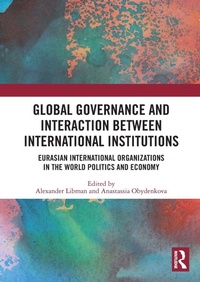
Global Governance and Interaction between International Institutions
Eurasian International Organizations in the World Politics and Economy
1st Edition
Published on 18. December 2024
Book
Paperback/Softback
236 pages
978-1-032-57327-4 (ISBN)
Description
This book builds on theory of authoritarian regionalism and is the first attempt to analyse the interaction of authoritarian regional organizations in Eurasia with their global and regional counterparts (NATO, EU, WTO, IMF etc.). It analyses three decades of the development of post-Soviet regional organizations prior to the tectonic geopolitical and security changes of 2022.
Eurasian regional organizations created by Russia have been frequently perceived as attempts to establish 'alternatives' to the global governance institutions and to compete with other regional organizations like, for example, the European Union (EU). They are seen as a pronounced example of 'authoritarian regionalism', i.e., regional organizations established by non-democracies. The way they interact with global and regional institutions has, however, remained understudied. This book aims to close this gap. It places Eurasia within a global context and considers similar trends world-wide as well as outlines the agenda for future studies of global versus regional governance. The book sheds light on long-term strategies of Russia in Eurasia, in global economy and in world politics, and on the interaction between Russia and other post-Soviet states.
With an extended introduction and conclusion, this book is an insightful resource for scholars; advanced students; and researchers of politics, international relations, and Eurasian area-studies. The chapters in this book were originally published as a special issue of Post-Communist Economies.
Eurasian regional organizations created by Russia have been frequently perceived as attempts to establish 'alternatives' to the global governance institutions and to compete with other regional organizations like, for example, the European Union (EU). They are seen as a pronounced example of 'authoritarian regionalism', i.e., regional organizations established by non-democracies. The way they interact with global and regional institutions has, however, remained understudied. This book aims to close this gap. It places Eurasia within a global context and considers similar trends world-wide as well as outlines the agenda for future studies of global versus regional governance. The book sheds light on long-term strategies of Russia in Eurasia, in global economy and in world politics, and on the interaction between Russia and other post-Soviet states.
With an extended introduction and conclusion, this book is an insightful resource for scholars; advanced students; and researchers of politics, international relations, and Eurasian area-studies. The chapters in this book were originally published as a special issue of Post-Communist Economies.
More details
Language
English
Place of publication
London
United Kingdom
Publishing group
Taylor & Francis Ltd
Target group
College/higher education
Postgraduate and Undergraduate
Dimensions
Height: 246 mm
Width: 174 mm
Thickness: 14 mm
Weight
449 gr
ISBN-13
978-1-032-57327-4 (9781032573274)
Copyright in bibliographic data and cover images is held by Nielsen Book Services Limited or by the publishers or by their respective licensors: all rights reserved.
Schweitzer Classification
Other editions
Additional editions
Alexander Libman | Anastassia Obydenkova
Global Governance and Interaction between International Institutions
Eurasian International Organizations in the World Politics and Economy
E-Book
09/2023
1st Edition
Routledge
€55.49
Available for download
Alexander Libman | Anastassia Obydenkova
Global Governance and Interaction between International Institutions
Eurasian International Organizations in the World Politics and Economy
Book
09/2023
1st Edition
Routledge
€206.40
Shipment within 10-20 days
Alexander Libman | Anastassia Obydenkova
Global Governance and Interaction between International Institutions
Eurasian International Organizations in the World Politics and Economy
E-Book
09/2023
1st Edition
Routledge
€55.49
Available for download
Persons
Alexander Libman is Professor at the Freie Universitaet Berlin, Germany. His research focuses at Russian international and sub-national politics and comparative authoritarianism. He has published eleven books and multiple articles and was awarded research prizes from the Public Choice Society and the European Public Choice Society.
Anastassia Obydenkova is Associate Professor at Uppsala University, Sweden. Her expertise is comparative politics, international relations, democracy, sustainable development, and area-focus on Eurasia and China. She has published nine books and multiple articles on these topics. She was awarded research fellowships at Yale, Princeton, and Harvard Universities.
Anastassia Obydenkova is Associate Professor at Uppsala University, Sweden. Her expertise is comparative politics, international relations, democracy, sustainable development, and area-focus on Eurasia and China. She has published nine books and multiple articles on these topics. She was awarded research fellowships at Yale, Princeton, and Harvard Universities.
Content
Introduction-Global Governance and interaction between international institutions: the challenge of the Eurasian international organizations 1. Geopolitical games in Eurasian regionalism: ideational interactions and regional international organisations 2. The Eurasian Economic Union: keeping up with the EU and China 3. The Eurasian Economic Union: integration without liberalisation? 4. Russia in international economic institutions: are there contradictions in the regional and global agendas? 5. Eurasian regionalism and the WTO: a building block or a stumbling stone? 6. Interaction of Eurasian and international financial institutions 7. NATO vs. the CSTO: security threat perceptions and responses to secessionist conflicts in Eurasia 8. Competitiveness through new industrialisation in the EAEU 9. Moving towards developmental regionalism? Industrial cooperation in the Eurasian Economic Union from an Armenian and Belarusian perspective Conclusion-Global governance and Eurasian international organisations: lessons learned and future agenda