

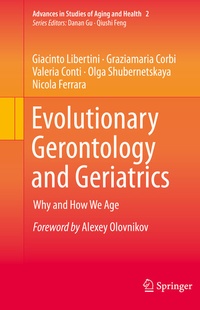
Evolutionary Gerontology and Geriatrics
Why and How We Age
Published on 26. May 2021
Book
Hardback
XVII, 413 pages
978-3-030-73773-3 (ISBN)
Description
This book provides concrete scientific basis that we can conceive the possibility of modifying or even completely canceling aging process, despite the fact that aging is commonly regarded as the result of the overall effects of many uncontrollable degenerative phenomena. The authors illustrate in detail the mechanisms by which cells and the whole organism age. Actions by which it is possible, or will be possible within a limited time, to operate for modifying aging are also debated.
The discussion is conducted within the frame and the concepts of evolutionary medicine, which is also indispensable for distinguishing between the manifestations of aging and: (i) diseases that worsen with age, and (ii) acceleration of normal aging rates, caused by unhealthy lifestyle habits and other avoidable factors. The book also discusses the impact of aging on overall mortality and the strange situation that, according to official statistics, aging does not exist as cause of death.
This book is a turning point between a gerontology and geriatrics conceived as the study and vain treatment of an incurable condition and one in which these disciplines examine the how and why of a physiological phenomenon that can be modified up to a possible total control. This means transforming the medical prevention and treatment of physiological aging from the greatest failure to the greatest success of medicine.
The discussion is conducted within the frame and the concepts of evolutionary medicine, which is also indispensable for distinguishing between the manifestations of aging and: (i) diseases that worsen with age, and (ii) acceleration of normal aging rates, caused by unhealthy lifestyle habits and other avoidable factors. The book also discusses the impact of aging on overall mortality and the strange situation that, according to official statistics, aging does not exist as cause of death.
This book is a turning point between a gerontology and geriatrics conceived as the study and vain treatment of an incurable condition and one in which these disciplines examine the how and why of a physiological phenomenon that can be modified up to a possible total control. This means transforming the medical prevention and treatment of physiological aging from the greatest failure to the greatest success of medicine.
More details
Series
Edition
2021 ed.
Language
English
Place of publication
Cham
Switzerland
Publishing group
Springer International Publishing
Target group
Professional and scholarly
Illustrations
64 s/w Abbildungen, 124 farbige Abbildungen
XVII, 413 p. 188 illus., 124 illus. in color.
Dimensions
Height: 241 mm
Width: 160 mm
Thickness: 29 mm
Weight
811 gr
ISBN-13
978-3-030-73773-3 (9783030737733)
DOI
10.1007/978-3-030-73774-0
Schweitzer Classification
Other editions
Additional editions
Giacinto Libertini | Graziamaria Corbi | Valeria Conti
Evolutionary Gerontology and Geriatrics
Why and How We Age
Book
05/2022
Springer
€149.79
Shipment within 7-9 days
Giacinto Libertini | Graziamaria Corbi | Valeria Conti
Evolutionary Gerontology and Geriatrics
Why and How We Age
E-Book
05/2021
1st Edition
Springer
€139.09
Available for download
Persons
Giacinto Libertini, MD, is Independent Researcher and Member of the Italian Society for Evolutionary Biology. He was the first to formulate some basic concepts of evolutionary medicine and to propose the theory of aging as an adaptive phenomenon favored by natural selection in terms of kin selection. He has also extended and deepened the concept of phenoptosis proposed by Vladimir Skulachev.
Graziamaria Corbi, PhD, is Assistant Professor of Internal Medicine and Geriatrics at the University of Molise, Campobasso, Italy. She has contributed to over 120 publications covering internal medicine, geriatrics, cardiology, clinical pharmacology and public health.
Valeria Conti, PhD, is Assistant Professor of Pharmacology at the University of Salerno, Italy. She is a brilliant young researcher with over sixty publications in the fields of clinical pharmacology, cardiology and geriatrics.
Olga Shubernetskaya, PhD, is Assistant Professor of Shemyakin-Ovchinnikov Institute of Bioorganic Chemistry, Moscow, Russia. She is a very promising and innovative scholar of telomere and telomerase biology.
Nicola Ferrara, PhD, is Professor of the Department of Translational Medical Sciences, Federico II Univ. of Naples, Italy, Dean of the Specialization School in Gerontology and Geriatrics, and former President of the Italian Society of Gerontology and Geriatrics. He has contributed to about 350 works in many fields including mainly cardiology, geriatrics, and biogerontology.
Graziamaria Corbi, PhD, is Assistant Professor of Internal Medicine and Geriatrics at the University of Molise, Campobasso, Italy. She has contributed to over 120 publications covering internal medicine, geriatrics, cardiology, clinical pharmacology and public health.
Valeria Conti, PhD, is Assistant Professor of Pharmacology at the University of Salerno, Italy. She is a brilliant young researcher with over sixty publications in the fields of clinical pharmacology, cardiology and geriatrics.
Olga Shubernetskaya, PhD, is Assistant Professor of Shemyakin-Ovchinnikov Institute of Bioorganic Chemistry, Moscow, Russia. She is a very promising and innovative scholar of telomere and telomerase biology.
Nicola Ferrara, PhD, is Professor of the Department of Translational Medical Sciences, Federico II Univ. of Naples, Italy, Dean of the Specialization School in Gerontology and Geriatrics, and former President of the Italian Society of Gerontology and Geriatrics. He has contributed to about 350 works in many fields including mainly cardiology, geriatrics, and biogerontology.
Content
Presentation.- Terminology.- Chapter 1. Introduction.- Chapter 2. Evolution and phenoptosis.- Chapter 3. Evolutionary medicine.- Chapter 4. The comparison between the two paradigms.- Chapter 5. Subtelomere-Telomere aging theory.- Chapter 6. Aging in the human species.- Chapter 7. The elderly subjects and their troubles.- Chapter 8. Prevention and treatment of the troubles of the elderly.- Appendix.