

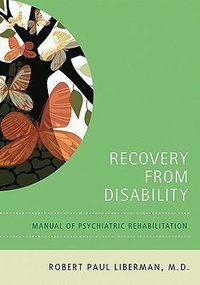
Recovery from Disability
Manual of Psychiatric Rehabilitation
Published on 30. June 2008
Book
Paperback/Softback
628 pages
978-1-58562-205-4 (ISBN)
Description
The time is right for recovery from serious mental disorders. Mental health professionals and state and local mental health agencies are responding to a national call for action on recovery: from the President's Commission on Mental Health, the Surgeon General, the National Alliance on Mental Illness, and the Substance Abuse and Mental Health Services Administration. But how can recovery from mental disorders become a reality? Recovery From Disability describes the principles and practices of psychiatric rehabilitation to bridge the gap between what is known and what actually can be used to achieve recovery for patients in real-life mental health programs. The book draws on Dr. Robert Paul Liberman's 40 years of designing, testing, and disseminating innovative treatments for persons with mental disabilities. Illuminating up-to-date treatment techniques that reflect a consensus of experts regarding evidence-based practices, Dr. Liberman shows how recovery can be the rule rather than the exception.
This practical book addresses day-to-day realities faced by practitioners who must wrestle with the individualized needs and personal goals of each patient while drawing up a rehabilitation roadmap to recovery. Written in a down-to-earth manner with minimal jargon, this clinical manual is intended for everyday use. Brimming with clear advice and ideas for effective services, the book is relevant to the work of all mental health disciplines, administrators, consumer advocates, and clinicians with all levels of experience. Practice-based evidence is highlighted by an abundance of real-life examples and a host of graphic aids. The author addresses the particular needs of Latino patients and takes up the latest developments in rehabilitation, such as illness management, social and independent living skills training, neurocognitive pharmacology, cognitive remediation, and use of computers in rehabilitation. Each chapter contains information, techniques, and treatment methods that enable clinicians to:
; Help patients select realistic yet personally meaningful goals for enriching their lives; Teach patients how to stabilize their symptoms and cognitive impairments; Train patients in social and independent living skills for empowerment and autonomy; Educate family members and other caregivers to collaborate with mental health professionals in overcoming their loved one's disability; Provide access to vocational rehabilitation, including supported employment; Facilitate comprehensiveness, continuity, and coordination of competency-based rehabilitation, using personal support specialists, assertive community treatment, and integrated mental health care
Dr. Liberman also describes how to customize services that are effective for individuals with more than one disorder, whose disorder is refractory to customary pharmacological and psychosocial treatments, or whose adaptation to community life is marred by aggressive behavior. With its wealth of rich and immediately applicable treatment approaches, Recovery From Disability will help professionals equip mentally disabled patients to reach their personally relevant goals and progress on the road to recovery.
This practical book addresses day-to-day realities faced by practitioners who must wrestle with the individualized needs and personal goals of each patient while drawing up a rehabilitation roadmap to recovery. Written in a down-to-earth manner with minimal jargon, this clinical manual is intended for everyday use. Brimming with clear advice and ideas for effective services, the book is relevant to the work of all mental health disciplines, administrators, consumer advocates, and clinicians with all levels of experience. Practice-based evidence is highlighted by an abundance of real-life examples and a host of graphic aids. The author addresses the particular needs of Latino patients and takes up the latest developments in rehabilitation, such as illness management, social and independent living skills training, neurocognitive pharmacology, cognitive remediation, and use of computers in rehabilitation. Each chapter contains information, techniques, and treatment methods that enable clinicians to:
; Help patients select realistic yet personally meaningful goals for enriching their lives; Teach patients how to stabilize their symptoms and cognitive impairments; Train patients in social and independent living skills for empowerment and autonomy; Educate family members and other caregivers to collaborate with mental health professionals in overcoming their loved one's disability; Provide access to vocational rehabilitation, including supported employment; Facilitate comprehensiveness, continuity, and coordination of competency-based rehabilitation, using personal support specialists, assertive community treatment, and integrated mental health care
Dr. Liberman also describes how to customize services that are effective for individuals with more than one disorder, whose disorder is refractory to customary pharmacological and psychosocial treatments, or whose adaptation to community life is marred by aggressive behavior. With its wealth of rich and immediately applicable treatment approaches, Recovery From Disability will help professionals equip mentally disabled patients to reach their personally relevant goals and progress on the road to recovery.
Reviews / Votes
Through easy-to- understand language, illustrations, and case examples, the author provides readers with some keys to augmentation of the treatment of patients with various types of mental health disorders. The book offers practical advice and, better yet, reasonable techniques and guidelines for enhancing treatment success for patients.With historic vision, clinical sensibility, and scientific tenacity, Dr. Robert P. Liberman has been a founding father of psychiatric rehabilitation, developing it to form a cornerstone of treatment for persons with serious mental illness. Clinicians from all disciplines who serve persons with severe mental illnesses will benefit by including this book in their library.
Recovery from Disability: Manual of Psychiatric Rehabilitation is a landmark achievement.
This book is highly recommended fir psychiatrists, psychologists, social workers, nurses or other health care worker who wish to help seriously ill psychiatric patients reach their personal goals and achieve a higher quality of life.
The author's breadth of knowledge in the field is demonstrated through the multiple well researched examples of recovery in practice that he cites. The author's personal passion for the possibilities that recovery brings, which is evident throughout, makes the book more compelling. The clinical examples make the text more readable and show how theory takes shape in the lives of individuals and families. The learning examples in each chapter give readers the chance to build skills and apply what they have learned to their current practice. The book addresses all of the multi-faceted components of recovery, breaking each component into manageable steps for practitioners and their clients. The section on social skills training, in particular, is excellent. The introductorysection on terminology is also appropriate and thought provoking.
More details
Language
English
Place of publication
VA
United States
Target group
Professional and scholarly
US School Grade: College Graduate Student and over
Product notice
Paperback (trade)
Illustrations
9 halftones, 93 line drawings, 58 tables
Dimensions
Height: 254 mm
Width: 178 mm
Thickness: 30 mm
Weight
1333 gr
ISBN-13
978-1-58562-205-4 (9781585622054)
Copyright in bibliographic data and cover images is held by Nielsen Book Services Limited or by the publishers or by their respective licensors: all rights reserved.
Schweitzer Classification
Other editions
Additional editions
E-Book
02/2009
1st Edition
American Psychiatric Association Publishing
€65.49
Available for download
Persons
Robert Paul Liberman, M.D., is Distinguished Professor in the Department of Psychiatry and Biobehavioral Sciences, and Director of the UCLA Psychiatric Rehabilitation Program, at the University of California, Los Angeles.
Content
ForewordPreface AcknowledgmentsIntroduction Terminology Chapter 1. Rehabilitation as the road to recovery Chapter 2. Principles and Practice of Psychiatric rehabilitation Chapter 3. Illness Management Chapter 4. Functional assessment Chapter 5. Social skills training Chapter 6. Involving families in treatment and rehabilitationChapter 7. Vocational rehabilitationChapter 8. Vehicles for Delivering rehabilitation servicesChapter 9. Special services for special PeopleChapter 10. New Developments for rehabilitation and recovery