

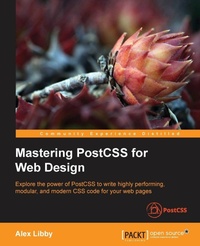
Mastering PostCSS for Web Design
Explore the power of PostCSS to write highly performing, modular, and modern CSS code for your web pages
Published on 30. June 2016
Book
Paperback/Softback
414 pages
978-1-78588-589-1 (ISBN)
Description
Explore the power of PostCSS to write highly performing, modular, and modern CSS code for your web pages
Key Features
[*] Incorporate cutting-edge styles in your web pages with PostCSS
[*] Simplify the process of writing CSS to a great extent using PostCSS shortcuts, fallbacks, and pack plugins
[*] This in-depth, step-by-step guide will help you master PostCSS, to create amazing and responsive web designs
Book DescriptionPostCSS is a tool that has quickly emerged as the future of existing preprocessors such as SASS and Less, mainly because of its power, speed, and ease of use. This comprehensive guide offers in-depth guidance on incorporating cutting-edge styles into your web page and at the same time maintaining the performance and maintainability of your code.
The book will show how you can take advantage of PostCSS to simplify the entire process of stylesheet authoring. It covers various techniques to add dynamic and modern styling features to your web pages. As the book progresses, you will learn how to make CSS code more maintainable by taking advantage of the modular architecture of PostCSS. By the end of this book, you would have mastered the art of adding modern CSS effects to web pages by authoring high performing, maintainable stylesheets.
What you will learn
[*] Add mixin and variable support to PostCSS along with conditional support
[*] Explore the different ways of nesting code such as BEM and standard nesting within PostCSS
[*] Optimize media queries built with PostCSS to get the best performance
[*] Add dynamic styling elements such as images, fonts, grids, and SVG and retina support using existing preprocessors as well as PostCSS
[*] Get familiar with using plugins, and extend PostCSS with the API
[*] Build a fully working custom preprocessor and test it on different sites such as WordPress
[*] Write a custom syntax in PostCSS while still using pre-built syntaxes such as Less, SASS, or Stylus
[*] Provide support for future CSS such as CSS4 using current CSS3 classes
Who this book is forThis book is ideal for web developers and designers who are comfortable with HTML5 and CSS and now want to master PostCSS for web design. Web designers who have been using SASS or Less and now want to adopt PostCSS would also find this book useful.
Key Features
[*] Incorporate cutting-edge styles in your web pages with PostCSS
[*] Simplify the process of writing CSS to a great extent using PostCSS shortcuts, fallbacks, and pack plugins
[*] This in-depth, step-by-step guide will help you master PostCSS, to create amazing and responsive web designs
Book DescriptionPostCSS is a tool that has quickly emerged as the future of existing preprocessors such as SASS and Less, mainly because of its power, speed, and ease of use. This comprehensive guide offers in-depth guidance on incorporating cutting-edge styles into your web page and at the same time maintaining the performance and maintainability of your code.
The book will show how you can take advantage of PostCSS to simplify the entire process of stylesheet authoring. It covers various techniques to add dynamic and modern styling features to your web pages. As the book progresses, you will learn how to make CSS code more maintainable by taking advantage of the modular architecture of PostCSS. By the end of this book, you would have mastered the art of adding modern CSS effects to web pages by authoring high performing, maintainable stylesheets.
What you will learn
[*] Add mixin and variable support to PostCSS along with conditional support
[*] Explore the different ways of nesting code such as BEM and standard nesting within PostCSS
[*] Optimize media queries built with PostCSS to get the best performance
[*] Add dynamic styling elements such as images, fonts, grids, and SVG and retina support using existing preprocessors as well as PostCSS
[*] Get familiar with using plugins, and extend PostCSS with the API
[*] Build a fully working custom preprocessor and test it on different sites such as WordPress
[*] Write a custom syntax in PostCSS while still using pre-built syntaxes such as Less, SASS, or Stylus
[*] Provide support for future CSS such as CSS4 using current CSS3 classes
Who this book is forThis book is ideal for web developers and designers who are comfortable with HTML5 and CSS and now want to master PostCSS for web design. Web designers who have been using SASS or Less and now want to adopt PostCSS would also find this book useful.
More details
Language
English
Place of publication
Birmingham
United Kingdom
Target group
Professional and scholarly
US School Grade: College Graduate Student
Dimensions
Height: 235 mm
Width: 191 mm
Thickness: 22 mm
Weight
769 gr
ISBN-13
978-1-78588-589-1 (9781785885891)
Copyright in bibliographic data and cover images is held by Nielsen Book Services Limited or by the publishers or by their respective licensors: all rights reserved.
Schweitzer Classification
Other editions
Additional editions
Alex Libby
Mastering PostCSS for Web Design
Explore the power of PostCSS to write highly performing, modular, and modern CSS code for your web pages
E-Book
07/2025
Packt Publishing
from
€38.39
Available for download
Person
Alex Libby has a background in IT support. He has been involved in supporting end users for almost 20 years in a variety of different environments; a recent change in role now sees Alex working as an MVT test developer for a global distributor based in the UK. Although Alex gets to play with different technologies in his day job, his first true love has always been with the open source movement, and in particular experimenting with CSS/CSS3, jQuery, and HTML5. To date, Alex has written 11 books on subjects such as jQuery, HTML5 Video, SASS, and CSS for Packt, and has reviewed several more. Responsive Web Design with HTML5 and CSS3 Essentials is Alex's twelfth book for Packt, and second completed as a collaboration project.
Content
Table of Contents
Introducing PostCSS
Creating Variables and Mixins
Nesting Rules
Building Media Queries
Managing Colors, Images and Fonts
Creating Grids
Extending PostCSS using the API
Working with Shortcuts, Fallbacks and Packs
Creating PostCSS Plugins
Building a Custom Preprocessor
Writing Custom Syntax with PostCSS
Mixing Preprocessors with PostCSS
Troubleshooting and Best Practices
Preparing for the Future
Introducing PostCSS
Creating Variables and Mixins
Nesting Rules
Building Media Queries
Managing Colors, Images and Fonts
Creating Grids
Extending PostCSS using the API
Working with Shortcuts, Fallbacks and Packs
Creating PostCSS Plugins
Building a Custom Preprocessor
Writing Custom Syntax with PostCSS
Mixing Preprocessors with PostCSS
Troubleshooting and Best Practices
Preparing for the Future