

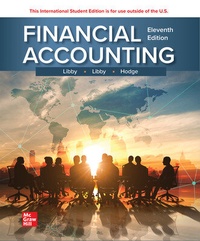
Financial Accounting ISE
11th Edition
Will be published approx. on 5. April 2022
Book
Paperback/Softback
882 pages
978-1-265-08392-2 (ISBN)
Description
Libby/Libby/Hodge wrote this text based on their belief that the subject of financial accounting is inherently interesting, but financial accounting textbooks are often not. They believe that accounting is an exciting field of study and one that is important to future careers in business. When writing this text, they considered career relevance as their guide when selecting material, and the need to engage the student as their guide to style, pedagogy, and design.
Financial Accounting 11e successfully implements a real-world, single focus company approach in every chapter. The companies chosen are engaging and the decision-making focus shows the relevance of financial accounting regardless of if a student has chosen to major in accounting.
Libby/Libby/Hodge believes in the building-block approach to teaching transaction analysis. Most faculty agree that mastery of the accounting cycle is critical to success in financial accounting, and yet most financial texts introduce and develop transaction analysis in one chapter, bombarding a student early in the course with an overload of new concepts and terms. The authors slow down the introduction of transactions, giving students time to practice and gain mastery. This building-block approach leads to greater student success in their study of later topics in financial accounting such as adjusting entries.
Financial Accounting 11e successfully implements a real-world, single focus company approach in every chapter. The companies chosen are engaging and the decision-making focus shows the relevance of financial accounting regardless of if a student has chosen to major in accounting.
Libby/Libby/Hodge believes in the building-block approach to teaching transaction analysis. Most faculty agree that mastery of the accounting cycle is critical to success in financial accounting, and yet most financial texts introduce and develop transaction analysis in one chapter, bombarding a student early in the course with an overload of new concepts and terms. The authors slow down the introduction of transactions, giving students time to practice and gain mastery. This building-block approach leads to greater student success in their study of later topics in financial accounting such as adjusting entries.
More details
Edition
11th edition
Language
English
Place of publication
OH
United States
Target group
College/higher education
US School Grade: From College Freshman to College Graduate Student
Illustrations
159 Illustrations
Dimensions
Height: 274 mm
Width: 231 mm
Thickness: 33 mm
Weight
1554 gr
ISBN-13
978-1-265-08392-2 (9781265083922)
Copyright in bibliographic data and cover images is held by Nielsen Book Services Limited or by the publishers or by their respective licensors: all rights reserved.
Schweitzer Classification
Other editions
New editions
Robert Libby
Financial Accounting ISE
Book
03/2025
12th Edition
McGraw-Hill Education
€77.03
Available immediately
Persons
Robert Libby is the David A. Thomas Professor of Accounting and Accounting Area Coordinator at Cornell University, where he teaches the introductory financial accounting course. He previously taught at the University of Illinois, Pennsylvania State University, the University of Texas at Austin, the University of Chicago, and the University of Michigan. He received his BS from Pennsylvania State University and his MAS and PhD from the University of Illinois; he also successfully completed the CPA exam (Illinois).
Bob was selected as the AAA Outstanding Educator in 2000 and received the AAA Outstanding Service Award in 2006 and the AAA Notable Contributions to the Literature Award in 1985 and 1996. He has received the Core Faculty Teaching Award multiple times at Cornell. Bob is a widely published author and researcher specializing in behavioral accounting. He has published numerous articles in The Accounting Review; Journal of Accounting Research; Accounting, Organizations, and Society; and other accounting journals. He has held a variety of offices including vice president, in the American Accounting Association, and he is a member of the American Institute of CPAs and the editorial boards of The Accounting Review and Accounting, Organizations, and Society.
Patricia Libby is chair of the department of accounting and an associate professor of accounting at Ithaca College, where she teaches the undergraduate financial accounting course. She previously taught graduate and undergraduate financial accounting at Eastern Michigan University and the University of Texas. Before entering academia, she was an auditor with Price Waterhouse (now PricewaterhouseCoopers) and a financial administrator at the University of Chicago. She received her B.S. from Pennsylvania State University, her M.B.A from DePaul University, and her Ph.D. from the University of Michigan; she also successfully completed the CPA exam (Illinois). Pat has published articles in The Accounting Review, Issues in Accounting Education, and The Michigan CPA and is also faculty advisor to Beta Alpha Psi and the Ithaca College Accounting Association.
Frank Hodge is the chair of the Accounting Department and the Michael G. Foster Endowed Professor at the University of Washington's Foster School of Business. He also serves in the President's Office as the University of Washington's Faculty Athletics Representative to the PAC-12 Conference and the National Collegiate Athletic Association.
Frank joined the faculty at the University of Washington in 2000. He earned his MBA and PhD degrees from Indiana University. He has won over 30 teaching awards at the University of Washington teaching financial accounting and financial statement analysis to undergraduate students, full-time MBA students, executive MBA students, and intercollegiate athletic administrators. Frank's research focuses on how individuals use accounting information to make investment decisions and how technology influences their information choices.
Frank was one of six members of the Financial Accounting Standards Research Initiative team and has presented his research at the Securities and Exchange Commission. He has published articles in The Accounting Review; Journal of Accounting Research; Contemporary Accounting Research; Accounting, Organizations, and Society; and several other journals. Frank lives in Seattle with his wife and two daughters.
Bob was selected as the AAA Outstanding Educator in 2000 and received the AAA Outstanding Service Award in 2006 and the AAA Notable Contributions to the Literature Award in 1985 and 1996. He has received the Core Faculty Teaching Award multiple times at Cornell. Bob is a widely published author and researcher specializing in behavioral accounting. He has published numerous articles in The Accounting Review; Journal of Accounting Research; Accounting, Organizations, and Society; and other accounting journals. He has held a variety of offices including vice president, in the American Accounting Association, and he is a member of the American Institute of CPAs and the editorial boards of The Accounting Review and Accounting, Organizations, and Society.
Patricia Libby is chair of the department of accounting and an associate professor of accounting at Ithaca College, where she teaches the undergraduate financial accounting course. She previously taught graduate and undergraduate financial accounting at Eastern Michigan University and the University of Texas. Before entering academia, she was an auditor with Price Waterhouse (now PricewaterhouseCoopers) and a financial administrator at the University of Chicago. She received her B.S. from Pennsylvania State University, her M.B.A from DePaul University, and her Ph.D. from the University of Michigan; she also successfully completed the CPA exam (Illinois). Pat has published articles in The Accounting Review, Issues in Accounting Education, and The Michigan CPA and is also faculty advisor to Beta Alpha Psi and the Ithaca College Accounting Association.
Frank Hodge is the chair of the Accounting Department and the Michael G. Foster Endowed Professor at the University of Washington's Foster School of Business. He also serves in the President's Office as the University of Washington's Faculty Athletics Representative to the PAC-12 Conference and the National Collegiate Athletic Association.
Frank joined the faculty at the University of Washington in 2000. He earned his MBA and PhD degrees from Indiana University. He has won over 30 teaching awards at the University of Washington teaching financial accounting and financial statement analysis to undergraduate students, full-time MBA students, executive MBA students, and intercollegiate athletic administrators. Frank's research focuses on how individuals use accounting information to make investment decisions and how technology influences their information choices.
Frank was one of six members of the Financial Accounting Standards Research Initiative team and has presented his research at the Securities and Exchange Commission. He has published articles in The Accounting Review; Journal of Accounting Research; Contemporary Accounting Research; Accounting, Organizations, and Society; and several other journals. Frank lives in Seattle with his wife and two daughters.
Content
CHAPTER 1: Financial Statements and Business Decisions??
Focus Company: Le-Nature's Inc.
CHAPTER 2: Investing and Financing Decisions and the Accounting System??
Focus Company: Chipotle Mexican Grill
CHAPTER 3: Operating Decisions and the Accounting System?
Focus Company: Chipotle Mexican Grill
CHAPTER 4: Adjustments, Financial Statements, and the Closing Process??
Focus Company: Chipotle Mexican Grill
CHAPTER 5: Communicating and Analyzing Accounting Information??
Focus Company: Apple Inc.
CHAPTER 6: Reporting and Interpreting Sales Revenue, Receivables, and Cash??
Focus Company: Skechers U.S.A.
CHAPTER 7: Reporting and Interpreting Cost of Goods Sold and Inventory??
Focus Company: Harley-Davidson, Inc.
CHAPTER 8: Reporting and Interpreting Property, Plant, and Equipment; Intangibles; and Natural Resources??
Focus Company: FedEx Corporation
CHAPTER 9: Reporting and Interpreting Liabilities?
Focus Company: Starbucks
CHAPTER 10: Reporting and Interpreting Bond Securities??
Focus Company: Amazon
CHAPTER 11: Reporting and Interpreting Stockholders' Equity?
Focus Company: Microsoft
CHAPTER 12: Statement of Cash Flows?
Focus Company: National Beverage Corporation
CHAPTER 13: Analyzing Financial Statements??
Focus Company: The Home Depot
APPENDIX A: Reporting and Interpreting Investments in Other Corporations?
Focus Company: The Walt Disney Company
APPENDIX B: Target Corporation, Form 10-K Annual Report??
APPENDIX C: Walmart Inc., Form 10-K Annual Report?
APPENDIX D: Industry Ratio Report??
APPENDIX E: Present and Future Value Tables??
Focus Company: Le-Nature's Inc.
CHAPTER 2: Investing and Financing Decisions and the Accounting System??
Focus Company: Chipotle Mexican Grill
CHAPTER 3: Operating Decisions and the Accounting System?
Focus Company: Chipotle Mexican Grill
CHAPTER 4: Adjustments, Financial Statements, and the Closing Process??
Focus Company: Chipotle Mexican Grill
CHAPTER 5: Communicating and Analyzing Accounting Information??
Focus Company: Apple Inc.
CHAPTER 6: Reporting and Interpreting Sales Revenue, Receivables, and Cash??
Focus Company: Skechers U.S.A.
CHAPTER 7: Reporting and Interpreting Cost of Goods Sold and Inventory??
Focus Company: Harley-Davidson, Inc.
CHAPTER 8: Reporting and Interpreting Property, Plant, and Equipment; Intangibles; and Natural Resources??
Focus Company: FedEx Corporation
CHAPTER 9: Reporting and Interpreting Liabilities?
Focus Company: Starbucks
CHAPTER 10: Reporting and Interpreting Bond Securities??
Focus Company: Amazon
CHAPTER 11: Reporting and Interpreting Stockholders' Equity?
Focus Company: Microsoft
CHAPTER 12: Statement of Cash Flows?
Focus Company: National Beverage Corporation
CHAPTER 13: Analyzing Financial Statements??
Focus Company: The Home Depot
APPENDIX A: Reporting and Interpreting Investments in Other Corporations?
Focus Company: The Walt Disney Company
APPENDIX B: Target Corporation, Form 10-K Annual Report??
APPENDIX C: Walmart Inc., Form 10-K Annual Report?
APPENDIX D: Industry Ratio Report??
APPENDIX E: Present and Future Value Tables??