

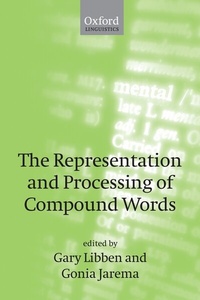
The Representation and Processing of Compound Words
Published on 20. September 2007
Book
Paperback/Softback
260 pages
978-0-19-922891-1 (ISBN)
Description
This book presents new work on the psycholinguistics and neurolinguistics of compound words. It shows the insights this work offers on natural language processing and the relation between language, mind, and memory. Compounding is an easy and effective way to create and transfer meanings. By building new lexical items based on the meanings of existing items, compounds can usually be understood on first presentation, though - as, for example, breadboard, cardboard, cupboard, and sandwich-board show - the rules governing the relations between the components' meanings are not always straightforward.
Compound words may be segmentable into their constituent morphemes in much the same way as sentences can be divided into their constituent words: children and adults would not otherwise find them interpretable. But compound sequences may also be independent lexical items that can be retrieved for production as single entities and whose idiosyncratic meanings are stored in the mind. Compound words reflect the properties both of linguistic representation in the mind and of grammatical processing. They thus offer opportunities for investigating key aspects of the mental operations involved in language: for example, the interplay between storage and computation; the manner in which morphological and semantic factors impact on the nature of storage; and the way the mind's computational processes serve on-line language comprehension and production. This book explores the nature of these opportunities, assesses what is known, and considers what may yet be discovered and how.
Compound words may be segmentable into their constituent morphemes in much the same way as sentences can be divided into their constituent words: children and adults would not otherwise find them interpretable. But compound sequences may also be independent lexical items that can be retrieved for production as single entities and whose idiosyncratic meanings are stored in the mind. Compound words reflect the properties both of linguistic representation in the mind and of grammatical processing. They thus offer opportunities for investigating key aspects of the mental operations involved in language: for example, the interplay between storage and computation; the manner in which morphological and semantic factors impact on the nature of storage; and the way the mind's computational processes serve on-line language comprehension and production. This book explores the nature of these opportunities, assesses what is known, and considers what may yet be discovered and how.
Reviews / Votes
...a good introduction to the issues that arise in doing research on compounds, and is instructive in illustrating how studying compounds provides insight into the nature of lexical access and the lexicon. * Dr. Sara Finley, Linguistlist *More details
Language
English
Place of publication
Oxford
United Kingdom
Target group
Professional and scholarly
Dimensions
Height: 233 mm
Width: 156 mm
Thickness: 16 mm
Weight
426 gr
ISBN-13
978-0-19-922891-1 (9780199228911)
Copyright in bibliographic data and cover images is held by Nielsen Book Services Limited or by the publishers or by their respective licensors: all rights reserved.
Schweitzer Classification
Other editions
Additional editions
Gary Libben | Gonia Jarema
The Representation and Processing of Compound Words
Book
11/2005
Oxford University Press
€190.30
Shipment within 15-20 days
Persons
Gary Libben is Professor of Linguistics and Director of the Centre for Comparative Psycholinguistics at the University of Alberta. He is the co-author, with M. Paradis, of The Assessment of Bilingual Aphasia (Erlbaum, 1987) and, with J. Archibald, of Research Perspectives on Second Language Acquisition (Copp, Clark, Pitman, 1995).
Gonia Jarema is Professor of Linguistics at the University of Montreal and Director of the Mental Lexicon Laboratory at the Research Centre of the Institut universitaire de geriatrie de Montreal. Her field of research is the psycho- and neurolinguistics of the mental lexicon from a cross-linguistic perspective.
Gary Jarema and Gonia Libben have been guest editors of Brain and Language and Folia Linguistica. They have both served as Directors of the International Mental Lexicon Research Group of the Social Sciences and Humanities Research Council of Canada. They are Editors of the journal The Mental Lexicon.
Gonia Jarema is Professor of Linguistics at the University of Montreal and Director of the Mental Lexicon Laboratory at the Research Centre of the Institut universitaire de geriatrie de Montreal. Her field of research is the psycho- and neurolinguistics of the mental lexicon from a cross-linguistic perspective.
Gary Jarema and Gonia Libben have been guest editors of Brain and Language and Folia Linguistica. They have both served as Directors of the International Mental Lexicon Research Group of the Social Sciences and Humanities Research Council of Canada. They are Editors of the journal The Mental Lexicon.
Content
1. Why Study Compound Processing? An Overview of the Issues ; 2. Compound Types ; 3. Compound Representation and Processing: A Cross-language Perspective ; 4. The Neuropsychology of Compound Words ; 5. Preschool Children's Acquisition of Compounds ; 6. Doghouse/Chien-maison/Niche: Approaches to the Understanding of Compounds Processing in Bilinguals ; 7. Conceptual Combination: Implictions for the Mental Lexicon ; 8. Processing Chinese Compounds: A Survey of the Literature ; References ; Index