

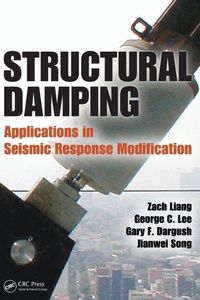
Structural Damping
Applications in Seismic Response Modification
1st Edition
Published on 21. November 2011
Book
Hardback
582 pages
978-1-4398-1582-3 (ISBN)
Description
Rapid advances have been made during the past few decades in earthquake response modification technologies for structures, most notably in base isolation and energy dissipation systems. Many practical applications of various dampers can be found worldwide and, in the United States, damper design has been included in building codes. The current design process is simple and useful for adding supplemental damping up to a reasonable level-but it is not as useful with higher levels of damping.
Taking a different approach, Structural Damping: Applications in Seismic Response Modification considers the dynamic responses of structures with added damping devices as systems governed by the combined effect of the static stiffness, period, and damping-or "dynamic stiffness"-of the structure-device system. This formulation supplies additional information for higher-level supplemental damping design that current provisions may not adequately cover. The authors also propose a more comprehensive consideration of the core issues in structural damping, which provides a useful foundation for continued research and development in seismic response modification technologies for performance-based engineering.
The book includes design examples, based on the authors' research and practical experience, to illustrate approaches that include higher-level supplemental damping to complement the use of the current NEHRP/ASCE-7 provisions. A self-contained resource on damping design principles, this book helps earthquake engineers select the most effective type of damper and determine the amount and configuration of damping under given working conditions.
Taking a different approach, Structural Damping: Applications in Seismic Response Modification considers the dynamic responses of structures with added damping devices as systems governed by the combined effect of the static stiffness, period, and damping-or "dynamic stiffness"-of the structure-device system. This formulation supplies additional information for higher-level supplemental damping design that current provisions may not adequately cover. The authors also propose a more comprehensive consideration of the core issues in structural damping, which provides a useful foundation for continued research and development in seismic response modification technologies for performance-based engineering.
The book includes design examples, based on the authors' research and practical experience, to illustrate approaches that include higher-level supplemental damping to complement the use of the current NEHRP/ASCE-7 provisions. A self-contained resource on damping design principles, this book helps earthquake engineers select the most effective type of damper and determine the amount and configuration of damping under given working conditions.
More details
Series
Language
English
Place of publication
Bosa Roca
United States
Publishing group
Taylor & Francis Inc
Target group
Professional and scholarly
Academic and Professional Practice & Development
Product notice
Paper over boards
Illustrations
136 s/w Abbildungen, 68 s/w Tabellen
68 Tables, black and white; 136 Illustrations, black and white
Dimensions
Height: 260 mm
Width: 183 mm
Thickness: 36 mm
Weight
1279 gr
ISBN-13
978-1-4398-1582-3 (9781439815823)
Copyright in bibliographic data and cover images is held by Nielsen Book Services Limited or by the publishers or by their respective licensors: all rights reserved.
Schweitzer Classification
Other editions
Additional editions
Zach Liang | George C. Lee | Gary F. Dargush
Structural Damping
Applications in Seismic Response Modification
E-Book
11/2011
CRC Press
€225.99
Available for download
Zach Liang | George C. Lee | Gary F. Dargush
Structural Damping
Applications in Seismic Response Modification
E-Book
11/2011
1st Edition
CRC Press
€225.99
Available for download
Persons
Dr. Zach Liang is a research professor in the Department of Mechanical and Aerospace Engineering at the State University of New York at Buffalo.
Dr. George C. Lee is a SUNY Distinguished Professor in the Department of Civil, Structural and Environmental Engineering at the State University of New York at Buffalo.
Dr. Gary F. Dargush is Professor and Chair of the Department of Mechanical and Aerospace Engineering (MAE) at the State University of New York at Buffalo.
Dr. Jianwei Song is a senior research scientist in the Multidisciplinary Center for Earthquake Engineering Research in the Department of Civil, Structural and Environmental Engineering at the State University of New York at Buffalo.
Dr. George C. Lee is a SUNY Distinguished Professor in the Department of Civil, Structural and Environmental Engineering at the State University of New York at Buffalo.
Dr. Gary F. Dargush is Professor and Chair of the Department of Mechanical and Aerospace Engineering (MAE) at the State University of New York at Buffalo.
Dr. Jianwei Song is a senior research scientist in the Multidisciplinary Center for Earthquake Engineering Research in the Department of Civil, Structural and Environmental Engineering at the State University of New York at Buffalo.
Content
VIBRATION SYSTEMS:
Free and Harmonic Vibration of Single-Degree-of-Freedom Systems. Linear Multi-Degree-of-Freedom Systems. Multi-Degree-of-Freedom Systems with General Damping. PRINCIPLES AND GUIDELINES FOR DAMPING CONTROL: Principles of Damper Design. System Nonlinearity and Damping of Irregular Structures. DESIGN OF SUPPLEMENTAL DAMPING: Linear Damping Design. Nonlinear Damping. Index.
Free and Harmonic Vibration of Single-Degree-of-Freedom Systems. Linear Multi-Degree-of-Freedom Systems. Multi-Degree-of-Freedom Systems with General Damping. PRINCIPLES AND GUIDELINES FOR DAMPING CONTROL: Principles of Damper Design. System Nonlinearity and Damping of Irregular Structures. DESIGN OF SUPPLEMENTAL DAMPING: Linear Damping Design. Nonlinear Damping. Index.