

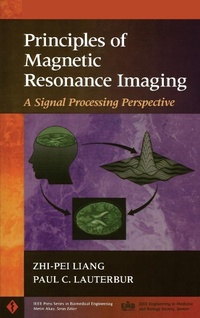
Principles of Magnetic Resonance Imaging
A Signal Processing Perspective
1st Edition
Published on 18. October 1999
Book
Hardback
432 pages
978-0-7803-4723-6 (ISBN)
Description
Principles of Magnetic Resonance Imaging Biomedical/Electrical Engineering
Principles of Magnetic Resonance Imaging
A Signal Processing Perspective
A volume in the IEEE Press Series in Biomedical Engineering
Metin Akay. Series Editor
Since its inception in 1971. MRI has developed into a premier tool for anatomical and runaional imaging. Prin??ples ofMagne??c Resonance Imaging provides a clear and comprehensive treatment of MR image formation principles from a signal processing perspective. You will find discussion of these essential topics:
Mathematical fundamentals
Signal generation and detection principles
Signal characteristics
Signal localization principles
Image reconstruction techniques
Image contrast mechanisms
Image resolution. noise, and artifacts
Fast-scan imaging
Constrained reconstruction
Spatial information encoding
Principles of Magnetic Resonance Imaging contains a omprehensive set or examples and homework problems. This textbook will provide students of biomedical engineering. biophysics. chetnistry. electrical engineering. and radiology with a systematic. in-depth understanding of MRI principles.
Principles of Magnetic Resonance Imaging
A Signal Processing Perspective
A volume in the IEEE Press Series in Biomedical Engineering
Metin Akay. Series Editor
Since its inception in 1971. MRI has developed into a premier tool for anatomical and runaional imaging. Prin??ples ofMagne??c Resonance Imaging provides a clear and comprehensive treatment of MR image formation principles from a signal processing perspective. You will find discussion of these essential topics:
Mathematical fundamentals
Signal generation and detection principles
Signal characteristics
Signal localization principles
Image reconstruction techniques
Image contrast mechanisms
Image resolution. noise, and artifacts
Fast-scan imaging
Constrained reconstruction
Spatial information encoding
Principles of Magnetic Resonance Imaging contains a omprehensive set or examples and homework problems. This textbook will provide students of biomedical engineering. biophysics. chetnistry. electrical engineering. and radiology with a systematic. in-depth understanding of MRI principles.
More details
Series
Language
English
Place of publication
United States
Publishing group
John Wiley & Sons Inc
Target group
College/higher education
Professional and scholarly
Product notice
sewn/stitched
Cloth over boards
Dimensions
Height: 235 mm
Width: 157 mm
Thickness: 28 mm
Weight
778 gr
ISBN-13
978-0-7803-4723-6 (9780780347236)
Copyright in bibliographic data and cover images is held by Nielsen Book Services Limited or by the publishers or by their respective licensors: all rights reserved.
Schweitzer Classification
Persons
ABOUT THE AUTHORS
Zhi-Pei Liang is a faculty member in the Department ot Electrical and Computer Engineering (ECE) and the Beckman Institute for Advanced Science and Technology at the University of Illinois at Urbana-Champaign (UIUC). Dr. Liang has contributed to the theory and applications of image reconstruction, constrained imaging, and image analysis. He received the Sylvia Sorkin Greenfield Best Paper Award of the Medical Physics Journal in 1990 and the National Science Foundation Career Award in 1995. Dr. Liang was named a Beckman Fellow of the UIUC Center for Advanced Study in 1997 and a Henry Magnuski Scholar for Outstanding Young Faculty Member in the ECE Department in 1999.
Paul C. Lauterbur is a Center-for-Advancrd-Study professor of Medical Information Sciences, Chemistry, and Molecular and Integrative Physiology and professor in the Center for Biophysics and Computational Biology, the Bioengineering Program, and the Becktnan Institute-all at the University of Illinois at Urbana-Champaign. Before conceiving of and demonstrating magnetic resonance imaging in 1971-1972, Dr. Lauterbur used nuclear magnetic resonance spectroscopy to study molecular structures. Among his numerous awards are the 1987 National Medal or Science, 1990 Bower Award and Prize for Achievement in Science, and 1994 Kyoto Prize for Advanced Technology. Dr. Lauterbur is a member of the National Academy of Sciences.
Zhi-Pei Liang is a faculty member in the Department ot Electrical and Computer Engineering (ECE) and the Beckman Institute for Advanced Science and Technology at the University of Illinois at Urbana-Champaign (UIUC). Dr. Liang has contributed to the theory and applications of image reconstruction, constrained imaging, and image analysis. He received the Sylvia Sorkin Greenfield Best Paper Award of the Medical Physics Journal in 1990 and the National Science Foundation Career Award in 1995. Dr. Liang was named a Beckman Fellow of the UIUC Center for Advanced Study in 1997 and a Henry Magnuski Scholar for Outstanding Young Faculty Member in the ECE Department in 1999.
Paul C. Lauterbur is a Center-for-Advancrd-Study professor of Medical Information Sciences, Chemistry, and Molecular and Integrative Physiology and professor in the Center for Biophysics and Computational Biology, the Bioengineering Program, and the Becktnan Institute-all at the University of Illinois at Urbana-Champaign. Before conceiving of and demonstrating magnetic resonance imaging in 1971-1972, Dr. Lauterbur used nuclear magnetic resonance spectroscopy to study molecular structures. Among his numerous awards are the 1987 National Medal or Science, 1990 Bower Award and Prize for Achievement in Science, and 1994 Kyoto Prize for Advanced Technology. Dr. Lauterbur is a member of the National Academy of Sciences.
Content
Preface.
Acknowledgments.
Introduction.
Mathematical Fundamentals.
Signal Generation and Detection.
Signal Characteristics.
Signal Localization.
Image Reconstruction.
Image Contrast.
Image Resolution, Noise, and Artifacts.
Fast-Scan Imaging.
Constrained Reconstruction.
Appendix A: Mathematical Formulas.
Appendix B: Glossary.
Appendix C: Abbreviations.
Appendix D: Mathematical Symbols.
Appendix E: Physical Constants.
Bibliography.
Index.
About the Authors.
Acknowledgments.
Introduction.
Mathematical Fundamentals.
Signal Generation and Detection.
Signal Characteristics.
Signal Localization.
Image Reconstruction.
Image Contrast.
Image Resolution, Noise, and Artifacts.
Fast-Scan Imaging.
Constrained Reconstruction.
Appendix A: Mathematical Formulas.
Appendix B: Glossary.
Appendix C: Abbreviations.
Appendix D: Mathematical Symbols.
Appendix E: Physical Constants.
Bibliography.
Index.
About the Authors.